

Construction vehicles are the backbone of every major infrastructure project. From skyscrapers to highways, these powerful heavy-duty machines perform tasks that would be impossible for human hands alone. Whether you are a construction professional, engineering student, or simply curious about heavy equipment, this comprehensive guide covers 50+ types of construction vehicles, their names, pictures, and detailed uses.
Understanding different construction machines helps workers choose the right equipment, improves site safety, and increases overall project efficiency. Each machine in this list serves a unique purpose — from digging deep foundations to laying smooth asphalt roads.
What Are Construction Vehicles?
Construction vehicles are heavy machinery specifically engineered for building, excavating, lifting, transporting, and grading materials on construction sites. They are also commonly called construction equipment, heavy equipment, or earth-moving machines.
These vehicles are classified into several broad categories:
- Earthmoving equipment (bulldozers, excavators, scrapers)
- Lifting and hoisting equipment (cranes, boom lifts, telehandlers)
- Road construction equipment (asphalt pavers, road rollers, cold planers)
- Material handling equipment (dump trucks, loaders, forklifts)
- Concrete and foundation equipment (cement mixers, pile drivers, concrete pump trucks)
- Compaction equipment (soil compactors, vibratory rollers)
- Trenching and drilling equipment (trenchers, rotary drills, augers)
Complete List of 50+ Construction Vehicles Names
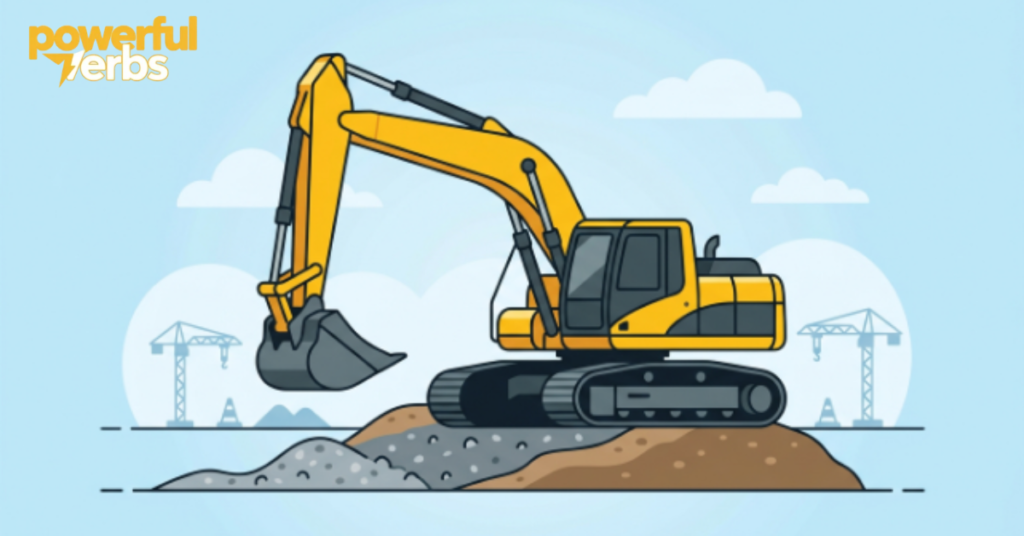
Here is a full construction vehicles list for quick reference:
- Articulated Dump Truck
- Asphalt Paver
- Asphalt Recycler
- Auger Drill
- Backhoe Loader
- Boom Lift
- Box Blade
- Bulldozer
- Cable Layer
- Cement Mixer (Concrete Mixer Truck)
- Cherry Picker
- Clamshell Excavator
- Cold Planer (Milling Machine)
- Compact Track Loader
- Concrete Pump Truck
- Concrete Spreader
- Crawler Crane
- Crane
- Dragline Excavator
- Demolition Robot
- Dump Truck
- Excavator
- Forklift
- Grader (Motor Grader)
- Hydraulic Breaker
- Hydrodemolition Robot
- Loader (Front-End Loader)
- Long-Reach Excavator
- Mini Excavator
- Mobile Crane
- Pavement Profiler
- Pile Driver
- Pipe Layer
- Road Planer
- Road Roller
- Rock Drill
- Rotary Drill
- Rough Terrain Crane
- Scraper
- Scissor Lift
- Skid Steer Loader
- Slipform Paver
- Soil Compactor
- Suction Excavator
- Telehandler
- Tower Crane
- Track Dozer
- Track Loader
- Trencher
- Vacuum Excavator
- Vibratory Roller
- Wheel Loader
- Wheeled Excavator
50+ Construction Vehicles with Names, Pictures, and Detailed Uses
1. Articulated Dump Truck
An articulated dump truck is a heavy-duty off-road hauling vehicle with a pivot joint connecting the cab and the dump bed. This flexible hinge allows the truck to navigate rough, muddy, and uneven terrain with great stability.
Primary Uses:
- Transporting loose materials like sand, gravel, and crushed stone
- Operating in mining sites, quarries, and large earth-moving projects
- Working in wet or soft ground conditions where rigid trucks cannot operate
Key Feature: The articulated chassis provides superior maneuverability in tight or difficult terrain compared to standard rigid dump trucks.
2. Asphalt Paver
An asphalt paver (also called a road paver or blacktop paver) is a construction machine used to lay asphalt on roads, parking lots, and bridge decks. It distributes and partially compacts hot-mix asphalt to a uniform thickness.
Primary Uses:
- Road construction and highway resurfacing
- Parking lot paving
- Airport runway construction
Key Feature: Modern asphalt pavers feature automatic grade and slope controls that ensure a perfectly even surface without manual measurement.
3. Asphalt Recycler
An asphalt recycler (also known as a reclaimer) processes old or broken asphalt pavement by grinding, mixing with binding agents, and recompacting it into reusable base layers.
Primary Uses:
- Road rehabilitation and pavement recycling
- Reducing construction material waste
- Strengthening weak or damaged road bases
4. Auger Drill
An auger drill is a construction machine with a helical screw blade (called a flighting) that rotates to bore holes into the earth. It is mounted on trucks, excavators, or skid steer loaders.
Primary Uses:
- Drilling holes for utility poles, fence posts, and street lights
- Foundation drilling and pier installation
- Soil sampling and geological surveys
5. Backhoe Loader
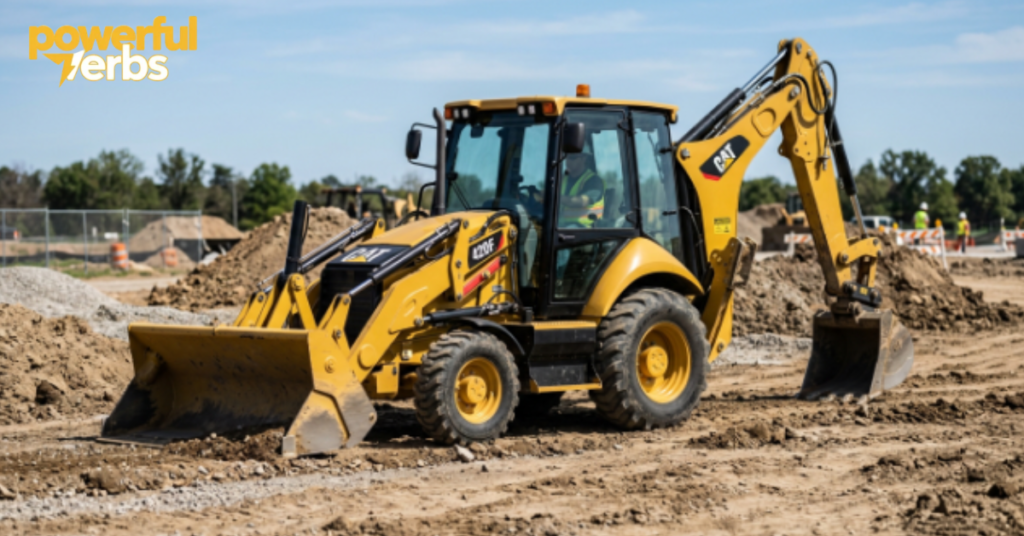
A backhoe loader is one of the most versatile construction vehicles available. It features a digging bucket arm (backhoe) at the rear and a loading bucket at the front. Its dual functionality makes it the most commonly seen machine on small to medium construction sites.
Primary Uses:
- Digging trenches for pipelines and cables
- Loading materials into trucks
- Breaking pavement and small demolition work
- Backfilling and grading
Key Feature: A single machine that performs two major jobs — loading and excavating — making it extremely cost-effective.
6. Boom Lift
A boom lift (articulating boom lift or telescoping boom lift) is an aerial work platform that extends a platform both vertically and horizontally. It provides workers with safe access to elevated work areas.
Primary Uses:
- Building maintenance and exterior painting
- Electrical and HVAC installation at height
- Bridge inspection and repair
- Window cleaning on tall buildings
Key Feature: Articulating boom lifts can reach up and over obstacles, making them ideal for complex elevated jobs.
7. Bulldozer
A bulldozer is arguably the most iconic construction vehicle. It is a powerful tracked machine equipped with a wide, heavy steel blade mounted at the front. Bulldozers are used for pushing large quantities of soil, sand, rubble, or other material.
Primary Uses:
- Site clearing and land preparation
- Grading and leveling terrain
- Pushing debris during demolition
- Road building and land reclamation
Key Feature: The Dozer’s tracked undercarriage provides excellent traction on soft, muddy, or rough terrain where wheeled vehicles cannot operate.
8. Cement Mixer (Concrete Mixer Truck)
A cement mixer truck (also called a concrete transit mixer) carries a rotating drum that continuously mixes cement, sand, aggregate, and water while in transit to prevent the concrete from hardening.
Primary Uses:
- Delivering ready-mix concrete to construction sites
- Foundation pours, slabs, and structural columns
- Tunnel and bridge construction
Key Feature: The rotating drum keeps concrete in a fluid, workable state during transport over long distances.
9. Cherry Picker
A cherry picker is a type of aerial work platform mounted on a truck or tracked vehicle. It features a hydraulic boom with a work basket at the end, giving workers a safe elevated working position.
Primary Uses:
- Utility and electrical line maintenance
- Tree trimming near power lines
- Street light installation and maintenance
- Telecommunication tower work
10. Cold Planer (Milling Machine)
A cold planer, also known as a road milling machine or asphalt milling machine, removes the top layer of an existing road surface without heating it. It uses a rotating drum with carbide cutting teeth.
Primary Uses:
- Removing old, cracked, or rutted asphalt before repaving
- Leveling uneven road surfaces
- Reclaiming asphalt material for recycling
- Preparing road base for new overlay
Key Feature: Cold planers produce a profiled, textured surface that helps new asphalt bond better, increasing road longevity.
11. Compact Track Loader
A compact track loader (CTL) is a small, highly maneuverable machine that rides on rubber tracks instead of wheels. It accepts a wide range of interchangeable attachments, making it one of the most versatile machines on any job site.
Primary Uses:
- Digging, grading, and backfilling
- Landscaping and land clearing
- Snow removal
- Operating in soft or wet ground conditions
Key Feature: The rubber track system distributes the machine’s weight over a larger area, preventing ground damage — ideal for finished lawns and soft terrain.
12. Concrete Pump Truck
A concrete pump truck uses a powerful hydraulic pump system to push freshly mixed concrete through pipes or hoses to areas that are difficult or impossible to reach by standard mixing trucks.
Primary Uses:
- Pumping concrete to upper floors of high-rise buildings
- Reaching over obstacles and into confined spaces
- Tunnel construction and underground work
- Bridge deck pours
Key Feature: Boom pump trucks can extend their delivery arm to heights exceeding 60 meters, making them essential for skyscraper construction.
13. Crane
A crane is a lifting machine that uses a combination of simple machines (pulleys, cables, and winches) to lift and move heavy loads vertically and horizontally. Cranes are essential on almost every large construction project.
Primary Uses:
- Lifting steel beams and prefabricated components
- Loading and unloading heavy cargo
- Placing HVAC equipment on rooftops
- Lifting precast concrete panels
Key Feature: Cranes dramatically reduce manual labor and improve construction safety by handling loads that no team of workers could safely move.
14. Crawler Crane
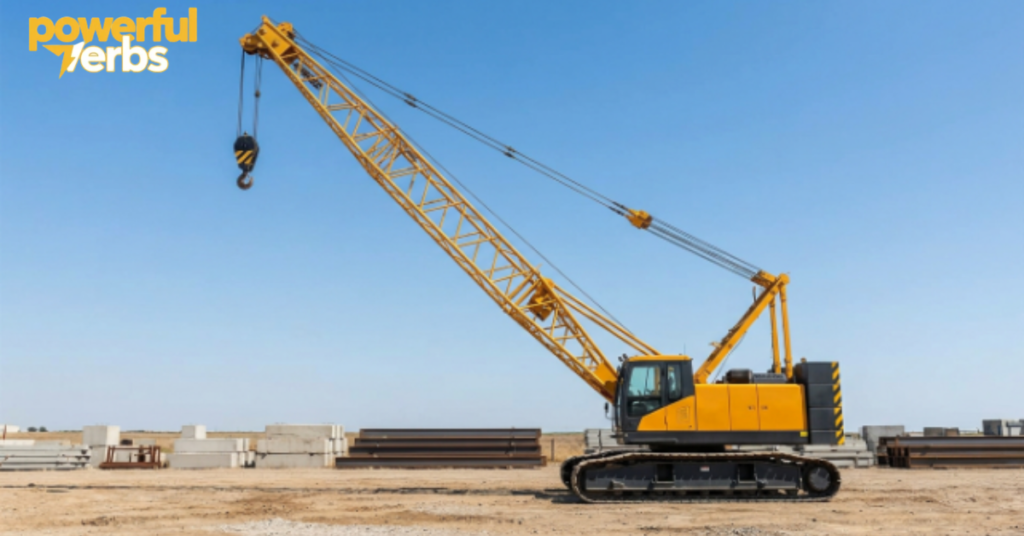
A crawler crane is a large crane mounted on a set of tracks (crawlers) rather than wheels. The tracks allow it to move across soft or uneven ground while supporting extremely heavy loads.
Primary Uses:
- Lifting massive structural components in large-scale construction
- Bridge and infrastructure projects
- Heavy industrial plant construction
- Operating in areas with soft ground conditions
Key Feature: Crawler cranes can lift significantly heavier loads than mobile cranes because their crawlers spread the load over a larger ground area.
15. Clamshell Excavator
A clamshell excavator uses a two-part bucket (resembling a clamshell) suspended from a crane. The bucket opens and closes to grab and lift loose materials from deep below the surface.
Primary Uses:
- Dredging rivers, harbors, and lakes
- Excavating deep foundations and well shafts
- Handling bulk loose materials (sand, gravel, coal)
- Demolition and scrap handling
16. Dragline Excavator
A dragline excavator is one of the largest construction machines ever built. It features a long boom with a bucket suspended from a hoist rope and a dragrope that pulls the bucket toward the machine.
Primary Uses:
- Large-scale strip mining and coal extraction
- Excavating large water retention basins and canals
- Port and harbor construction
- Major civil engineering earthworks
Key Feature: Draglines are among the largest self-propelled machines in the world, with some weighing over 8,000 tons.
17. Demolition Robot
A demolition robot (or remote-controlled demolition machine) is a compact, remotely operated vehicle equipped with a hydraulic hammer, crusher, or cutter attachment. It is used for controlled demolition in dangerous or confined spaces.
Primary Uses:
- Demolishing walls, concrete, and rock in confined spaces
- Tunnel demolition and mine clearance
- Hazardous environment work where operator safety is a priority
18. Dump Truck
A dump truck (also called a tipper truck) is one of the most common and recognizable construction vehicles. Its hydraulically operated open bed tilts backward to unload bulk materials quickly.
Primary Uses:
- Transporting sand, gravel, soil, and demolition waste
- Hauling asphalt and concrete aggregate
- Supporting earthmoving operations
Key Feature: Available in rigid and articulated forms, with payload capacities ranging from a few tons to over 400 tons in mining applications.
19. Excavator
An excavator (also called a digger or mechanical shovel) is a heavy construction machine with a rotating cab, a hydraulic boom arm, and a digging bucket. It is one of the most versatile and widely used machines in the construction industry.
Primary Uses:
- Digging foundations, basements, and trenches
- Demolition of buildings and structures
- Lifting and placing heavy materials
- Dredging waterways and rivers
- Land clearing and forestry
Key Feature: The 360-degree rotating cab allows operators to dig and deposit material without repositioning the machine.
20. Forklift
A forklift (also called a lift truck or forklift truck) is a compact industrial vehicle with two metal forks at the front used to lift, carry, and stack pallets and heavy materials.
Primary Uses:
- Loading and unloading delivery trucks at construction sites
- Moving building materials in warehouses and storage yards
- Stacking materials at height in confined spaces
Key Feature: Available in various load capacities from 1 ton to over 50 tons for specialized industrial applications.
21. Grader (Motor Grader)
A grader (also called a motor grader or road grader) is a construction machine with a long adjustable blade used to create flat, level surfaces. It is a critical piece of road construction equipment.
Primary Uses:
- Fine grading of road surfaces before paving
- Creating drainage slopes and crowns on roads
- Maintenance of unpaved gravel roads
- Leveling large areas for building foundations
Key Feature: The blade can be angled, tilted, and extended sideways to achieve very precise grading results.
22. Hydraulic Breaker
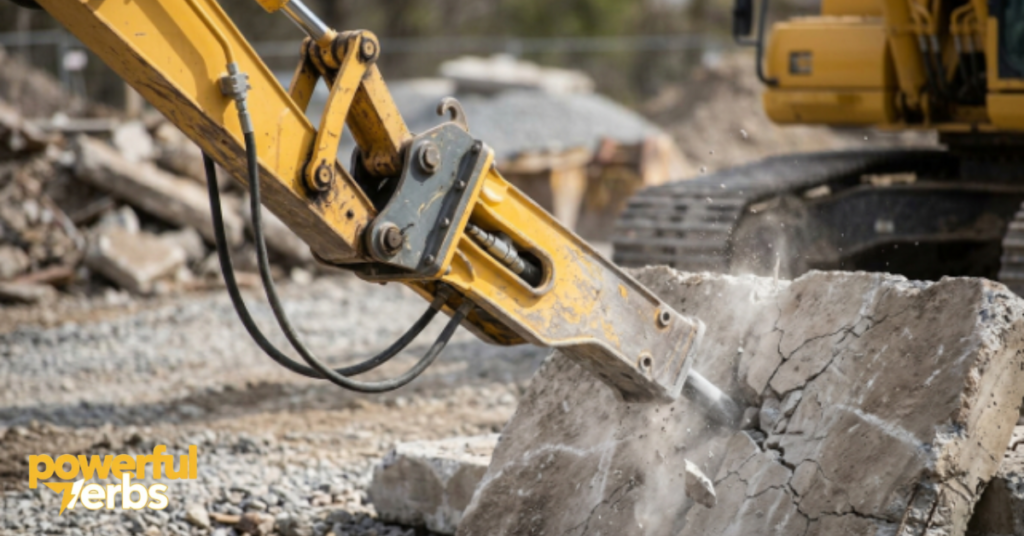
A hydraulic breaker (also known as a demolition hammer or rock breaker) is an attachment fitted to an excavator or backhoe that delivers powerful, repeated hammer blows to break hard surfaces.
Primary Uses:
- Breaking reinforced concrete slabs and structures
- Rock excavation and quarrying
- Trench cutting in hard ground
- Road demolition
23. Loader (Front-End Loader)
A front-end loader (also called a wheel loader) is a heavy machine with a large bucket on the front used for scooping, carrying, and loading bulk materials.
Primary Uses:
- Loading trucks with sand, gravel, and soil
- Moving stockpiled construction materials
- Snow removal operations
- Light grading and cleanup tasks
24. Long-Reach Excavator
A long-reach excavator is a standard excavator fitted with an extended boom and arm assembly, allowing it to dig or dredge at much greater horizontal distances.
Primary Uses:
- Dredging rivers, ponds, and waterways
- Demolition of tall structures from a safe distance
- Excavating in areas where the machine cannot get close
25. Mini Excavator
A mini excavator (also called a compact excavator or mini digger) is a smaller version of a standard excavator, designed to work in tight, confined spaces.
Primary Uses:
- Digging trenches for utilities, drainage, and plumbing
- Landscaping and garden work
- Indoor demolition projects
- Urban construction in narrow spaces
Key Feature: Mini excavators weigh between 1 and 8 tons, allowing them to access areas completely inaccessible to full-size machines.
26. Mobile Crane
A mobile crane is a crane mounted on a truck or crawler unit that can be driven between job sites without disassembly. It is one of the most flexible types of crane available.
Primary Uses:
- Lifting operations on medium to large construction projects
- Bridge construction and maintenance
- Industrial plant installation
- Emergency recovery operations
27. Pile Driver
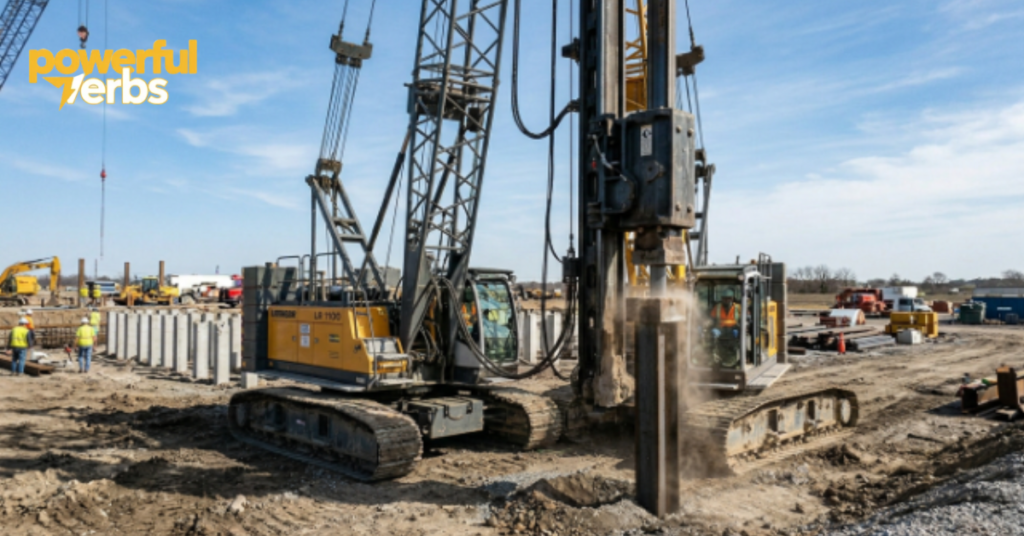
A pile driver is a construction machine that installs piles — long structural columns — deep into the ground to support foundations for buildings, bridges, and other structures.
Primary Uses:
- Deep foundation work for high-rise buildings
- Bridge pile foundation installation
- Marine construction and dock building
- Retaining wall installation
Key Feature: Modern pile drivers use hydraulic hammers for quieter, more energy-efficient pile driving compared to older diesel hammer systems.
28. Pipe Layer
A pipe layer (also called a side boom tractor) is a specialized tracked vehicle with a boom and counterweight on one side used to lift and lower pipes into trenches.
Primary Uses:
- Installing large-diameter water and gas pipelines
- Sewer main construction
- Oil and gas pipeline projects
29. Road Roller
A road roller (also called a steamroller or compaction roller) is a heavy construction vehicle used to compact soil, asphalt, gravel, or concrete by rolling over the material repeatedly.
Primary Uses:
- Compacting asphalt during road construction
- Preparing sub-base layers for road paving
- Compacting fill material at embankments and dams
Key Feature: Modern road rollers are equipped with vibration systems to improve compaction efficiency.
30. Rotary Drill
A rotary drill is a powerful drilling machine that uses a rotating cutting bit to bore deep holes into rock or soil for various construction and mining applications.
Primary Uses:
- Blasting hole drilling in quarrying and mining
- Geotechnical investigation and soil testing
- Well drilling and anchor installation
31. Rough Terrain Crane
A rough terrain crane is a compact, four-wheel-drive crane designed specifically for off-road use on soft or uneven ground. Unlike truck-mounted cranes, rough terrain cranes have a single operator cab for both driving and crane operation.
Primary Uses:
- Lifting operations on muddy or unprepared construction sites
- Remote rural and off-road project sites
- Industrial plant maintenance
32. Scraper
A scraper (also called an earth scraper or motor scraper) is a construction vehicle designed to cut, load, carry, and unload soil or earth in a single pass. It is one of the most productive earthmoving machines for large, open sites.
Primary Uses:
- Large-scale land leveling and grading
- Dam and reservoir construction
- Highway embankment and cut operations
- Agricultural land preparation
33. Scissor Lift
A scissor lift is an aerial work platform that extends vertically using a crisscross (scissor-like) mechanism. Unlike boom lifts, scissor lifts only move straight up and down.
Primary Uses:
- Interior construction work at height
- Ceiling installation and HVAC fitting
- Warehouse storage and retrieval
- Painting and maintenance of elevated surfaces
Key Feature: Scissor lifts provide a large, stable working platform making them safer for tasks requiring multiple workers at height.
34. Skid Steer Loader
A skid steer loader is a small, rigid-frame machine that steers by varying the speed of the wheels on each side (skidding). It accepts dozens of different attachments, making it one of the most versatile machines on any construction site.
Primary Uses:
- Digging, grading, and material handling in tight spaces
- Demolition with hydraulic breaker attachment
- Trenching, auger drilling, and cold planer attachments
- Snow removal
Key Feature: The ability to spin in place (zero-turn radius) makes skid steers ideal for extremely confined working areas.
35. Slipform Paver
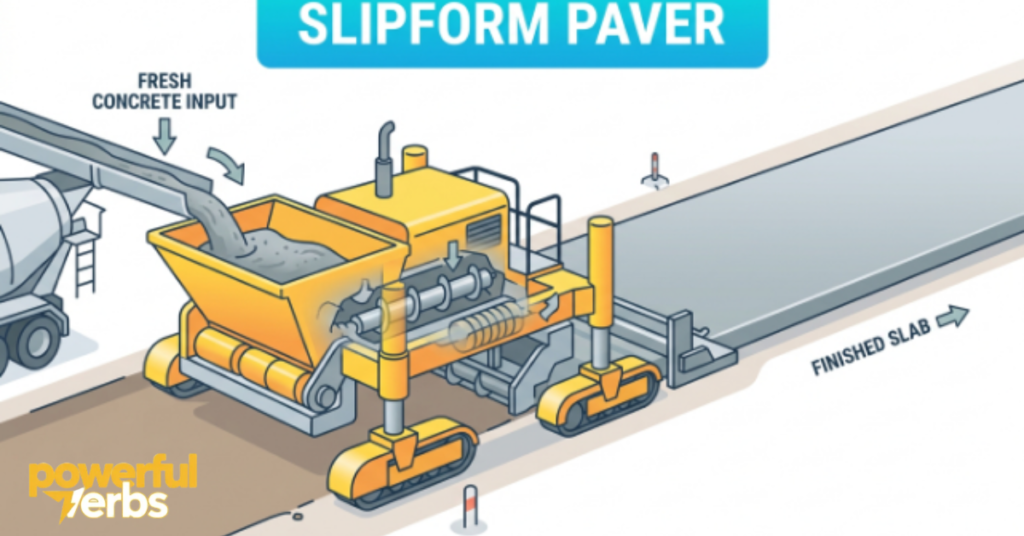
A slipform paver is a specialized road construction machine that extrudes concrete road sections continuously, forming and finishing the concrete in one pass.
Primary Uses:
- Concrete highway construction
- Airport runway and taxiway construction
- Concrete canal lining
36. Soil Compactor
A soil compactor is a construction machine used to compress and increase the density of soil, gravel, or fill material, creating a stable foundation for buildings and roads.
Primary Uses:
- Compacting fill layers during road and building construction
- Embankment and dam construction
- Trench backfill compaction
37. Suction Excavator (Vacuum Excavator)
A suction excavator (also called a vacuum excavator or hydrovac) uses high-powered suction or a combination of water jets and suction to break up and remove soil without mechanical cutting tools.
Primary Uses:
- Excavating around buried utilities without damage risk
- Potholing and daylighting underground services
- Cleaning drainage systems and catch basins
Key Feature: Suction excavators are the safest method for digging near buried gas, water, and electrical infrastructure.
38. Telehandler
A telehandler (also known as a telescopic handler or reach forklift) is a versatile machine with an extendable telescoping boom arm. It can be fitted with forks, buckets, work platforms, or other attachments.
Primary Uses:
- Placing building materials at height on construction scaffolding
- Agricultural bale and material handling
- Loading and unloading in confined spaces
Key Feature: The telescoping boom provides both height and horizontal outreach, far exceeding the reach of standard forklifts.
39. Tower Crane
A tower crane is a fixed, tall crane used in the construction of high-rise buildings and large structures. It is assembled on-site and anchored to the building’s structure as it rises.
Primary Uses:
- Lifting steel, concrete, and large prefabricated components in high-rise construction
- Skyscraper and apartment tower construction
- Large commercial and industrial building projects
Key Feature: Tower cranes can lift loads of 12 to 20 metric tons and reach heights exceeding 265 meters.
40. Track Dozer
A track dozer is a tracked bulldozer variant specifically designed for pushing, ripping, and reclaiming material in very demanding applications, including mining and heavy earthmoving.
Primary Uses:
- Mining overburden removal
- Large land clearing and reclamation projects
- Pushing heavy material in extreme conditions
41. Track Loader
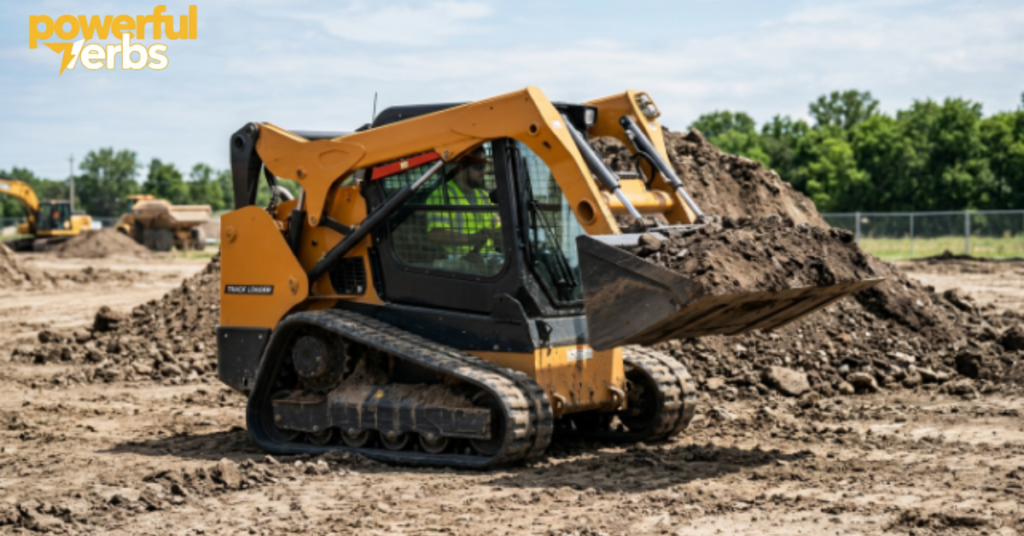
A track loader (also called a crawler loader) is a loader mounted on tracks instead of wheels. Tracks provide superior stability on soft, wet, or uneven ground.
Primary Uses:
- Loading material in difficult terrain
- Stockpile management at aggregate facilities
- Land clearing and stump removal
42. Trencher
A trencher is a construction machine used to dig narrow, deep trenches in the ground. It uses either a chain-style digging system or a rotating disc to cut through soil.
Primary Uses:
- Installing underground utilities (gas, water, electrical cables, fiber optic)
- Drainage and irrigation installation
- Landscaping and garden drainage projects
Key Feature: Chain trenchers can cut through hard clay, soft rock, and asphalt, making them far faster than excavator trenching.
43. Vibratory Roller
A vibratory roller is a compaction machine that combines the rolling weight of a drum roller with powerful vibrations to achieve deeper, more effective compaction of soil and asphalt.
Primary Uses:
- Compacting granular soils and aggregate base layers
- Asphalt compaction in road construction
- Embankment and dam fill compaction
Key Feature: The vibration effect compacts material at greater depths than static rollers, producing stronger and more durable foundations.
44. Wheel Loader
A wheel loader (also called a front loader or bucket loader) is a large construction machine on rubber-tired wheels with a wide front-mounted bucket for scooping, lifting, and moving bulk materials.
Primary Uses:
- Loading trucks with sand, gravel, and aggregates
- Stockpile management at quarries and sand pits
- Clearing snow from roads and yards
- Site cleanup and material segregation
45. Wheeled Excavator
A wheeled excavator is a standard excavator mounted on rubber-tired wheels instead of tracks. While it sacrifices some stability, it can travel quickly on roads between job locations.
Primary Uses:
- Urban construction and utility work where road travel is needed
- Drainage and utility excavation on paved streets
- Canal and riverbank maintenance
46. Concrete Spreader
A concrete spreader distributes freshly poured concrete evenly across a road or slab form before it is screeded and finished.
Primary Uses:
- Concrete road and runway construction
- Large slab pours
47. Pavement Profiler
A pavement profiler measures the surface profile (roughness, smoothness, and texture) of road surfaces using laser sensors and inertial measurement units.
Primary Uses:
- Road quality inspection and monitoring
- Pavement maintenance planning
- Highway department road condition surveys
48. Rock Drill
A rock drill (also called a percussion drill or jackhammer drill) is a pneumatic or hydraulic tool used to drill blast holes or anchor holes in rock and concrete.
Primary Uses:
- Blast hole drilling in quarries and mines
- Rock bolt installation in tunnels
- Anchor drilling for retaining walls
49. Scissor Lift (Rough Terrain)
A rough terrain scissor lift is a heavy-duty, four-wheel-drive version of a standard scissor lift, designed to operate on uneven outdoor surfaces at construction sites.
Primary Uses:
- Elevated work on construction sites with uneven terrain
- Steel erection and formwork at height
- Exterior building cladding and facade work
50. Cable Layer
A cable layer (also called a cable plow or cable laying machine) is a specialized vehicle that lays electrical cables, fiber optic cables, or small-diameter pipes directly into the ground in one continuous operation.
Primary Uses:
- Rural and urban electrical grid cable laying
- Telecommunications fiber optic installation
- Irrigation pipe installation
Heavy Construction Vehicles: Weight and Capacity Comparison
| Vehicle | Operating Weight | Max Payload / Capacity |
| Mini Excavator | 1–8 tons | N/A |
| Backhoe Loader | 7–12 tons | 1–2 tons bucket |
| Excavator | 20–100 tons | N/A |
| Wheel Loader | 8–60 tons | 3–35 tons |
| Bulldozer | 8–100+ tons | N/A |
| Articulated Dump Truck | 25–55 tons | 20–45 tons payload |
| Tower Crane | 200–300+ tons | 12–25 ton lift capacity |
| Dragline Excavator | 1,000–8,000+ tons | N/A |
How Construction Vehicles Are Classified
Construction vehicles are classified according to their primary function on a construction site:
Earthmoving Equipment
Machines in this category move large quantities of soil, rock, or debris. Examples include excavators, bulldozers, scrapers, and graders.
Hoisting and Lifting Equipment
These machines lift heavy loads vertically and position them horizontally. Examples include tower cranes, mobile cranes, crawler cranes, telehandlers, and boom lifts.
Compaction Equipment
Compaction machines increase the density of soil, gravel, or asphalt. Examples include road rollers, vibratory rollers, and soil compactors.
Transportation Equipment
These vehicles move materials across construction sites or between locations. Examples include dump trucks, articulated dump trucks, and conveyor systems.
Concrete Equipment
Machines used in mixing, transporting, and placing concrete. Examples include cement mixer trucks, concrete pump trucks, and slipform pavers.
Paving Equipment
Machines used for surface construction. Examples include asphalt pavers, cold planers, and road rollers.
Foundation and Drilling Equipment
Machines used for deep foundation work. Examples include pile drivers, auger drills, and rotary drills.
Construction Vehicles Safety Tips
Safe operation of construction vehicles requires strict adherence to established protocols:
- Always check the operator’s manual before operating any construction machine
- Perform daily pre-operation inspections covering fluid levels, tires, lights, and safety systems
- Never exceed the rated load capacity of any lifting or hauling machine
- Maintain clear communication with ground workers using standard hand signals or radio
- Establish exclusion zones around operating heavy machinery
- Wear appropriate personal protective equipment (PPE) at all times on the construction site
- Never operate equipment under the influence of alcohol, drugs, or extreme fatigue
- Receive formal training and certification before operating heavy equipment
Frequently Asked Questions About Construction Vehicles
What is the most commonly used construction vehicle?
The excavator is widely regarded as the most commonly used construction vehicle globally. Its versatility — from digging foundations to demolishing buildings — makes it indispensable on virtually every type of construction project.
What is the largest construction vehicle in the world?
The Bagger 293 bucket-wheel excavator used in German lignite mining is the largest land vehicle ever built, weighing approximately 14,200 metric tons. Among general construction equipment, the largest dragline excavators and ultra-class haul trucks used in open-pit mining are among the biggest machines.
What are RC construction vehicles?
RC construction vehicles (remote-controlled construction vehicles) are scale models or functional miniatures of real construction machines. They are used for educational purposes, hobbyist collecting, and in professional settings to demonstrate equipment operation. Some RC construction machines are also used for actual light-duty tasks in hazardous environments.
What is the difference between a bulldozer and an excavator?
A bulldozer uses a wide front blade to push material forward and is primarily used for land clearing and grading. An excavator uses a hydraulic boom and bucket to dig material and can rotate 360 degrees, making it suitable for digging, trenching, demolition, and lifting.
What is the heaviest construction vehicle?
The Liebherr T 284 mining dump truck is one of the heaviest wheeled construction vehicles in the world, with a gross vehicle weight exceeding 600 metric tons when fully loaded. In crawler equipment, large dragline excavators and crawler cranes can exceed several thousand tons.
What construction vehicles are used for road construction?
Road construction typically requires a combination of: motor graders (leveling), soil compactors (base preparation), cold planers (removing old surfaces), asphalt pavers (laying new asphalt), and road rollers (final compaction).
What construction vehicle digs the deepest?
Dragline excavators and rotary drills can reach the greatest depths. In civil construction, continuous flight auger (CFA) piling rigs can drill to depths exceeding 60 meters for deep pile foundation work.
Conclusion
From small mini excavators working in tight urban spaces to massive dragline excavators reshaping entire landscapes, construction vehicles represent some of the most powerful and sophisticated machinery ever designed. Each machine in this guide — all 50+ types of construction vehicles — serves a specific, critical role in the modern construction process.
Understanding the names, uses, and capabilities of construction equipment not only helps construction professionals make better equipment selections but also helps the general public appreciate the engineering behind the infrastructure we rely on every day. Whether it is a tower crane reaching into the sky or a trencher quietly laying cables underground, every construction vehicle plays its part in building the world around us.

Liam Johnson is a dedicated language expert with 4 years of professional experience. He specializes in Grammar, Vocabulary, and Sentence structure.
