

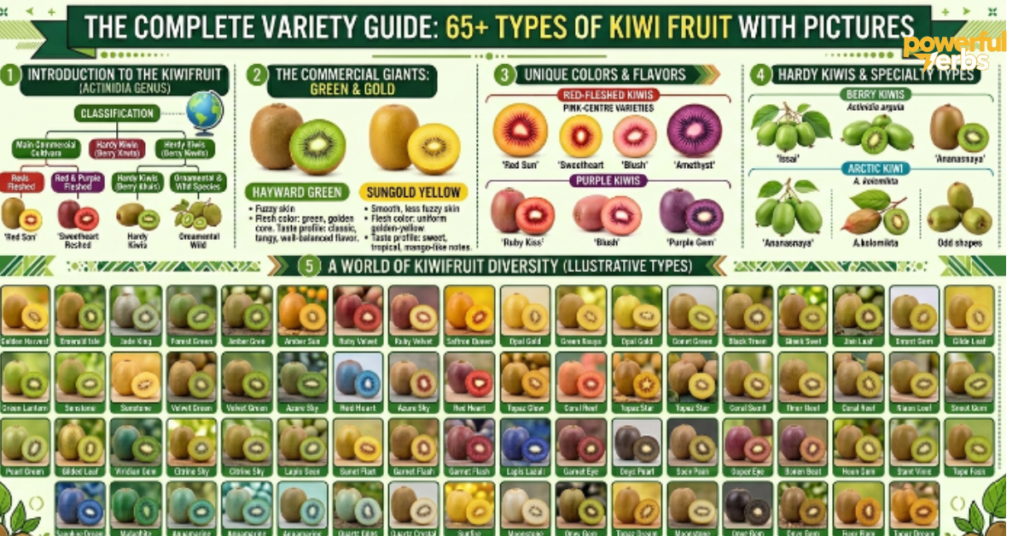
Most people walk into a grocery store and see just one type of kiwi — that small, fuzzy brown fruit with bright green flesh. What they do not realize is that the kiwi family is extraordinarily diverse, spanning over 60 botanical species and dozens of cultivated varieties in colors ranging from emerald green to golden yellow to deep ruby red.
Whether you are a home gardener, a food enthusiast, a chef, or simply a curious fruit lover, this complete guide covers 65+ types of kiwi fruit from every corner of the world — with flavor profiles, growing details, and everything you need to identify each one.
What Is Kiwi Fruit? A Quick Botanical Overview
Kiwi fruit belongs to the genus Actinidia, a family of woody vines native to China and other parts of East Asia. The plant was originally called the Chinese gooseberry before being commercially rebranded as “kiwifruit” in New Zealand during the 1950s. Today, kiwi is cultivated on every inhabited continent, with China, Italy, New Zealand, Iran, and Greece being the world’s top producers.
The Actinidia genus contains over 60 known species, and within those species, plant breeders have developed hundreds of cultivars with different sizes, colors, flavors, textures, and growing requirements. For the purposes of this guide, kiwi varieties are grouped into five major categories:
- Green Kiwi — the classic fuzzy variety most people recognize
- Golden Kiwi — smooth-skinned, sweet, yellow-fleshed varieties
- Red Kiwi — rare and striking varieties with red or pink interior coloring
- Kiwi Berries — small, grape-sized hardy varieties with smooth, edible skin
- Wild and Specialty Kiwi — lesser-known species used in breeding and niche markets
Complete List of Kiwi Fruit Varieties (65+)
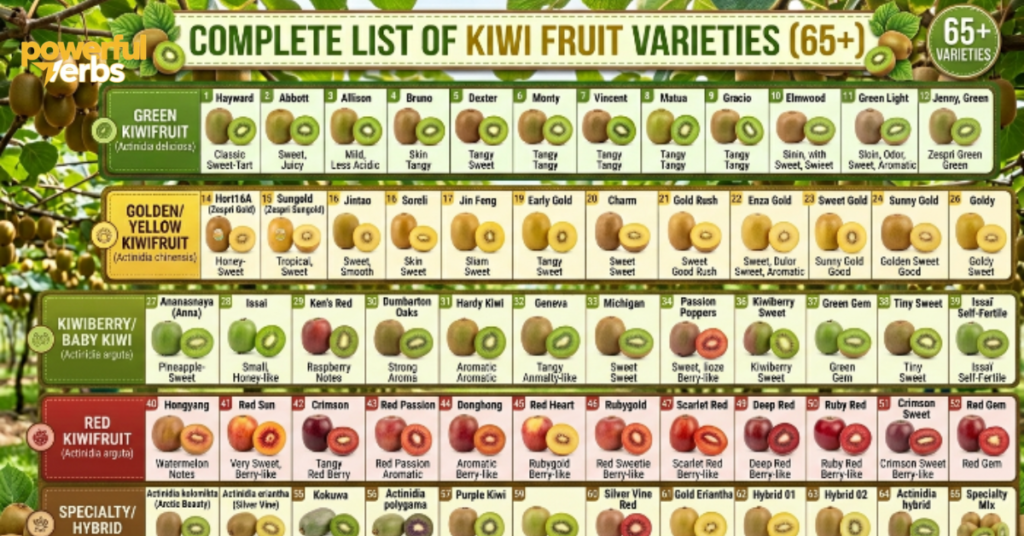
Green Kiwi Varieties
Green kiwi is the most widely grown and commercially dominant kiwi category. These varieties feature the characteristic brown, fuzzy skin and bright green flesh that most consumers recognize immediately.
1. Hayward
The undisputed king of commercial kiwi production. Hayward is grown in virtually every kiwi-producing country in the world and accounts for the majority of global kiwi exports. It produces large, oval fruits with rich brown fuzzy skin, vibrant green flesh, a balanced sweet-tart flavor, and outstanding post-harvest storage life of up to six months under refrigeration. Hayward vines are vigorous but require a pollinator male plant to bear fruit.
Flavor: Sweet with mild tartness | Skin: Brown, fuzzy | Best for: Fresh eating, export, long storage
2. Abbott
One of the earliest-ripening commercial green kiwi cultivars, Abbott produces medium-sized fruits with juicy flesh and a pleasantly mild sweet flavor. Widely cultivated in New Zealand, Chile, and parts of Asia, Abbott vines are productive and relatively easy to manage. The fruit matures several weeks before Hayward, making it valuable for growers seeking early-season harvests.
Flavor: Mild, sweet | Skin: Brown, lightly fuzzy | Best for: Early harvest, fresh markets
3. Allison
Allison is a productive New Zealand cultivar that performs well across a variety of temperate climates. It produces oval to oblong fruits with smooth green flesh and a refreshing, well-balanced flavor. Allison vines show good adaptability to different soil types and are commonly found in mixed commercial orchards alongside Hayward.
Flavor: Refreshing, balanced | Skin: Brown, fuzzy | Best for: Commercial growing, mixed orchards
4. Bruno
Distinguished by its unusually large, elongated fruit shape, Bruno is one of the most visually distinct green kiwi cultivars. The flesh is deep green, the flavor is intense and characteristically tangy, and the vines are among the most vigorous of any green kiwi variety. Bruno is harvested later in the season and is particularly popular in parts of Europe and New Zealand.
Flavor: Strong, tangy | Skin: Dark brown, fuzzy | Best for: Home gardens, specialty markets
5. Monty
Monty is a reliable, mid-season green kiwi cultivar valued for consistent productivity and pleasant fruit quality. The fruits are medium-sized with a slightly tangy sweetness and smooth green interior. Monty is well-suited to temperate growing conditions and is frequently planted alongside Hayward in commercial orchards to diversify harvest timing.
Flavor: Sweet-tart | Skin: Brown, fuzzy | Best for: Mixed orchards, fresh eating
6. Blake
Blake stands out among green kiwi varieties for its unusually smooth flesh texture and gentle, mild sweetness. It is considered an excellent choice for young children and people who find standard kiwi too acidic. Blake vines produce consistent yields and perform well in temperate regions. The fruit has a shorter storage life than Hayward but superior eating quality when fresh.
Flavor: Mild, smooth | Skin: Brown, fuzzy | Best for: Fresh eating, family gardens
7. Green Light
Green Light is a modern green kiwi selection developed to address some of the yield limitations of older cultivars. It produces fruits with a clean, balanced flavor, improved vine vigor, and higher productivity per acre than many traditional varieties. Green Light is becoming increasingly popular among commercial growers looking to diversify beyond Hayward.
Flavor: Balanced, clean | Skin: Brown, fuzzy | Best for: Commercial production, modern orchards
8. Gracie
Gracie produces highly uniform, attractively shaped fruits that make it particularly appealing for fresh retail markets where visual presentation matters. The flesh is a vivid green with a tropical, refreshing flavor profile. Gracie vines are moderately vigorous and show good disease tolerance under proper orchard management.
Flavor: Tropical, refreshing | Skin: Brown, fuzzy | Best for: Retail markets, fresh sales
9. Elmwood
A hardy and dependable green kiwi cultivar, Elmwood is appreciated by growers for its reliable annual yields and pleasant sweet-tart flavor. The fruits are medium-sized and ripen consistently across the vine, reducing the need for multiple selective harvests. Elmwood performs particularly well in cooler temperate climates.
Flavor: Sweet-tart | Skin: Brown, fuzzy | Best for: Cool climates, reliable production
10. Jones
Jones is a traditional green kiwi selection producing medium-sized fruits with aromatic, flavorful flesh and a well-balanced acidity. While less common in modern commercial production, Jones remains a respected variety in heritage orchards and among enthusiast growers who value flavor complexity over yield efficiency.
Flavor: Aromatic, balanced | Skin: Brown, fuzzy | Best for: Heritage orchards, specialty growers
11. Saanichton 12
Developed in British Columbia, Canada, Saanichton 12 is one of the most cold-tolerant fuzzy kiwi cultivars, capable of surviving temperatures that would damage or kill most other Actinidia deliciosa varieties. The fruits are large, flavorful, and ripen relatively early in the season, making this cultivar extremely valuable for growers in northern temperate regions.
Flavor: Sweet, full-bodied | Skin: Brown, fuzzy | Best for: Cold climates, northern gardens
12. Matua
Matua is not a fruiting variety but is the most widely used male pollinator kiwi cultivar in the world. Planted alongside female fruiting vines, Matua produces abundant pollen over an extended flowering period that overlaps well with most commercial green kiwi cultivars. No Hayward orchard is complete without Matua or a comparable male pollinator nearby.
Role: Male pollinator | Best for: Commercial orchards, home gardens with fruiting vines
13. Tomuri
Another essential male pollinator cultivar, Tomuri flowers later in the season than Matua and is specifically paired with late-flowering female varieties like Hayward. Using both Matua and Tomuri in the same orchard maximizes pollination coverage throughout the entire flowering window.
Role: Late male pollinator | Best for: Hayward orchards, extended pollination coverage
14. Chieftain
Chieftain is a vigorous green kiwi cultivar producing large, high-quality fruits with deep green flesh and strong flavor. Developed in New Zealand, it offers good cold hardiness relative to other Actinidia deliciosa varieties and has gained a following among specialty growers in cooler parts of Europe and North America.
Flavor: Rich, full | Skin: Brown, fuzzy | Best for: Cool climates, specialty production
15. Tewi
Tewi is a compact-growing kiwi cultivar particularly suited to smaller gardens and home orchards where space is limited. Despite its more manageable vine size, Tewi produces good-quality fruits with a pleasant sweet-tart flavor comparable to many commercial varieties. It requires standard cross-pollination with a male plant.
Flavor: Sweet-tart | Skin: Brown, fuzzy | Best for: Home gardens, small spaces
Golden Kiwi Varieties
Golden kiwi varieties belong primarily to the species Actinidia chinensis and are distinguished by their smooth (non-fuzzy) skin, golden or yellow flesh, higher natural sugar content, and lower acidity compared to green kiwi. They have become enormously popular worldwide for their sweeter, more tropical flavor profile.
16. Hort16A — Zespri Gold
The variety that introduced golden kiwi to the global market. Developed by HortResearch in New Zealand, Hort16A features smooth bronze-yellow skin, luminous golden flesh, and a distinctive tropical sweetness reminiscent of mango and melon with very low acidity. For years it was the gold standard of the golden kiwi category — until Pseudomonas syringae (PSA) bacterial canker devastated orchards worldwide in the early 2010s, prompting replacement by more resistant varieties.
Flavor: Tropical, very sweet | Skin: Smooth, bronze-yellow | Best for: Fresh eating, premium markets
17. SunGold — Zesy002
SunGold is the direct successor to Hort16A and is now the world’s most recognized golden kiwi variety. Developed specifically for PSA resistance while retaining exceptional eating quality, SunGold delivers a remarkably sweet flavor with notes of mango, honey, and citrus. The flesh is bright golden yellow, the skin is smooth and hairless, and the vitamin C content is nearly three times higher than a standard orange. SunGold is exclusively marketed under the Zespri brand.
Flavor: Mango-honey, very sweet | Skin: Smooth, golden | Best for: Fresh eating, premium retail, export
18. Jin Tao
Jin Tao is a Chinese golden kiwi cultivar that has gained significant commercial traction in Asian markets. The fruits are large, with aromatic golden flesh, excellent sugar levels, and a fragrant tropical flavor that many tasters describe as superior to standard green kiwi. Jin Tao is one of the leading golden kiwi varieties grown in China’s Shaanxi and Sichuan provinces.
Flavor: Aromatic, sweet | Skin: Smooth, light brown | Best for: Asian markets, commercial production
19. Soreli
Developed in Italy by the CRA-FRU research institute, Soreli is one of Europe’s most commercially significant golden kiwi cultivars. It ripens earlier than most golden varieties, which gives Italian growers a competitive advantage in reaching autumn markets before New Zealand product arrives. Soreli fruits have smooth skin, balanced sweetness, and excellent visual appeal.
Flavor: Sweet, balanced | Skin: Smooth, golden-brown | Best for: Early season, European markets
20. Dori
Dori is a premium Italian golden kiwi selection valued for its consistent fruit uniformity, attractive golden coloring, and rich tropical taste. It performs reliably in Mediterranean climates and has shown strong results in commercial trials for both yield and eating quality. Dori is a newer arrival in European kiwi production but is growing in commercial importance.
Flavor: Rich, tropical | Skin: Smooth, golden | Best for: Premium fresh markets, Italy
21. Gold3 — Zesy003
Gold3, marketed as Zespri Green Gold, represents a further development in golden kiwi breeding, offering improved resistance to PSA, stronger vine health, and consistently sweet fruit. While less widely known to consumers than SunGold, Gold3 is an important part of Zespri’s strategy for sustainable golden kiwi production in New Zealand.
Flavor: Sweet, clean | Skin: Smooth, golden | Best for: Commercial orchards, disease-resistant production
22. Charm
Charm is a newer golden kiwi cultivar with bright yellow flesh, an enticing tropical fragrance, and good market appeal. Developed as part of ongoing kiwi breeding programs, Charm offers growers an alternative golden variety with solid commercial characteristics and a flavor profile that resonates strongly with consumers accustomed to SunGold.
Flavor: Fragrant, tropical | Skin: Smooth, golden | Best for: Specialty markets, newer plantings
23. Jintao No.2
An improved selection derived from the original Jin Tao cultivar, Jintao No.2 produces larger fruits with refined flavor characteristics and better vine disease tolerance. It is gaining popularity in Chinese commercial orchards as growers seek to upgrade from older golden kiwi plantings.
Flavor: Sweet, aromatic | Skin: Smooth, light brown | Best for: Chinese markets, upgraded orchards
24. Megagreen Gold
A hybrid golden-green kiwi cultivar producing fruits with golden skin and flesh that retains some of the characteristic green kiwi tartness alongside golden sweetness. Megagreen Gold offers growers a bridge between the two major kiwi flavor categories and performs well in a range of temperate climates.
Flavor: Sweet-tart blend | Skin: Semi-smooth, golden-green | Best for: Specialty markets, experimental growers
25. Yellow Queen
Yellow Queen is a golden kiwi selection appreciated in specialty growing circles for its outstanding flavor intensity and deep golden flesh color. While not yet widely commercialized, Yellow Queen has attracted interest from premium fruit producers seeking to offer consumers a visually stunning and richly flavored golden kiwi option.
Flavor: Intensely sweet | Skin: Smooth, golden | Best for: Specialty growers, premium niches
26. Aurea
Aurea is a golden kiwi cultivar producing medium to large fruits with particularly smooth skin and exceptionally high vitamin C content. Originally developed in research settings, Aurea is valued in functional food markets where nutritional density is as important as flavor. The flesh is a warm golden-orange with a clean, honeyed sweetness.
Flavor: Honeyed, clean | Skin: Smooth, golden-orange | Best for: Health markets, nutritional focus
Red Kiwi Varieties
Red kiwi varieties are the most visually spectacular members of the Actinidia family. Most belong to the species Actinidia chinensis var. rufopulpa and are distinguished by red or pink coloring inside the fruit, often appearing as a vivid red ring, star, or center surrounded by green or yellow flesh. These varieties are primarily grown in China and are increasingly appearing in specialty fruit markets worldwide.
27. Hongyang
Hongyang is the most famous and widely grown red kiwi cultivar, developed in China’s Sichuan province. When sliced crosswise, it reveals a breathtaking pattern — green outer flesh transitioning to a striking red or crimson center surrounding the core. The flavor is intensely sweet with berry-like undertones, and the fruit has lower acidity than most green kiwi. Hongyang has become a prized novelty fruit in international specialty markets.
Flavor: Sweet, berry-like | Flesh: Green with red center | Best for: Specialty markets, visual appeal
28. Donghong
Donghong is an improved red kiwi cultivar selected for deeper, more consistent red coloration throughout the flesh compared to Hongyang. The fruits are larger, the sweetness is more pronounced, and the red pigmentation extends further from the center outward, creating an even more dramatic visual cross-section. Donghong is becoming the preferred red kiwi variety for commercial production in China.
Flavor: Sweet, full-bodied | Flesh: Deep red throughout | Best for: Premium markets, commercial red kiwi
29. Red Princess
As the name suggests, Red Princess is a decorative kiwi cultivar valued as much for its visual beauty as for its eating quality. The flesh features a vibrant red center with soft, tropical-tasting green flesh surrounding it. Red Princess fruits are medium-sized, smooth-skinned, and make an exceptional presentation when sliced for fruit platters, restaurant desserts, or specialty gift boxes.
Flavor: Sweet, tropical | Flesh: Red center, green surround | Best for: Presentation, hospitality, gift markets
30. EnzaRed
EnzaRed is a premium red kiwi variety developed for both visual impact and flavor excellence. The interior reveals a distinctive red star pattern radiating outward from the core, with high sugar content and a sophisticated sweet flavor. EnzaRed has been developed with commercial packaging and premium retail positioning in mind, targeting health-conscious consumers who want visually stunning fruit.
Flavor: Sweet, sophisticated | Flesh: Red star pattern | Best for: Premium retail, health markets
31. RubyRed
RubyRed is among the rarest of commercially documented red kiwi cultivars, producing fruits with deep ruby-colored flesh throughout rather than a distinct center ring. The flavor is rich, sweet, and distinctly different from green kiwi, with a complexity that makes it highly sought after by specialty fruit importers and high-end restaurants. RubyRed vines are more demanding to cultivate than standard varieties.
Flavor: Rich, complex | Flesh: Deep ruby throughout | Best for: Fine dining, ultra-premium markets
32. Juanli
Juanli is a Chinese red kiwi cultivar producing medium-sized fruits with attractive red-tinted flesh and excellent flavor characteristics. While less internationally known than Hongyang or Donghong, Juanli is well-regarded within Chinese domestic markets for its consistent quality and reliable production in the country’s central growing regions.
Flavor: Sweet-tart | Flesh: Red-tinted | Best for: Chinese domestic markets
33. Changxing
Changxing is a red kiwi selection named after the Chinese county where it was developed. It produces elongated fruits with a characteristic red interior pattern and performs well in humid subtropical growing conditions. Changxing is used in both fresh fruit markets and processed kiwi products in China.
Flavor: Sweet | Flesh: Red-patterned | Best for: Chinese markets, processing
34. Jinyan
Jinyan is a unique hybrid cultivar developed by crossing Actinidia chinensis with Actinidia eriantha, resulting in a fruit that blends golden and red flesh characteristics. The result is a beautiful, complex fruit with golden-red interior coloring, exceptional sweetness, and a fruity aroma that sets it apart from both pure golden and pure red kiwi varieties.
Flavor: Complex, very sweet | Flesh: Golden-red blend | Best for: Specialty growing, novelty markets
35. Chiliwang
Chiliwang is a less common red kiwi cultivar documented primarily in Chinese growing regions. It produces small to medium fruits with distinctive red coloring and a pleasantly sweet flavor. Chiliwang is primarily of interest to kiwi breeding programs and specialty growers exploring the diversity of the red kiwi category.
Flavor: Sweet | Flesh: Red-tinted | Best for: Breeding programs, specialty cultivation
Kiwi Berry Varieties
Kiwi berries come from cold-hardy kiwi species — primarily Actinidia arguta and Actinidia kolomikta — that are native to northern Asia and capable of surviving temperatures as low as -25°C (-13°F). The fruits are grape-sized or smaller, have thin, smooth, edible skin that requires no peeling, and taste sweeter and more intense than standard kiwi. Kiwi berries are one of the fastest-growing segments of the specialty fruit market.
36. Issai
Issai is the most popular kiwi berry cultivar for home gardeners worldwide, and for excellent reason — it is the only commercially available kiwi variety that is fully self-fertile, meaning it produces fruit without requiring a separate male pollinator plant. The berries are small, smooth-skinned, intensely sweet, and packed with nutrients. Issai vines are vigorous but manageable, making them ideal for trellises, fences, and pergolas in small gardens.
Flavor: Very sweet, intense | Size: Grape-sized | Best for: Home gardens, containers, beginners
37. Ananasnaya — Anna
Also known simply as “Anna,” Ananasnaya is one of the most beloved hardy kiwi berry cultivars among enthusiast growers. The name comes from the Russian word for pineapple, reflecting the fruit’s distinctive pineapple-like sweetness with tropical undertones. The berries are slightly larger than most kiwi berries, with smooth green skin that blushes slightly when fully ripe. Ananasnaya requires a male pollinator.
Flavor: Pineapple-sweet, tropical | Size: Slightly larger than average | Best for: Home growing, fresh eating
38. Ken’s Red
Ken’s Red is one of the most visually striking kiwi berry cultivars, producing berries with deep reddish-purple skin that stands out dramatically in a fruit bowl or on a vine. The flavor is sweet and aromatic with a hint of berry complexity that distinguishes it from green-skinned kiwi berries. Ken’s Red performs well in cooler climates and is a popular choice for ornamental edible gardens.
Flavor: Sweet, aromatic, berry-like | Size: Small | Best for: Cool climates, ornamental edible gardens
39. Geneva
Geneva is an early-ripening hardy kiwi berry cultivar developed at Cornell University in New York. It produces smooth, edible-skinned fruits that ripen weeks earlier than most other kiwi berry varieties, extending the fresh kiwi season into late summer. Geneva berries have a refreshing sweetness and excellent eating quality, making this cultivar particularly valuable for northern growers with short growing seasons.
Flavor: Refreshing, sweet | Size: Small to medium | Best for: Short-season climates, early harvest
40. Dumbarton Oaks
Named after the famous Washington D.C. estate where it was originally collected, Dumbarton Oaks is a vigorous cold-hardy kiwi berry producing flavorful small fruits on strong, productive vines. It is one of the hardiest kiwi berry cultivars available, tolerating deep cold that would damage less robust varieties. The berries have smooth edible skin and a pleasant sweet flavor.
Flavor: Sweet, pleasant | Size: Small | Best for: Very cold climates, northern gardens
41. Cordifolia
Cordifolia is a wild-type Actinidia arguta species selection rather than a developed cultivar. It produces small, smooth fruits used primarily in kiwi breeding programs and by specialty growers interested in exploring the full genetic diversity of the Actinidia genus. The berries are edible and sweet but smaller and less uniform than selected cultivars.
Flavor: Sweet, variable | Size: Very small | Best for: Breeding, specialty cultivation
42. Weiki
Weiki is a German-selected kiwi berry cultivar that has gained strong popularity in European home gardens. It produces reliable crops of sweet, smooth-skinned berries on cold-hardy vines that perform well in continental European climates. Weiki requires a male pollinator and is commonly paired with the Pollinator male plant sold by European nurseries.
Flavor: Sweet, clean | Size: Small | Best for: European gardens, home growing
43. Natasha
Natasha is a productive Actinidia arguta cultivar producing abundant crops of medium-sized, flavorful kiwi berries with smooth, edible green skin. It was selected for both fruit quality and vine cold-hardiness, making it suitable for growing in USDA hardiness zones 4 through 8. Natasha berries have a clean, sweet kiwi flavor without excessive acidity.
Flavor: Sweet, mild | Size: Medium | Best for: Cold-hardy growing, home production
44. Jumbo
True to its name, Jumbo produces some of the largest fruits in the kiwi berry category — significantly bigger than average Actinidia arguta berries. The flavor is sweet and full, and the skin is smooth and entirely edible. Jumbo vines require a male pollinator and perform best in temperate climates with adequate summer warmth to develop full fruit size.
Flavor: Sweet, full | Size: Large for a kiwi berry | Best for: Novelty growing, fresh markets
45. Pasha
Pasha is a compact kiwi berry cultivar suited to container growing and small gardens. Despite its restrained vine size, Pasha produces good crops of flavorful, smooth-skinned berries. Its manageable growth habit makes it one of the better options for urban gardeners and balcony growers who want to enjoy fresh kiwi berries from a pot.
Flavor: Sweet | Size: Small | Best for: Container growing, balconies, urban gardens
46. MSU Hardy
Developed at Michigan State University, MSU Hardy is one of the most cold-tolerant kiwi berry cultivars in North American production. It survives harsh Midwest winters that would kill most fruiting vines and still produces good quality sweet kiwi berries in summer. MSU Hardy is particularly valued by growers in zones 4 and 5 who have previously struggled to grow kiwi in their climate.
Flavor: Sweet | Size: Small | Best for: Extreme cold climates, zone 4-5 growers
Wild, Rare & Specialty Kiwi Varieties
Beyond the major commercial and home-garden categories, the Actinidia genus contains numerous lesser-known species and specialty cultivars that are grown in research settings, botanical gardens, and by dedicated specialist growers. These varieties expand our understanding of kiwi’s extraordinary diversity.
47. Actinidia kolomikta — Arctic Kiwi
Arctic Kiwi is one of the hardiest Actinidia species on Earth, capable of withstanding temperatures as low as -40°C. The berries are very small but intensely sweet, often with higher vitamin C content than any other kiwi variety. An additional remarkable feature is the ornamental value of the male plants, whose leaves develop beautiful pink, white, and green variegation. Arctic Kiwi is an outstanding choice for extremely cold growing regions.
Flavor: Very sweet, intense | Hardiness: To -40°C | Best for: Arctic and subarctic climates, ornamental use
48. Actinidia melanandra — Purple Kiwi
Purple Kiwi is a rare and visually unusual Actinidia species producing small berries with unusual purplish-red coloring on the skin and flesh. It is not commercially cultivated but is of great interest to plant breeders working to introduce new colors, flavors, and cold-hardiness characteristics into next-generation kiwi cultivars.
Flavor: Sweet-tart | Appearance: Purple-red | Best for: Breeding programs, botanical collections
49. Actinidia polygama — Silver Vine
Silver Vine is best known as a powerful attractant for cats — even more potent than catnip — but it also produces small, edible fruits used in traditional Japanese pickling. The berries have a spicy, complex flavor that is quite different from other kiwi varieties. Silver Vine leaves also develop attractive silver variegation, adding ornamental value to the plant.
Flavor: Spicy, complex | Special feature: Cat attractant | Best for: Japanese cuisine, ornamental growing
50. Actinidia eriantha — White Kiwi
White Kiwi, also known as Mao Hua Mihoutao in China, produces fruits covered in distinctive white hairs rather than the brown fuzz of standard kiwi. The flesh is green-white and has a delicate, mildly sweet flavor. Actinidia eriantha is used extensively in Chinese breeding programs, including in the development of the Jinyan hybrid cultivar.
Flavor: Delicate, mildly sweet | Skin: White-haired | Best for: Breeding programs, specialty cultivation
51. Actinidia latifolia — Large-Leaf Kiwi
Large-Leaf Kiwi is a wild Actinidia species native to southern China and Southeast Asia. It produces medium-sized fruits with good flavor that are consumed locally in its native range. Actinidia latifolia is one of several wild species being evaluated by breeders for traits that could improve disease resistance and climate adaptability in cultivated kiwi varieties.
Flavor: Pleasant, variable | Origin: South China, Southeast Asia | Best for: Wild food foraging, breeding
52. Actinidia valvata
Actinidia valvata is a cold-hardy Chinese Actinidia species that produces small, round berries with edible smooth skin. While not commercially cultivated, it is documented in botanical collections and used in breeding programs targeting cold hardiness. The fruits are notably sweet for a wild-type Actinidia species.
Flavor: Sweet | Hardiness: High | Best for: Botanical collections, cold-hardiness breeding
53. Actinidia macrosperma
Known for producing fruits with unusually large seeds relative to its fruit size, Actinidia macrosperma is a rare Chinese species grown primarily in research and botanical settings. It contributes genetic diversity to breeding programs but has no significant commercial presence.
Flavor: Variable | Notable: Large seeds | Best for: Botanical research
54. Tsuru Ume
Tsuru Ume is a Japanese kiwi berry selection valued in Japanese specialty horticulture for its early ripening, compact vine, and sweet, flavorful fruits. It performs well in Japan’s humid temperate climate and is cultivated by specialty fruit growers seeking to offer unique kiwi varieties to premium domestic markets.
Flavor: Sweet | Origin: Japan | Best for: Japanese specialty markets
55. Chang Shan Xiaoqihou
This traditional Chinese cultivar is grown in mountain regions of Zhejiang province and prized for its exceptional sweetness and aromatic fragrance. Chang Shan Xiaoqihou produces small, smooth-skinned fruits with brilliant green flesh and a flavor that local growers describe as more complex and nuanced than standard commercial varieties.
Flavor: Very sweet, aromatic | Origin: Zhejiang, China | Best for: Chinese specialty markets
Additional Notable Kiwi Cultivars
56. Tomua
A productive New Zealand male pollinator variety used specifically in combination with Bruno and Monty female cultivars. Tomua’s flowering period aligns well with mid-season female varieties, ensuring effective pollination across a broader range of cultivar types than either Matua or Tomuri alone.
57. Arctic Beauty — Male Kolomikta
The male form of Arctic Kiwi, grown primarily for its spectacular ornamental foliage — leaves with pink, white, and green tricolor variegation — while also serving as a pollinator for female Actinidia kolomikta plants. Arctic Beauty male is one of the most ornamentally beautiful of all Actinidia plants.
58. Rosanna
An Italian golden kiwi research cultivar developed for early ripening and high fruit quality. Rosanna produces smooth-skinned, golden-fleshed fruits with a clean tropical sweetness and good commercial packing characteristics. It is among the cultivars being evaluated for large-scale adoption in Italian kiwi orchards.
59. Minerva
Minerva is an Italian-developed kiwi cultivar producing large, flavorful fruits with excellent storage characteristics. It is one of several new Italian green kiwi selections aimed at providing growers with higher-value alternatives to aging standard cultivars, particularly in light of increasing competition from Southern Hemisphere producers.
60. Bingo
Bingo is a compact, early-ripening kiwi cultivar developed for home garden use. Its contained growth habit and early fruit set make it particularly suitable for gardeners in cooler climates who need a kiwi that can ripen fruit before autumn temperatures drop. Bingo produces medium-sized fruits with a pleasant sweet flavor.
61. Chieftain Yellow
A golden-fleshed variant selection from the Chieftain green kiwi lineage, Chieftain Yellow produces fruits with intermediate coloring between standard green and full golden varieties. It represents one of many intermediate cultivars that exist along the spectrum between green and golden kiwi.
62. Red Star
Red Star is a specialty red kiwi cultivar selected specifically for the clarity and symmetry of its internal red star pattern. While similar to EnzaRed in visual concept, Red Star has been developed by different breeders and shows slightly different flavor and vine characteristics, giving specialty growers an alternative option in the premium red kiwi segment.
63. Taggarts Red
A heritage kiwi berry selection producing berries with red-flushed skin and aromatic, complex flavor. Taggarts Red is mainly found in collector’s gardens and specialty nurseries and has not entered mainstream commercial production, but it maintains a dedicated following among kiwi enthusiasts.
64. Dunbarton Oaks Female
The female counterpart to the Dumbarton Oaks cultivar described earlier, specifically selected for high productivity and fruit quality. Often paired with a Dumbarton Oaks male or other Actinidia arguta males for cross-pollination in cold-climate gardens.
65. Purpurna Sadova
A Czech-developed kiwi berry cultivar producing attractive fruits with slight purple skin tinting and sweet, aromatic flavor. Purpurna Sadova has shown good cold-hardiness in central European trials and is gaining attention from specialty growers in Germany, Austria, and the Czech Republic.
How to Identify Different Kiwi Varieties
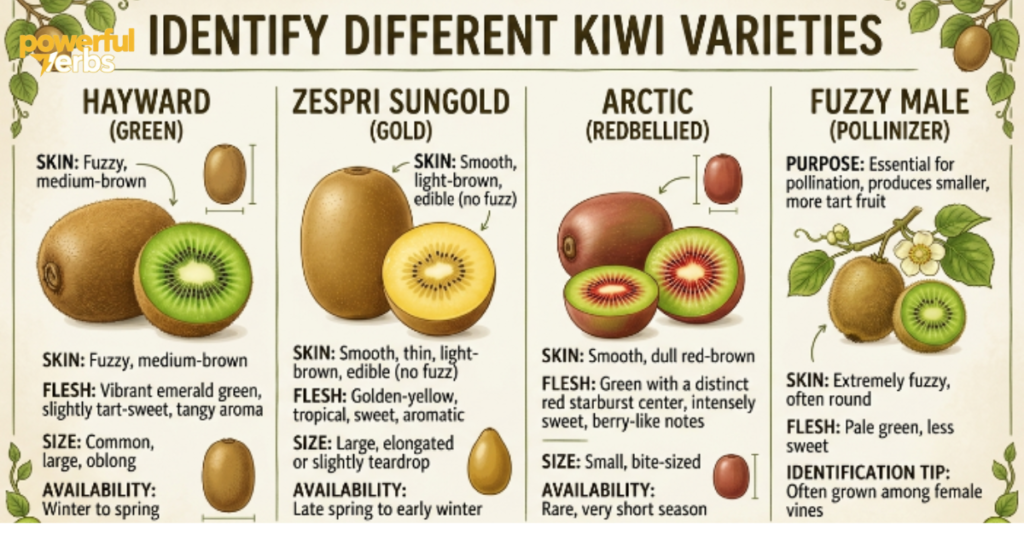
With so many kiwi types available, here is a simple identification framework based on the most visible characteristics:
| Characteristic | What to Look For | Likely Category |
| Fuzzy brown skin, green flesh | Standard oval fruit | Green Kiwi |
| Smooth golden skin, yellow flesh | No fuzz, sweet smell | Golden Kiwi |
| Smooth skin, red center when cut | Dramatic cross-section | Red Kiwi |
| Grape-sized, smooth edible skin | No peeling needed | Kiwi Berry |
| Very tiny berries, ornamental leaves | Variegated foliage | Kolomikta / Arctic |
| White hair on skin | Unusual appearance | Actinidia eriantha |
Nutritional Comparison: Green vs. Golden vs. Red Kiwi
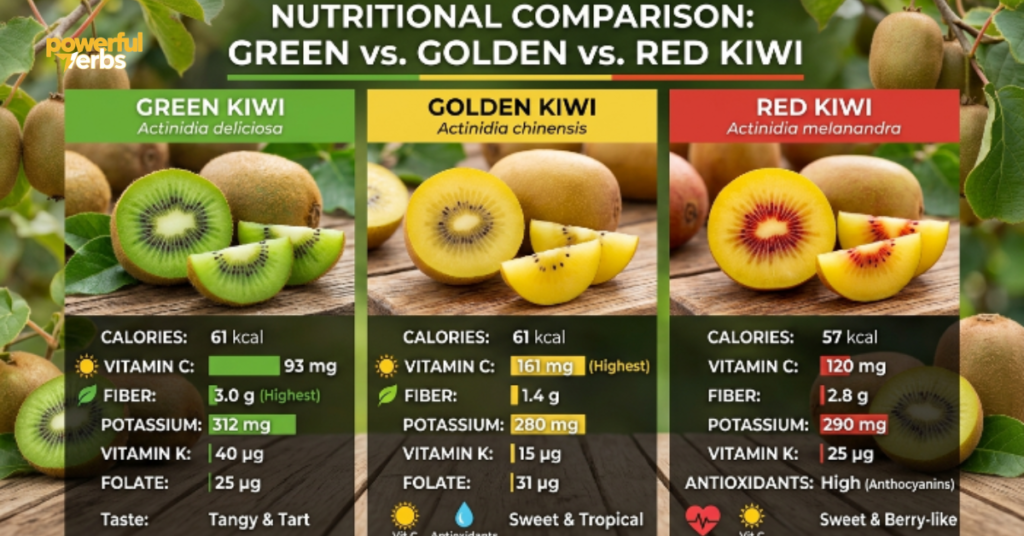
| Nutrient | Green Kiwi | Golden Kiwi | Red Kiwi |
| Vitamin C | ~93 mg per 100g | ~161 mg per 100g | ~85–120 mg per 100g |
| Sugar content | Moderate | High | High |
| Acidity | Medium-high | Low | Low-medium |
| Fiber | High | Moderate | Moderate |
| Antioxidants | Good | Excellent | Excellent |
| Folate | Moderate | High | Moderate |
Golden kiwi varieties consistently deliver more vitamin C per serving than green kiwi, while red varieties offer unique anthocyanin antioxidants responsible for their striking coloring.
Growing Kiwi Fruit: Key Facts for Every Variety Type
Climate Requirements
Fuzzy Green Kiwi (Actinidia deliciosa) — Requires a long, warm growing season with 200–240 frost-free days. Best in USDA zones 7–9. Hardy to approximately -12°C when dormant.
Golden Kiwi (Actinidia chinensis) — Similar to fuzzy kiwi but slightly less cold-tolerant. Performs best in zones 7–9 with warm summers and mild winters.
Kiwi Berries (Actinidia arguta) — Extremely cold-hardy, surviving to -25°C or lower depending on cultivar. Suitable for zones 4–8 and growing seasons as short as 150 days.
Arctic Kiwi (Actinidia kolomikta) — The hardiest of all, surviving to -40°C. Ideal for zones 3–6 and challenging northern climates.
Pollination Requirements
Most kiwi varieties are dioecious, meaning male and female flowers grow on separate plants. A single male pollinator can service up to eight female plants. Key exceptions include:
- Issai — fully self-fertile, no pollinator needed
- Weiki — partially self-fertile, produces better with a pollinator
- All other commercial varieties require dedicated male pollinator plants
Time to First Fruit
| Variety Type | Years to First Harvest |
| Fuzzy Green Kiwi | 3–5 years from planting |
| Golden Kiwi | 3–5 years from planting |
| Kiwi Berries | 2–4 years from planting |
| Issai (self-fertile) | 2–3 years from planting |
Top Kiwi Producing Countries and Their Signature Varieties
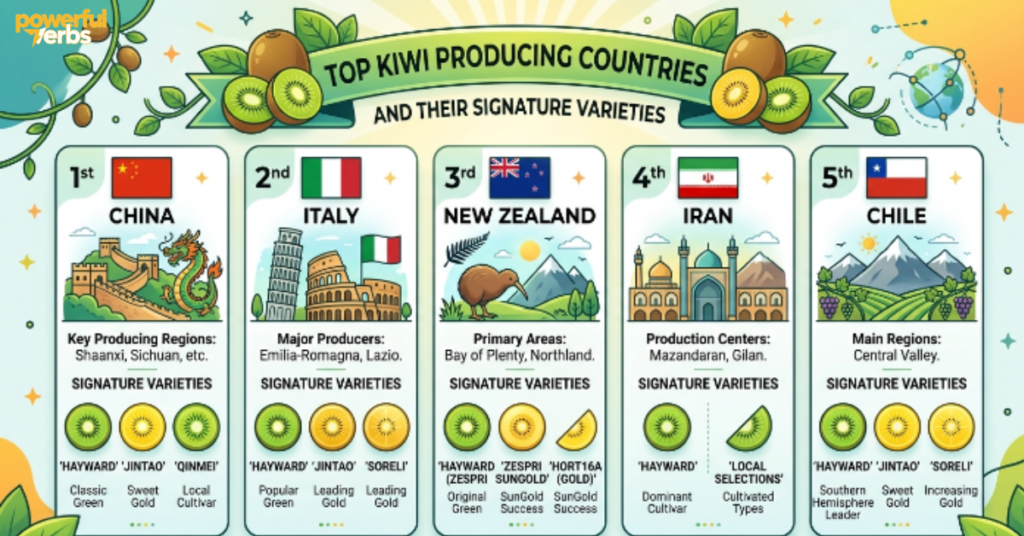
| Country | Primary Varieties Grown | Annual Production |
| China | Hayward, Hongyang, Jin Tao, Donghong | ~2.2 million tonnes |
| Italy | Hayward, Soreli, Dori, Minerva | ~480,000 tonnes |
| New Zealand | Hayward, SunGold, Gold3 | ~430,000 tonnes |
| Iran | Hayward, Abbott | ~380,000 tonnes |
| Greece | Hayward | ~170,000 tonnes |
| Chile | Hayward, Abbott, Monty | ~200,000 tonnes |
China produces more kiwi than the rest of the world combined, largely due to the fact that the Actinidia genus is native to its central and southern provinces.
Kiwi Fruit Flavor Profile Guide
Understanding flavor differences helps consumers choose the right kiwi variety for specific uses:
Mild and Sweet — Blake, SunGold, Ananasnaya, Dori
Best for: Children, desserts, smoothies, fresh eating without added sugar
Sweet-Tart Balance — Hayward, Allison, Monty, Geneva
Best for: General fresh eating, fruit salads, baking, yogurt toppings
Intensely Sweet — Jin Tao, Hongyang, Donghong, Issai
Best for: Specialty fresh markets, premium gift boxes, restaurant desserts
Tropical and Aromatic — Hort16A, Charm, Gracie, Ananasnaya
Best for: Tropical fruit platters, cocktails, exotic recipes
Complex and Unusual — RubyRed, Actinidia polygama, Chang Shan
Best for: Adventurous food lovers, specialty cuisine, tasting menus
Conclusion
The world of kiwi fruit is far richer, more colorful, and more flavorful than most people ever realize. From the familiar Hayward green kiwi to the golden sweetness of SunGold, the dramatic red interior of Hongyang, and the bite-sized delight of an Issai kiwi berry, every variety offers something genuinely unique.
Exploring the full spectrum of kiwi fruit types transforms an ordinary fruit into an extraordinary culinary and horticultural adventure — one that spans continents, climates, and centuries of cultivation.
FAQs
How many types of kiwi fruit are there?
The Actinidia genus contains over 60 botanical species, with approximately 20 to 30 varieties commercially cultivated worldwide. Including specialty, heritage, and research cultivars, the total number of documented kiwi varieties exceeds 400, though most are not available in mainstream markets.
What is the difference between green and golden kiwi?
Green kiwi belongs to the species Actinidia deliciosa and has brown fuzzy skin, bright green flesh, and a balanced sweet-tart flavor. Golden kiwi belongs to Actinidia chinensis, has smooth bronze skin, golden-yellow flesh, higher sugar content, lower acidity, and a tropical flavor profile closer to mango or melon.
Which kiwi variety is healthiest?
Golden kiwi varieties, particularly SunGold, contain nearly three times the vitamin C of a standard orange and significantly more than green kiwi per serving. Red kiwi varieties offer additional anthocyanin antioxidants from their red pigmentation. All kiwi varieties are rich in vitamin K, folate, potassium, and dietary fiber.
Can you eat kiwi skin?
Kiwi berry skins are entirely smooth and edible — no peeling necessary. Standard fuzzy green and golden kiwi skin is technically edible and nutritious, containing additional fiber and vitamin C, but the texture is unpleasant to many people. Washing thoroughly before eating skin is always recommended.
What is the sweetest kiwi variety?
Among widely available varieties, SunGold golden kiwi is consistently rated the sweetest, followed by Ananasnaya kiwi berry and Hongyang red kiwi. Among green kiwi, Blake and Abbott are considered milder and sweeter than the more common Hayward.
What country has the most kiwi varieties?
China has by far the greatest kiwi diversity, which is unsurprising given that the Actinidia genus originated there. China’s mountainous central provinces remain a center of wild kiwi species diversity, and the country’s agricultural research institutions are the world’s most active in developing new cultivars.
Are kiwi berries just baby kiwis?
No — kiwi berries are not immature regular kiwi fruits. They come from entirely different Actinidia species, primarily Actinidia arguta, which naturally produces small, grape-sized fruits as its mature fruit form. Kiwi berries are fully ripe when they reach their small size and have a flavor that is actually sweeter and more concentrated than standard kiwi.
What is red kiwi fruit?
Red kiwi fruit refers to varieties of Actinidia chinensis that produce flesh with red or crimson coloring, typically concentrated in a ring or star pattern around the core. The most well-known red kiwi cultivar is Hongyang. Red kiwi varieties have higher anthocyanin content than green or golden types, contributing both their color and additional antioxidant benefits.
Where can I buy unusual kiwi varieties?
Specialty kiwi varieties beyond standard Hayward and SunGold are most often found at farmers markets, specialist fruit stores, Asian grocery stores, and online specialist fruit retailers. Hardy kiwi berry plants can be purchased from specialist nurseries and grown at home even in cold climates.

Liam Johnson is a dedicated language expert with 4 years of professional experience. He specializes in Grammar, Vocabulary, and Sentence structure.
