

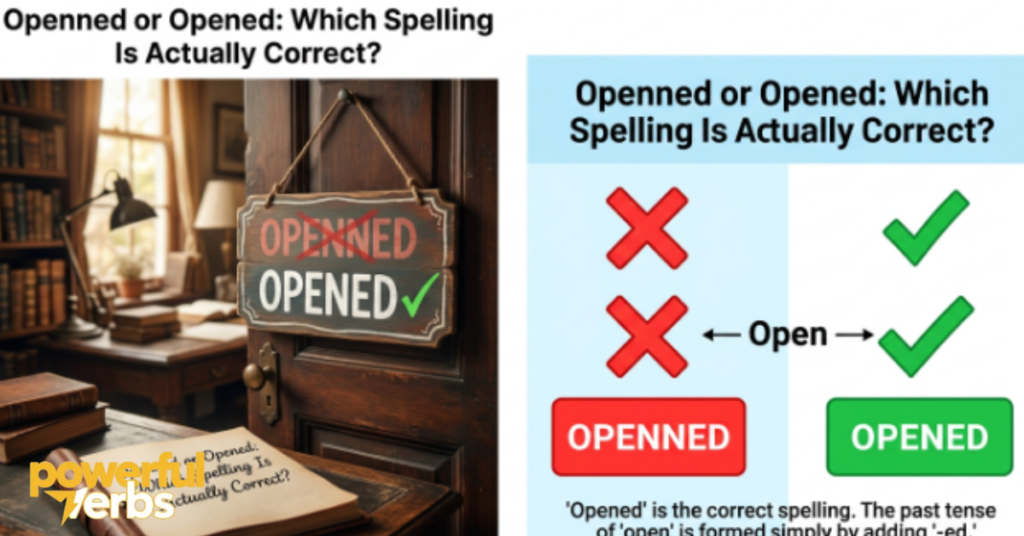
Have you typed “openned” in a text message or email and then stared at it, unsure if it looks right? You’re not the only one. This is one of the most common spelling slips in English, and it trips up native speakers and learners alike.
The good news is that the answer is short and the reasoning behind it is even shorter once you see the pattern. By the time you finish reading, you won’t second-guess this word again.
see also: Reinforce or Reenforce? Which Spelling Is Correct?
The Short Answer
Opened is the correct spelling. Openned does not exist in standard English and is always treated as an error.
Every major dictionary, style guide, and grammar checker recognizes only one version of this past-tense verb — and it has a single “n.”
What Does “Opened” Mean?
Opened is the simple past tense and past participle of the base verb open. Depending on context, it can describe:
- Removing something from a closed or sealed state
- Beginning or commencing an activity, event, or process
- Making a place, service, or opportunity available to others
- Revealing the contents or inside of something
Sample sentences:
- The librarian opened the doors at exactly nine o’clock.
- Our team opened the quarterly report with a summary of sales.
- He opened the jar after running it under hot water.
- The new bakery opened to a long line of customers.
Since open is a regular verb, it simply takes the standard past-tense suffix:
open + -ed = opened
No extra letters, no doubling — just the base word plus “-ed.”
Why Do So Many People Write “Openned” Instead?
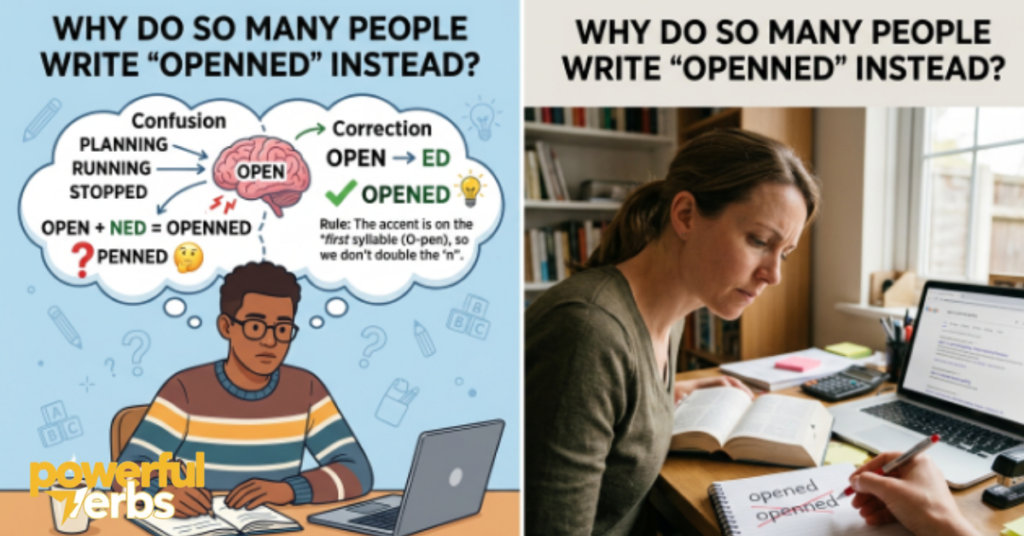
This mix-up isn’t random. It comes from a real (and partly correct) spelling instinct that gets misapplied.
In English, certain verbs do double their final consonant before adding a suffix like -ed or -ing. Familiar examples include:
- stop → stopped
- plan → planned
- grab → grabbed
- drop → dropped
Because these patterns are so common, writers sometimes assume open should behave the same way. But that assumption misses one important detail buried in the rule.
The Real Rule Behind Consonant Doubling
A final consonant is only doubled when both of these conditions are true:
- The word ends in a single vowel followed by a single consonant
- The stress (the emphasized syllable when you say it aloud) falls on that final syllable
Words like admit (ad-MIT) and refer (re-FER) meet both conditions, so they double: admitted, referred
But say the word open out loud: OH-pen. The emphasis sits on the first syllable, not the second. Because the stress doesn’t land on the final syllable, the doubling rule simply doesn’t apply.
That single difference in pronunciation is the entire reason “openned” feels tempting but is wrong.
A Quick Trick to Lock This In
If you ever pause mid-sentence, try this memory cue:
“Open” already sounds complete — it doesn’t need a second N to finish the job.
Or think of it this way: words that double their consonant (stopped, planned, dropped) are all short, one-syllable words. Open has two syllables with the stress up front, which instantly puts it in a different category.
Openned vs Opened at a Glance
| Spelling | Valid in English? | Function | Sample Use |
| Opened | Yes | Past tense / past participle of “open” | “She opened her laptop.” |
| Openned | No | Misspelling — not a recognized word | Always flagged as incorrect |
“Opened” in Real-World Contexts
Seeing the word used naturally across different settings makes the spelling stick.
Casual speech
- I opened the fridge and grabbed a snack.
- We opened all the windows to let some air in.
Workplace and business
- The branch opened ahead of schedule this year.
- Leadership opened the call by reviewing last month’s numbers.
Academic and formal writing
- The author opened the chapter with a historical overview.
- The panel opened the session for audience questions.
Texting and online use
- I opened your message but forgot to reply, sorry!
- They opened the thread and the replies poured in.
Mistakes Worth Watching For
A handful of habits tend to cause this error again and again:
- Typing fast and instinctively hitting the N key twice
- Assuming every short verb doubles its final letter before -ed
- Copying spelling from social media captions, which are often unedited
- Relying on “it looks correct” instead of the actual rule
Most spell-checking tools will catch “openned” immediately, but understanding why it’s wrong means you won’t need to rely on autocorrect at all.
Does British English Spell It Differently?
No. Unlike pairs such as colour/color or travelled/traveled, this word has zero regional variation. American English, British English, Australian English, and every other major variety all agree:
open → opened, with one N, every time.
So regardless of your audience — US readers, UK readers, or a global one — opened is the only acceptable form.
Other Forms of the Word “Open”
Recognizing the full word family helps the correct spelling feel automatic.
As a verb
- open (present)
- opened (past / past participle)
- opening (present participle / gerund)
As an adjective
- an open invitation
- an open mind
- an open road
As a noun
- playing in the open
- a grand opening
Notice that across every single form, the letter N appears only once. There’s no version of this word, in any tense or function, that carries a double N.
Useful Alternatives to “Opened”
Swapping in a synonym occasionally can make your writing feel more dynamic. Depending on the meaning you’re going for, try:
- unlocked
- launched
- began
- unveiled
- initiated
- revealed
- activated
- commenced
Example swap: Original — The CEO opened the conference with a keynote. Revised — The CEO launched the conference with a keynote.
Quick Self-Check
Pick the version that’s spelled correctly:
- “She openned the box and smiled.”
- “She opened the box and smiled.”
The second sentence is correct. If you picked it without hesitating, the rule has already clicked.
Why This Small Detail Actually Matters
A single misplaced letter might seem trivial, but spelling errors carry weight in ways many writers underestimate:
- They can undermine credibility in professional emails and reports
- They distract readers and slow down comprehension
- They can hurt how search engines and readers perceive content quality
- They signal a lack of proofreading, even when the underlying ideas are strong
Getting a common word like this right is a small effort with an outsized payoff for how polished your writing appears.
Conclusion
The confusion between openned and opened comes down to one simple detail: consonant doubling only happens when stress falls on the final syllable, and open doesn’t follow that pattern. Since the emphasis sits on “OH,” not “pen,” no extra letter is ever needed before adding “-ed.” This isn’t a sign of weak writing — it’s just a common instinct borrowed from words like stopped or planned that behave differently. Once you check where the stress falls, the correct spelling becomes second nature. Getting small details like this right builds trust with readers and keeps your writing looking polished. So the next time you pause while typing, you won’t need to guess.
Remember: one N is all you need — opened is correct, every time, everywhere.
see also: Targeted vs Targetted: Which Spelling Is Actually Correct?
FAQs
Is “openned” ever acceptable in any context?
No. It isn’t recognized in any dictionary or formal style guide and is always considered a typo.
Why doesn’t “open” follow the doubling rule like “stop” or “plan” does?
Because the stress in “open” falls on the first syllable, not the last, so the consonant-doubling rule doesn’t apply.
Is “open” a regular or irregular verb?
It’s regular — it simply adds “-ed” for both the past tense and past participle, with no spelling changes.
Can “opened” function as more than a verb?
Yes, it can act as part of a verb phrase (the shop is opened daily) or as a participial adjective (an opened envelope).
Will autocorrect always catch this mistake?
Usually, but not in every app, especially casual messaging platforms with limited spell-check support.
What’s an easy way to remember the correct spelling?
Picture the phrase “one open, one N” — it pairs the single syllable stress with the single consonant.

Liam Johnson is a dedicated language expert with 4 years of professional experience. He specializes in Grammar, Vocabulary, and Sentence structure.
