

If you have ever paused mid-sentence, stared at the screen, and wondered whether it’s “receive” or “recieve,” you are far from alone. This single word ranks among the most frequently mistyped words in the English language, tripping up students, professionals, and even native speakers in emails, resumes, and social media captions every single day.
The good news is that the confusion is easy to fix once you understand why it happens. In this guide, you’ll get a clear, no-nonsense answer, the linguistic reasoning behind the correct spelling, real-world usage examples, and memory tricks that make this mistake disappear for good.
see also: 1500+ Nouns List in English | With Meaning, Pictures & Free PDF
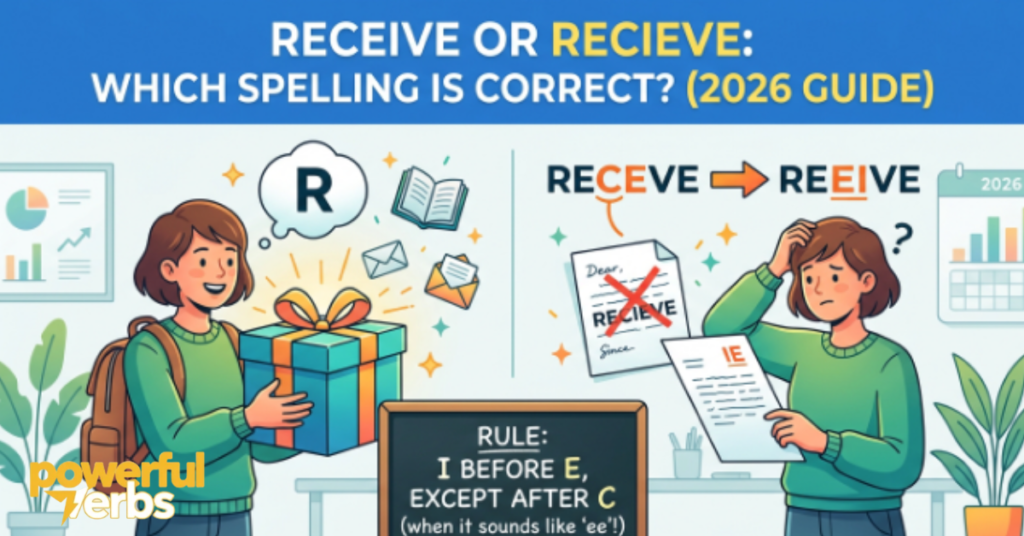
The Short Answer: Receive Is Correct
There is only one accepted spelling in standard English: receive. The version “recieve” is a typo, not an alternate spelling, a regional variant, or an informal shortcut. No dictionary, style guide, or English-speaking country recognizes it as valid. Correct: She will receive the package tomorrow. Incorrect: She will recieve the package tomorrow.
Whether you’re writing a casual text message or a formal business proposal, “receive” is the only version that belongs on the page.
Why So Many People Write “Recieve” by Mistake

Most spelling slip-ups don’t happen randomly — they follow a pattern, and “recieve” is a textbook example. English learners are often taught a famous shortcut early on: i before e, except after c. It’s catchy, easy to memorize, and genuinely useful for words like “believe,” “achieve,” and “thief.” The problem is that people misapply the rule in reverse when a word actually contains the letter c.
Because “receive” starts with the sound “ree-seev,” many writers instinctively place the i first, the same way they would in “believe” — forgetting that the presence of the letter c right before the vowel pair flips the order. The brain hears the sound pattern and types based on instinct rather than the actual spelling convention, and that’s where “recieve” sneaks in.
Autocorrect tools and spell-checkers usually catch this error instantly, which is part of why so many people don’t realize they’ve been spelling it wrong for years until they write without digital assistance — during an exam, a handwritten note, or a quick typed message on a device with autocorrect turned off.
The Spelling Rule, Explained Properly
The classic mnemonic deserves a closer look because it actually explains the entire mystery behind this word:
“I before E, except after C.”
In most English words, the i comes before the e. But when those two vowels follow the letter c, English flips the order so that e comes first. Since “receive” contains a c directly before the vowel pair, the correct order is e-i, giving you rec-e-i-ve.
This same rule governs other commonly confused words such as deceive, conceive, perceive, and ceiling — all of which follow a c with “ei” rather than “ie.” Recognizing this pattern across multiple words makes it far easier to internalize the correct order for receive specifically, instead of memorizing it as an isolated case.
Where the Word Receive Comes From
Tracing a word’s origin often makes its spelling click into place, and “receive” is no exception. The word descends from the Old French receivre, which itself comes from the Latin verb recipere — a combination of re- (back) and capere (to take or seize). Literally, the word once meant “to take back” or “to accept something given.”
Latin and French roots are responsible for a huge portion of irregular-looking English spellings, and “receive” is part of that inherited family. Understanding this history reinforces why the word doesn’t follow simpler phonetic spelling — it was shaped by centuries of borrowing rather than invented fresh in English.
American English vs. British English: Does It Change Anything?
Some English words split into two camps depending on the country — think “color” versus “colour,” or “center” versus “centre.” Receive is not one of them. Both American and British English, along with Canadian, Australian, and Indian English, use the exact same spelling.
| Region | Accepted Spelling | “Recieve” Accepted? |
| United States | receive | No |
| United Kingdom | receive | No |
| Canada | receive | No |
| Australia | receive | No |
| India | receive | No |
No matter your audience or location, there is zero ambiguity here — receive is universal.
Receive in All Its Forms
Spelling mistakes often multiply once a word changes tense or form, so it helps to see the full family at a glance.
| Form | Spelling | Example Sentence |
| Base form | receive | I receive client calls every morning. |
| Third-person singular | receives | He receives a paycheck every two weeks. |
| Past tense | received | They received the documents yesterday. |
| Present participle | receiving | We are currently receiving applications. |
| Noun (person) | receiver | The receiver signed for the delivery. |
| Noun (act) | reception / receipt | Please confirm receipt of this email. |
Every single one of these forms keeps the same “ei after c” pattern — there’s no version where the letters flip back to “ie.”
Other Words That Play the Same Trick
Once you understand why receive is spelled the way it is, a handful of other notorious words start making sense too. Words like deceive, conceive, perceive, and ceiling all share the same structural DNA: a hard c sound directly followed by the “ei” vowel combination. On the flip side, words like believe, achieve, relief, and friend don’t contain a c before the vowel pair, so they correctly follow the more common “ie” order.
Keeping a mental list of these “c-words” — deceive, conceive, perceive, receive, ceiling — can turn a confusing exception into a reliable, recognizable group.
Simple Tricks to Never Misspell It Again
A few memory aids can lock this spelling in permanently. Picturing the phrase “i before e, except after c” as a tiny rhyme often does the job on its own, but if you want something more visual, try associating the letter c with the idea of “cutting” the usual order — the c interrupts the normal ie pattern and forces it to flip.
Another trick that works well for visual learners is breaking the word into syllables while reading it aloud slowly: rec-EI-ve. Saying it this way, rather than rushing through the sound “ree-seev,” helps the brain associate the correct letter order with the correct pronunciation.
Typing the word a few extra times in a sentence you’ll actually use — like “Did you receive my message?” — also builds muscle memory far faster than memorizing the word in isolation.
Receive in Everyday Writing
Seeing the word in context makes the correct usage stick. Here’s how it naturally shows up across different types of writing:
In professional emails: “Please let me know once you receive the signed contract.”
In customer service: “Your order will arrive within five business days after we receive payment confirmation.”
In academic writing: “Students who submit their work late may receive a reduced grade.”
In casual conversation: “I can’t wait to receive my package — it’s been in transit for a week!”
In formal announcements: “All shortlisted candidates will receive an email with interview details by Friday.”
Notice that across every tone — formal, casual, professional — the spelling never changes. Context affects word choice and sentence structure, but never the correct letters in “receive.”
Quick Comparison at a Glance
| Spelling | Is It Correct? | Common Context |
| receive | Yes | Standard spelling for all uses |
| recieve | No | Typing error, avoid completely |
| recive | No | Missing letter, incorrect |
| receeve | No | Phonetic misspelling |
| received | Yes | Correct past-tense form |
| recieved | No | Incorrect past-tense form |
Final Thoughts
The difference between receive and recieve comes down to one small but important rule: i before e, except after c. Once that pattern is clear, the mistake becomes far less likely to creep back into your writing. Since both American and British English agree on this spelling, there’s no regional excuse to fall back on — receive is simply the only correct option, everywhere, every time.
Mastering small details like this one might seem minor, but consistent, error-free spelling builds credibility, whether you’re sending a job application, writing a blog post, or replying to a client. The next time your fingers hesitate before typing this word, remember: the c comes first, so the e leads the way.
see also: 200+ Adjectives to Describe Yourself | Unique Words for Every Situation
FAQs
Is “recieve” a real word in any dictionary?
No. It does not appear as a valid entry or alternate spelling in any major English dictionary.
Why does the “i before e” rule have an exception for c?
Historically, this pattern developed from how certain vowel sounds were pronounced and borrowed from French and Latin, settling into the “ei after c” pattern over time.
Is “receive” used differently in formal versus informal writing?
No, the spelling stays identical in every register — only sentence tone and structure change, not the word itself.
What’s an easy way to remember the correct order?
Say the word slowly as “rec-EI-ve” instead of rushing through the sound, and link it mentally with deceive, conceive, and perceive.
Does autocorrect always catch “recieve”?
Most modern spell-checkers flag it instantly, but handwriting, fast typing, or disabled autocorrect can still let the mistake slip through.
Are there exceptions where “ie” still follows c in English?
Yes, a few rare words like “science” and “species” don’t follow the rule, which is why it’s treated as a helpful guideline rather than an absolute law.

Liam Johnson is a dedicated language expert with 4 years of professional experience. He specializes in Grammar, Vocabulary, and Sentence structure.
