

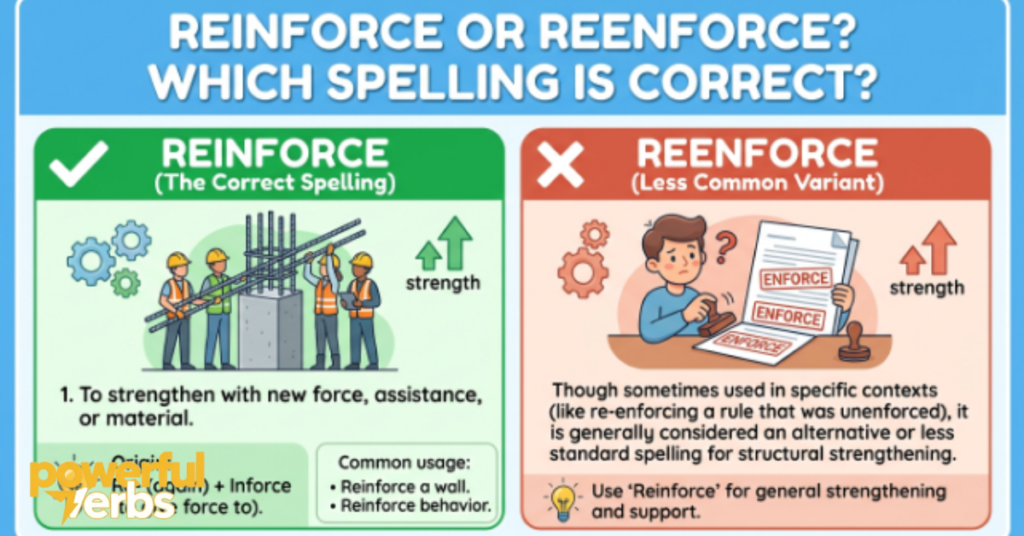
Have you typed “reenforce” in an email, then stared at it wondering if it actually looks right? You’re not the only one. This is one of the most common spelling mix-ups in English, and it trips up native speakers and learners alike. The good news is that the answer isn’t complicated at all — once you understand the logic behind it, you’ll never hesitate again.
This guide breaks down the real difference between reinforce and reenforce, explains why only one of them belongs in modern writing, and gives you practical tools — examples, synonyms, and memory tricks — so the correct spelling sticks for good.
see also: Combating vs Combatting: Which Spelling Are You Getting Wrong?
The Short Answer
Reinforce is the only spelling accepted in current English. Reenforce is a fossil — an old form that has essentially disappeared from everyday use and is treated as a misspelling by virtually every dictionary, editor, and grammar checker today.
If you remember nothing else from this article, remember this: write reinforce, every time, in every context.
Breaking Down the Word: What Reinforce Actually Means

At its core, reinforce describes the act of making something stronger, sturdier, or more solid — whether that “something” is physical, emotional, or conceptual.
- Physical strengthening: Steel cables reinforce the suspension bridge.
- Behavioral or psychological strengthening: Consistent praise reinforces a child’s confidence.
- Logical or argumentative strengthening: The new survey data reinforces the researcher’s hypothesis.
- Military or structural support: Additional troops were sent to reinforce the front line.
Notice how flexible the word is — it works equally well in engineering reports, psychology textbooks, debate essays, and casual conversation.
So Where Does “Reenforce” Come From?
Reenforce isn’t a made-up word — it genuinely existed in older English texts, back when writers were less consistent about merging prefixes with root words. Over time, English simplified, and “re” fused directly into “inforce” to create the smooth, single-vowel form we use today: reinforce.
Modern dictionaries that still list “reenforce” usually tag it as archaic or nonstandard, meaning you might stumble across it in century-old literature, but you should never reach for it in a blog post, a resume, an academic paper, or a business email.
Why Did Reinforce Win Out?
Language tends to favor whatever is easiest to read, write, and pronounce — and reinforce checks every box:
- It flows naturally without an awkward double vowel sound.
- It matches the pattern of related words built the same way.
- It’s instantly recognized by spellcheckers, search engines, and readers.
- It appears consistently across news outlets, textbooks, and style guides.
Reenforce, by contrast, just looks like a typo to the modern eye — and that’s exactly how most readers (and algorithms) will interpret it.
Reinforce vs Reenforce: Quick Comparison
| Aspect | Reinforce | Reenforce |
| Current usage | Standard and widely used | Virtually extinct |
| Dictionary status | Fully accepted | Listed as archaic/variant only |
| Spellcheck result | Passes | Flagged as an error |
| Found in formal writing | Constantly | Almost never |
| Reader impression | Polished, credible | Careless, outdated |
Is This an American vs British Spelling Thing?
No — and this is where a lot of confusion comes from. Unlike pairs such as color/colour or realize/realise, this isn’t a regional spelling split. Both American and British English settled on the exact same form.
- 🇺🇸 American English → reinforce
- 🇬🇧 British English → reinforce
- 🇨🇦 Canadian English → reinforce
- 🇦🇺 Australian English → reinforce
No matter which English-speaking audience you’re writing for, “reenforce” isn’t the regional alternative — it’s simply outdated everywhere.
Where Writers Go Wrong
A few habits explain why people keep typing reenforce by accident:
- They assume prefixes like “re-” always get tacked on separately, without adjusting the spelling underneath.
- They’ve seen the word in an old book or document and assumed it was a valid alternate spelling rather than an outdated one.
- They confuse it with words that genuinely do have a double-e pattern, like “preempt” or “reelect.”
- Autocorrect on some older or non-English-tuned keyboards occasionally lets it slip through.
None of these mix-ups change the meaning — they just chip away at how polished your writing looks.
Reinforce in Everyday Situations
Because reinforce is such a versatile verb, it shows up across almost every type of writing:
Construction & Engineering
- Builders reinforce the foundation before adding extra floors.
- The contractor reinforced the roof to handle heavy snow.
Education & Parenting
- Teachers reinforce good habits through repetition.
- Positive reinforcement helps reinforce a student’s motivation.
Business & Academic Writing
- The quarterly report reinforces the need for budget cuts.
- This study reinforces earlier findings on sleep and memory.
Everyday Conversation
- His apology reinforced how much he valued the friendship.
- Daily practice reinforces muscle memory.
Words That Mean the Same Thing
If you want to avoid repeating “reinforce” too often in your own writing — which also helps with readability and search engine variety — these related terms work as natural substitutes:
strengthen, fortify, bolster, solidify, support, back up, intensify, stabilize, cement, shore up
Example swap: “The findings strengthen the theory” reads just as naturally as “The findings reinforce the theory.”
A Simple Trick So You Never Mix It Up Again
Picture the word in three pieces: RE + IN + FORCE.
You’re putting force back into something. There’s only one “e” sitting right after the R — if you ever see a second one trying to sneak in there, that’s your signal something’s off.
Correct vs Incorrect, Side by Side
The new locks reenforce the door’s security.The new locks reinforce the door’s security.
Her confidence was reenforced by the positive feedback.Her confidence was reinforced by the positive feedback.
They reenforced the wall with extra concrete. They reinforced the wall with extra concrete.
Conclusion
The comparison between reinforce and reenforce isn’t really a debate — it’s a settled matter. Both forms once carried the same meaning, but only reinforce survived into modern, professional, everywhere-accepted English. Reenforce belongs in the history books, not your next document.
Make it a habit: every time your fingers start typing “reenforce,” pause and swap in reinforce instead. That one small correction instantly makes your writing look sharper, more credible, and more trustworthy to any reader — or search engine — that comes across it.
see also: Are Violet, Indigo, and Purple the Same Color? The Answer Will Surprise You
FAQs
Is reenforce a real word?
It existed historically, but it’s considered obsolete now. Modern English recognizes only reinforce as correct.
Does reenforce mean something different from reinforce?
No, the meanings are identical. The only difference is that one spelling is current and the other is outdated.
Will Google or Word flag reenforce as wrong?
Yes, most spellcheckers and search engines treat it as a misspelling and will suggest reinforce instead.
Is reenforce used in British English specifically?
No, both American and British English use reinforce exclusively. There’s no regional version with the double “e.”
Can reinforce be used as a noun?
Rarely, but the related noun form “reinforcement” is far more common, as in military or behavioral reinforcement.
What’s an easy way to remember the correct spelling?
Break it into re + in + force, and remember there’s only one “e” right after the R.

Liam Johnson is a dedicated language expert with 4 years of professional experience. He specializes in Grammar, Vocabulary, and Sentence structure.
