

If you’ve ever paused mid-sentence wondering whether to write afterward or afterwards, you’re not alone. These two words trip up even confident English writers because they look almost identical, sound the same, and mean exactly the same thing. So why do both exist, and does it actually matter which one you pick?
The short answer: it comes down to which version of English you’re writing in. The longer answer — including the grammar rules, regional patterns, and real usage examples — is what this guide covers in full.
see also: 1500+ Daily Use English Sentences for Everyday Conversations
Quick Answer
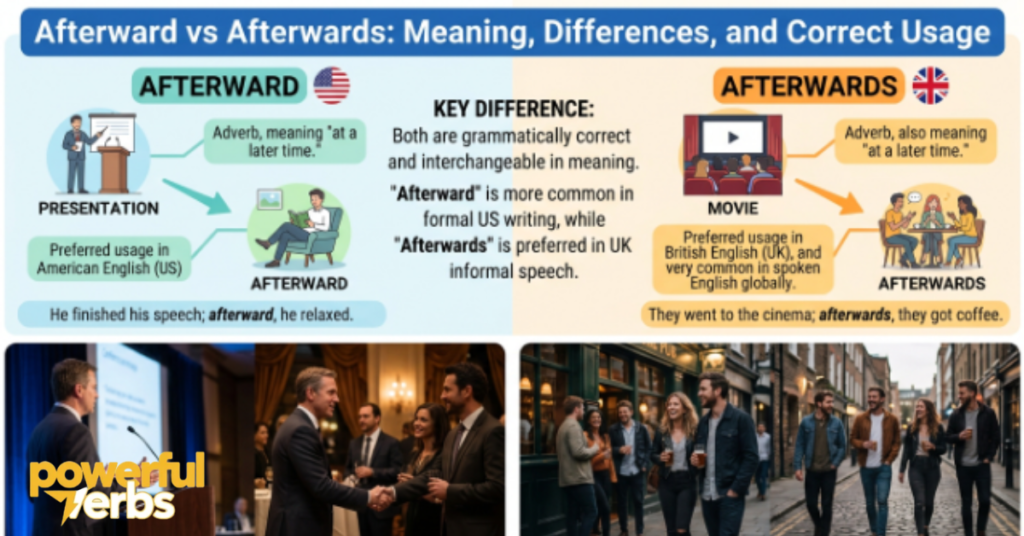
Afterward and afterwards are both adverbs that describe something happening at a later point in time, after an event has already taken place. They are 100% interchangeable in meaning. The only real distinction is geographic:
- Afterward → standard in American English
- Afterwards → standard in British, Canadian, and Australian English
Neither word is “more correct” than the other. Your audience and writing style guide decide which one fits.
What Does “Afterward” Mean?
Afterward functions as an adverb of time. It signals that an action or event occurs after something else has already happened. It’s the preferred form across the United States, showing up consistently in American newspapers, business writing, textbooks, and everyday conversation.
Example:
- We grabbed coffee and talked for an hour afterward.
What Does “Afterwards” Mean?
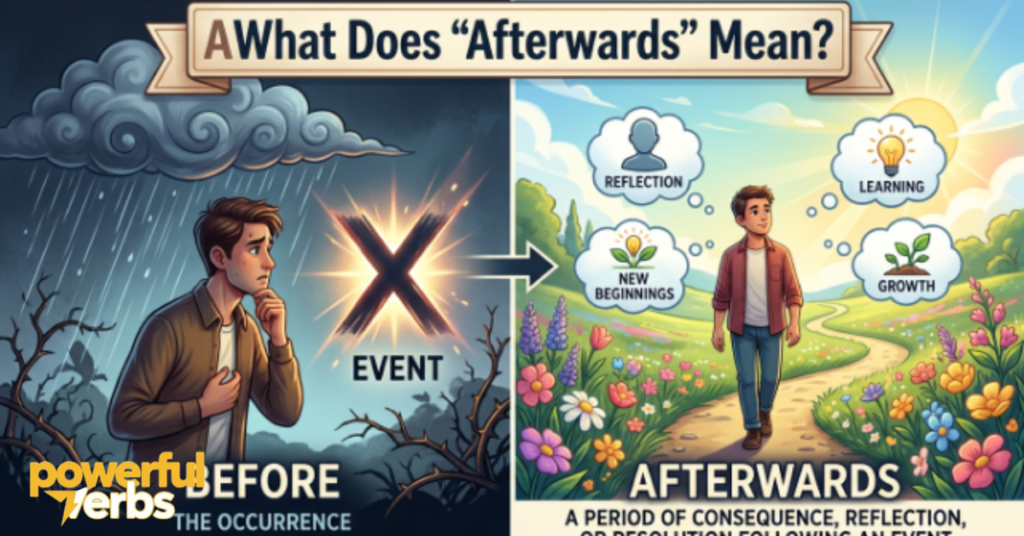
Afterwards carries the identical meaning — at a later time, following an event — but it’s the form favored outside the U.S., particularly in the UK, Ireland, Canada, Australia, and New Zealand. You’ll spot it regularly in British novels, news outlets, and academic publications.
Example:
- The lecture ran long, and afterwards everyone headed straight to the cafeteria.
Afterward vs Afterwards: Key Differences at a Glance
| Feature | Afterward | Afterwards |
| Meaning | Later, following an event | Later, following an event |
| Region | American English | British/Commonwealth English |
| Part of speech | Adverb | Adverb |
| Formality | Equally formal | Equally formal |
| Interchangeable? | Yes | Yes |
Both words come from the same root — Old English “æftanweard” — and evolved along slightly different paths in American and British usage over the centuries, which is why the spelling split exists today.
American English vs British English: Why the Split Happened
This isn’t an isolated case. English has plenty of word pairs that diverged after American and British English began evolving separately — think toward/towards, forward/forwards, and backward/backwards. In each pair, American English typically drops the final “s,” while British English keeps it. Afterward/afterwards simply follows that same historical pattern.
This pattern is worth remembering because it applies beyond just this one word — once you know the rule, you can predict the regional spelling for similar adverbs too.
Grammar Rules: How to Use Afterward and Afterwards Correctly
Both words are adverbs, which means they modify a verb by adding information about when something happens. A few rules to keep in mind:
- They typically appear at the end or beginning of a sentence, rarely in the middle.
- They cannot take an object — you wouldn’t say “afterward the meeting,” you’d say “after the meeting” (using the preposition “after” instead).
- They don’t change form for tense, number, or subject.
Correct: She apologized and left afterward. Incorrect: She apologized afterward the argument. (Use “after,” not “afterward,” when a noun follows.)
Afterward/Afterwards vs “After”: Don’t Mix Them Up
This is one of the most common errors learners make. After is a preposition or conjunction that connects to a noun or clause (“after the show,” “after he left”). Afterward/afterwards stands alone as an adverb and never directly precedes a noun.
- He felt better after the medicine kicked in.
- He felt better afterward.
- He felt better afterward the medicine kicked in.
Common Mistakes to Avoid
- Assuming one form is wrong. Both afterward and afterwards are grammatically valid; neither is slang or informal.
- Switching between the two in the same document. Inconsistency looks careless, even though it isn’t technically incorrect. Pick one and stay consistent throughout an essay, email, or article.
- Confusing it with “after.” Remember: “after” needs a noun or clause; “afterward(s)” stands alone.
- Overusing the word entirely. Sometimes the timeline is already clear from context, and adding “afterward” is redundant.
Real-World Examples
Afterward (American English)
- The team finished the project and celebrated afterward.
- He reviewed his notes and felt confident afterward.
- The storm passed, and the streets were quiet afterward.
- She signed the contract and called her lawyer afterward.
Afterwards (British English)
- The match ended in a draw, and the fans cheered afterwards.
- They toured the museum and had tea afterwards.
- The interview went smoothly, and she felt relieved afterwards.
- He gave the speech and took questions afterwards.
Synonyms and Related Phrases
If you want to vary your sentences or avoid repeating the same word, these alternatives carry a similar meaning:
- Subsequently
- Later on
- Thereafter
- Following that
- In due course
- After that point
- Eventually
- Once that was done
Mixing in synonyms like these can make your writing feel more natural, especially in longer pieces where “afterward” or “afterwards” might otherwise repeat too often.
Which One Should You Use?
Ask yourself one question: who is reading this?
- Writing for a U.S. audience, American publication, or following AP/Chicago style → use afterward.
- Writing for a UK, Canadian, Australian, or international audience following Oxford or British style conventions → use afterwards.
- Unsure of your audience? Either is acceptable — just stay consistent across the entire piece.
Tips to Remember the Difference
- Link the “s” in afterwards to other British “s” forms like towards and backwards.
- Think of afterward as the shorter, American version — Americans tend to trim the “s” off this whole family of words.
- When editing, use “Find” to check your document for both spellings — if you spot both, standardize to one.
Conclusion
Afterward and afterwards mean exactly the same thing — there’s no hidden nuance, no difference in formality, and no grammatical advantage to either one. The choice is purely regional: afterward leans American, afterwards leans British. The real skill isn’t memorizing which is “correct,” but staying consistent within your own writing and matching your audience’s expectations. Once you internalize that, this small grammar question stops being confusing for good.
see also: Practical Uses of Is, Am, and Are with Examples in English
FAQs
Is afterward or afterwards more formal?
Neither is more formal than the other. Both are fully acceptable in professional, academic, and casual writing — the difference is regional, not a matter of formality.
Can I use afterward and afterwards in the same document?
You can, but it’s not recommended. Mixing the two makes your writing look inconsistent. Pick one based on your audience and stick with it throughout.
Does Microsoft Word or Grammarly flag one as incorrect?
Some tools may flag whichever form doesn’t match your selected language setting (e.g., English UK vs. English US), but both spellings are grammatically valid worldwide.
Is “afterwards” used in American English at all?
It’s rare but not unheard of, especially in casual speech or when influenced by British media. Formal American writing, however, almost always uses “afterward.”
What’s the difference between “after” and “afterward”?
“After” is a preposition or conjunction that needs a noun or clause attached to it. “Afterward” is a standalone adverb that doesn’t take an object.
Which form should I use for SEO or blog content?
If your audience is primarily American, use “afterward” for consistency with search intent. For UK or international audiences, “afterwards” usually performs better and feels more natural to readers.

Liam Johnson is a dedicated language expert with 4 years of professional experience. He specializes in Grammar, Vocabulary, and Sentence structure.
