

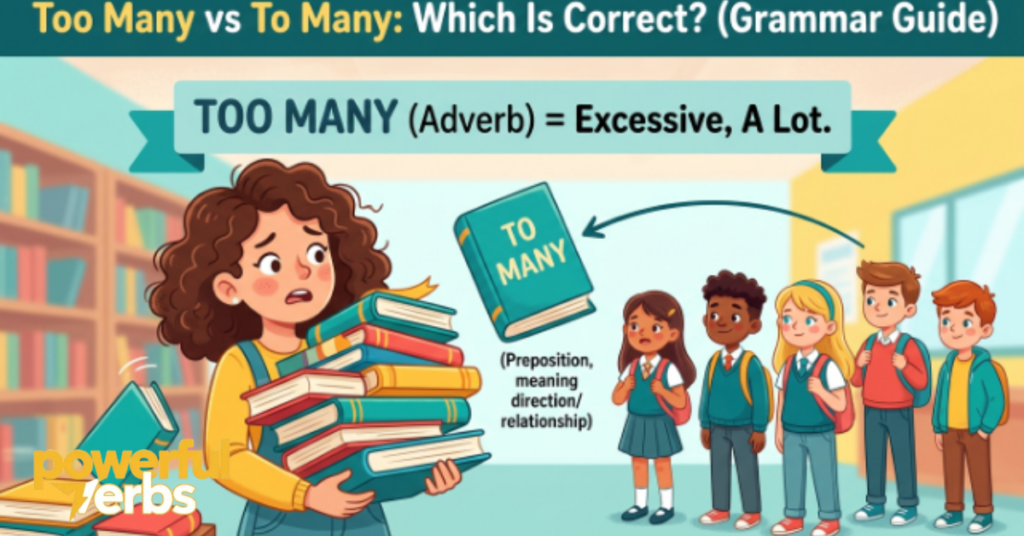
If you’ve ever paused mid-sentence wondering whether to type “too many” or “to many,” you’re not alone. This is one of the most common homophone mix-ups in English writing, and it trips up native speakers and learners alike. The good news is that the rule is straightforward once you understand the difference between these two soundalike words.
In this guide, you’ll learn exactly when to use “too many,” why “to many” is almost never the right choice, and how to permanently fix this grammar mistake in your writing.
see also: What Does BFFR Mean in Text Messages? Full Meaning, Usage & Examples
Quick Answer
“Too many” is the grammatically correct phrase. It functions as a quantifier that describes an excessive or unnecessary number of countable items. “To many” is not a standard grammatical construction — it only appears correctly in rare cases where “to” is a preposition followed by the adjective “many” used as a pronoun (for example, “She gave gifts to many of her friends”). In everyday usage about quantity, “to many” is simply a spelling slip.
Why “Too” and “To” Get Confused
English is full of homophones — words that sound identical but carry different meanings and spellings. “Too” and “to” are a classic example, and the confusion usually comes down to three things:
- They are pronounced exactly the same way in spoken English
- Autocorrect and fast typing often skip the extra “o”
- Many learners memorize sounds before they memorize spelling rules
Understanding the distinct function of each word is the fastest way to stop mixing them up for good.
Breaking Down the Grammar: What “Too” Actually Does
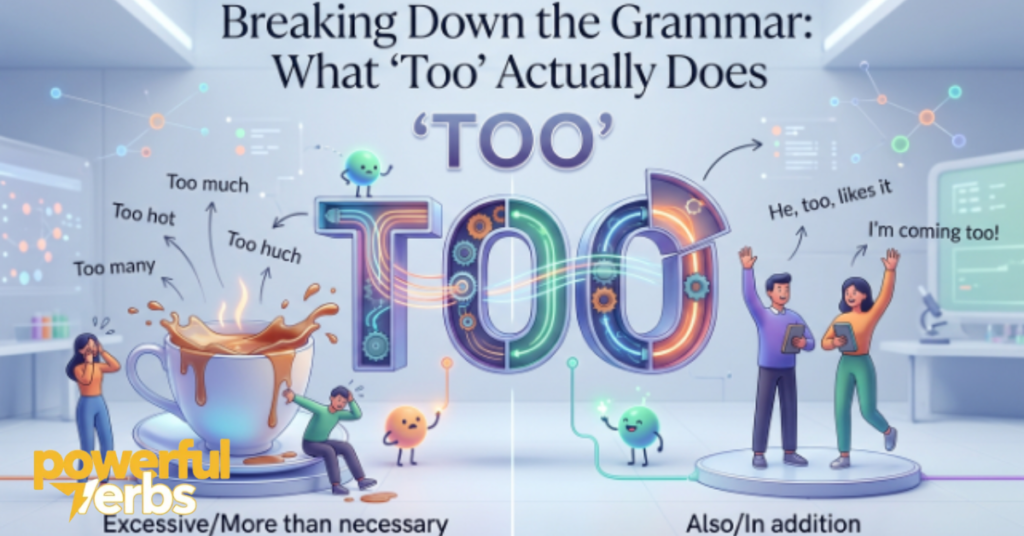
The word “too” is an adverb that intensifies or modifies another word. It signals excess, surplus, or “also.” When “too” is placed before “many,” it builds a quantifier phrase meaning more than what is needed, wanted, or acceptable.
The word “to,” on the other hand, is a preposition or an infinitive marker. It shows direction, purpose, or connection — as in “go to the store” or “want to learn.” It does not carry any meaning of excess on its own, which is exactly why it cannot stand in for “too” when you’re talking about quantity.
So whenever your sentence is about how many of something exists or happens, “too many” is the structure you need.
Too Many vs Too Much vs Too Few: Knowing the Difference
A big part of mastering “too many” is understanding how it relates to its sibling phrases — “too much” and “too few.”
Too many pairs with countable nouns — things you can put a number in front of, like chairs, emails, mistakes, or deadlines.
Too much pairs with uncountable nouns — things that can’t be split into individual units, like water, advice, patience, or traffic.
Too few is the opposite of “too many.” It describes a shortage rather than an excess, as in “too few volunteers signed up.”
A simple memory trick: if you can count it one by one, reach for “many.” If it flows or exists as a mass, reach for “much.”
A Fast Way to Test Countable vs Uncountable Nouns
Not sure whether a noun is countable? Try this quick test before choosing between “too many” and “too much”:
- Can you place a number directly in front of it (three books, ten messages)? If yes, it’s countable — use too many.
- Does it sound odd with a number (three waters, ten honesty)? If yes, it’s uncountable — use too much.
- Does the noun have a natural plural form (book/books, idea/ideas)? Countable nouns almost always do.
This test works for the vast majority of everyday nouns and removes the guesswork instantly.
“Too Many” in Real Sentences
Seeing the phrase in context makes the rule stick. Here are natural examples:
- The inbox had too many unread emails by Monday morning.
- There were too many cooks in the kitchen for such a small space.
- She turned down the project because she already had too many commitments.
- Too many late nights left him exhausted by the weekend.
- The report contained too many unnecessary details.
Notice that every noun here — emails, cooks, commitments, nights, details — can be counted individually.
Where “To Many” Goes Wrong
The phrase “to many” usually shows up as a typing error in sentences that were actually meant to express excess. Here’s how the mistake typically plays out:
- He sent the invite to many people by mistake → in this version, “to many” is technically correct grammar because “many” describes “people” receiving the invite directly.
- There are to many problems with this plan → should be too many problems, since the sentence is expressing excess, not direction.
- I have to many things on my schedule → should be too many things, because the meaning is “an excessive number of things.”
The pattern to watch for: if removing “many” still leaves a complete, sensible sentence about direction or destination (“sent it to people”), then “to” might be correct. If the sentence is really about quantity being excessive, you need “too.”
Side-by-Side Comparison
| Phrase | Function | Correct Usage | Example |
| Too many | Quantifier showing excess | Always correct for countable excess | Too many tabs open on my browser |
| To many | Preposition + adjective/pronoun | Rare, only for direction/distribution | He spoke to many students today |
| Too much | Quantifier for uncountable excess | Correct for mass nouns | Too much pressure at work |
Common Mistakes Even Experienced Writers Make
- Swapping “too” and “to” simply because of identical pronunciation
- Applying “too many” to uncountable nouns (saying “too many information” instead of “too much information”)
- Forgetting that “many” must always be followed by a plural noun, never a singular one
- Relying purely on spell-check, which won’t catch this error since both words are spelled correctly — just used incorrectly
Practical Tips to Never Mix Them Up Again
Read your sentence out loud and ask whether you’re describing an excessive amount. If yes, the word needs that extra “o.”
Replace “too” mentally with “excessively” or “overly.” If the sentence still makes sense, “too many” is correct.
Remember the visual cue: the extra “o” in “too” mirrors the idea of “one more than enough” — a small trick that helps the spelling stick.
Proofread a second time specifically for “to/too/two” errors, since these are easy to miss even after a full read-through.
Conclusion
The difference between “too many” and “to many” comes down to function, not sound. “Too many” expresses an excessive, countable quantity and is the phrase you’ll need in almost every situation involving numbers, amounts, or overload. “To many” only works in the rare case where “to” is genuinely showing direction or connection, separate from any idea of excess.
Once you internalize this distinction, the mistake becomes easy to catch — whether you’re writing a quick text message or polishing a professional document.
see also: 600+ Positive Nouns that Start with A with Examples (Complete Guide)
FAQs
Is “to many” ever grammatically correct?
Yes, but only when “to” functions as a preposition showing direction, such as “she spoke to many guests.” It’s incorrect when describing excess quantity.
What part of speech is “too” in “too many”?
“Too” is an adverb here, intensifying the quantifier “many” to show excess.
Can “too many” be used with uncountable nouns?
No. Uncountable nouns require “too much” instead, such as “too much sugar” rather than “too many sugar.”
Why do spell-checkers miss this error?
Both “to” and “too” are correctly spelled words, so spell-check tools see no spelling mistake — only grammar context reveals the error.
Is there a simple memory trick for this rule?
Yes — think of the extra “o” in “too” as representing “one too many,” a visual reminder of excess.
Does this rule change in formal versus casual writing?
No. “Too many” follows the same rule in both formal and informal English; only “to many” used for direction changes by context, not formality.

Liam Johnson is a dedicated language expert with 4 years of professional experience. He specializes in Grammar, Vocabulary, and Sentence structure.
