

You’re typing a sentence, you reach the word “itself,” and suddenly you freeze. Is it one word? Two words? Does it need an apostrophe? This tiny hesitation trips up far more writers than you’d expect — including people who are otherwise confident in their English.
The truth is, this mix-up isn’t really about vocabulary. It’s about understanding how reflexive pronouns work, and once that clicks, you’ll never second-guess yourself again. This guide walks through the real grammar behind “itself” and “its self,” when each one belongs in a sentence, and how to avoid the small errors that quietly make writing look unpolished.
Why “Its Self” Looks Right (But Almost Never Is)
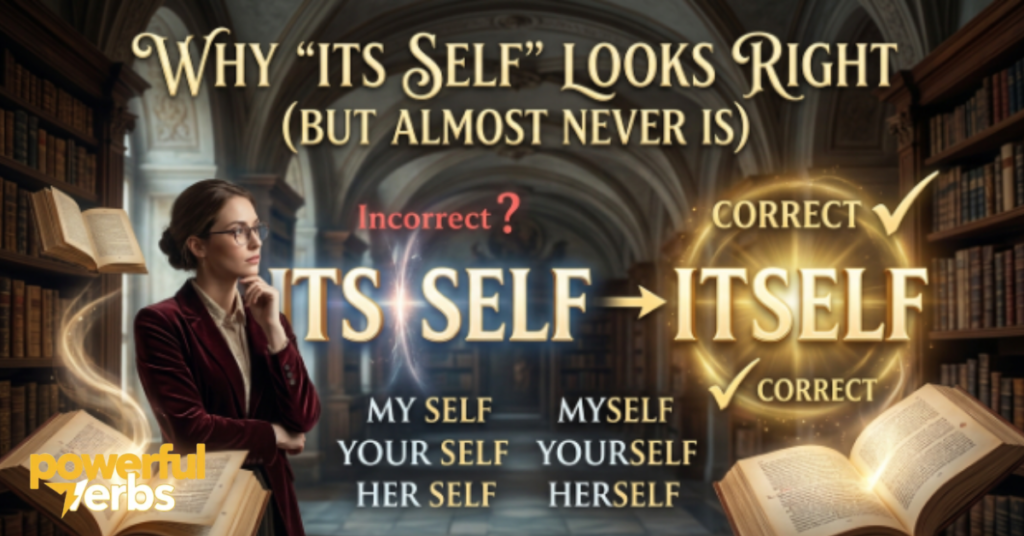
The confusion makes total sense once you break it down. Both words start with “its,” apostrophes in “its” and “it’s” already cause headaches on their own, and older English texts genuinely did write reflexives as two separate words. Add to that the fact that “self” is a real, standalone noun in English, and your brain naturally assumes “itself” must be valid too.
It mostly isn’t — but understanding why is what separates confident writers from hesitant ones.
What Reflexive Pronouns Actually Do
A reflexive pronoun sends the action of a sentence back to its own subject. English has a fixed, compact set of these — and “itself” is the only one assigned to the pronoun “it.”
| Subject | Reflexive Form |
| I | myself |
| you | yourself |
| he | himself |
| she | herself |
| it | itself |
| we | ourselves |
| they | themselves |
Notice the pattern: every reflexive pronoun in modern English is written as one solid word. “Its self,” written as two separate words, simply doesn’t fit that pattern — which is the core reason it reads as incorrect.
Itself: The Only Reflexive Form English Recognizes for “It”
You’ll reach for “itself” in three main situations:
- When something performs an action on itself
- When you want to add emphasis to a subject
- When the subject is non-human, an object, or a concept
Examples:
- The thermostat adjusts itself based on room temperature.
- The startup rebuilt itself after a rocky first year.
- The argument itself was solid, even if the delivery wasn’t.
Read these out loud and notice how naturally “itself” fits. That smoothness is exactly why it’s the standard, universally accepted form in modern grammar.
When “Its Self” Actually Shows Up (Rare but Real)
Here’s the twist most learners never hear about: “its self” isn’t always wrong — it’s just almost never reflexive. In specific contexts, “self” functions as its own noun, meaning identity, essence, or inner being. When that happens, “its” simply works as an ordinary possessive pronoun modifying that noun.
You’ll mostly find this usage in psychology, philosophy, or spiritual writing.
Examples:
- The organism gradually develops a sense of its self, distinct from its environment.
- The culture struggles to preserve its self amid rapid modernization.
- The character searches for itself throughout the story’s arc.
In every one of these, “self” could be swapped for “identity” or “core nature” without changing the meaning — a useful test for spotting this rare case.
Its vs. It’s vs. Itself: Solving the Triple Confusion
These three words sound nearly identical out loud, yet they serve completely different grammatical roles.
| Word | Function | Example |
| its | possessive pronoun | The company raised its prices. |
| it’s | contraction (it is / it has) | It’s been a long week. |
| itself | reflexive pronoun | The dog hurt itself jumping off the couch. |
A simple way to separate them: if you can substitute “it is” or “it has” and the sentence still makes sense, you need the apostrophe. If the sentence describes ownership, drop the apostrophe entirely.
Why Possessive “Its” Never Takes an Apostrophe
This trips up even experienced writers, but the logic is straightforward. English possessive pronouns — his, hers, theirs, ours — never use apostrophes, and “its” follows that exact same family pattern.
| Pronoun | Possessive | Reflexive |
| he | his | himself |
| she | her | herself |
| they | their | themselves |
| it | its | itself |
If you wouldn’t write “the dog wagged it’s tail,” you shouldn’t write “his’ tail” either — and recognizing that parallel makes the rule far easier to remember.
Three Quick Tests to Never Get This Wrong Again
- The substitution test — swap “it’s” for “it is.” If the sentence still works, the apostrophe stays.
- The ownership test — if something belongs to “it,” the answer is “its,” no apostrophe needed.
- The reflexive test — if the subject is acting on or referring back to itself, “itself” is correct.
Running a sentence through these three filters takes only a few seconds and eliminates nearly every mistake on this topic.
Real Examples: Wrong vs. Right Side-by-Side
| Context | Incorrect | Correct |
| Everyday speech | The cat groomed it’s self. | The cat groomed itself. |
| Business writing | The brand reinvented it’s self this year. | The brand reinvented itself this year. |
| Texting | Its raining outside. | It’s raining outside. |
| Academic writing | The system corrects it self automatically. | The system corrects itself automatically. |
| Marketing copy | The app updates it’s self overnight. | The app updates itself overnight. |
A Real-World Example of How One Error Changes Perception
A SaaS company once published an ad headline reading “Reinventing Its Self.” Readers assumed it was a typo, and several commenters questioned whether the brand could be trusted with something as basic as grammar. After the copy was corrected to “Reinventing Itself,” engagement on the same campaign noticeably improved.
The lesson is simple: a single misplaced space can shift how polished — or careless — your writing appears to a reader within seconds.
Common Mistakes Writers Make (And How to Fix Each One)
- Splitting the reflexive pronoun into two words — ❌ The robot powered it self down. → ✅ The robot powered itself down.
- Confusing possession with reflexive meaning — ❌ The team improved it’s self this season. → ✅ The team improved itself this season.
- Dropping the apostrophe in contractions — ❌ Its been a great year. → ✅ It’s been a great year.
- Adding an apostrophe to the possessive form — ❌ The company changed it’s strategy. → ✅ The company changed its strategy.
- Using “its self” outside identity-related contexts — reserve this phrasing strictly for discussions of essence, being, or inner nature.
The One Rule That Settles This Permanently
If the subject is acting on or referring back to itself — use itself. If something belongs to “it” — use its. If you mean “it is” or “it has” — use it’s. If you’re discussing identity, essence, or inner being as a standalone concept — and only then — its self may apply.
Keep these four lines in mind, and this entire grammar puzzle stops being a puzzle.
see also: “Shown” or “Showed”? Past Tense vs Past Participle Explained Simply
FAQs
Is “itself” ever correct in English?
Rarely. It only applies when “self” is used as a standalone noun meaning identity or essence, not as a reflexive pronoun.
What is the standard reflexive form of “it”?
“Itself” — written as one word — is the only recognized reflexive pronoun for “it” in modern English.
How do I tell “its” and “it’s” apart quickly?
Try replacing the word with “it is.” If the sentence still makes sense, use “it’s”; otherwise, use “its.”
Why doesn’t “its” have an apostrophe like “it’s” does?
Because “its” is a possessive pronoun, and possessive pronouns in English — like “his” and “her” — never take apostrophes.
Can “its self” and “itself” mean the same thing?
Almost never. “Itself” reflects an action back onto the subject, while “its self” refers to an inner identity or essence.
What’s the fastest way to avoid this mistake while writing?
Run the sentence through the substitution, ownership, and reflexive tests — together they catch nearly every error in seconds.
Final Thoughts
The difference between “itself” and “its self” comes down to recognizing what role the word is playing — reflexive pronoun or standalone noun. In well over 99% of everyday writing, “itself” is the form you need.
Keep the core rule in mind, run a quick mental test when you’re unsure, and this small grammar detail will stop being something you have to think twice about.

Liam Johnson is a dedicated language expert with 4 years of professional experience. He specializes in Grammar, Vocabulary, and Sentence structure.
