

If you’ve ever typed “countrys” and then paused, wondering if it looked wrong — your instinct was right. This is one of the most common plural spelling mistakes in English, and once you understand the simple rule behind it, you’ll never second-guess it again.
The correct spelling is “countries.” The form “countrys” is not a recognized English word and should never appear in writing. Let’s break down exactly why this happens, the rule that governs it, and how to make this correction permanent in your memory.
see also:Rapport or Rapport? The Spelling Mistake Costing You Credibility
Why This Mixup Happens So Often

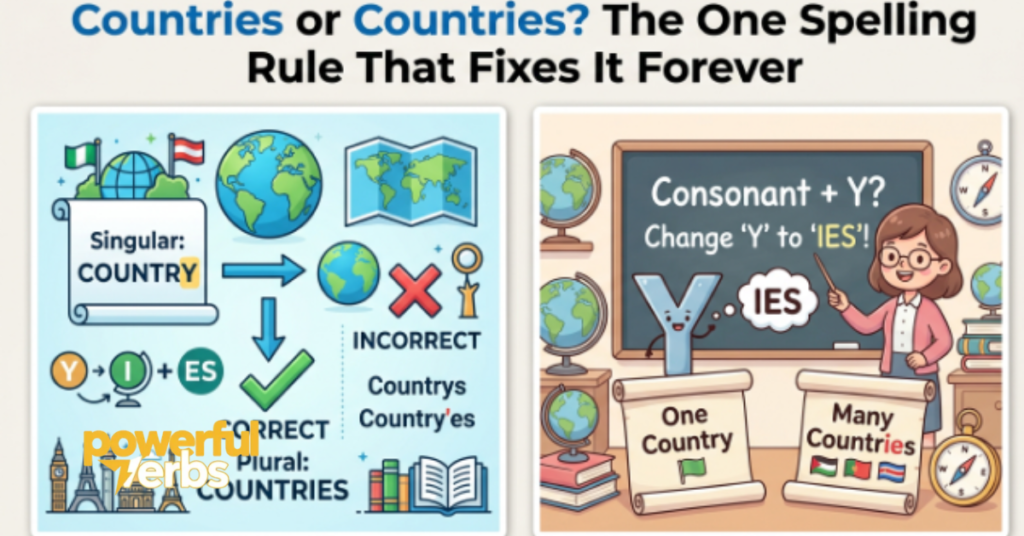
Most people assume plurals are formed by simply adding an “s” to the end of a word. That works for thousands of English nouns — but not for words that end in a consonant followed by “y.”
“Country” falls into that exact category. Adding “s” gives you the incorrect “countries,” while following the proper rule gives you “countries” — the only form accepted in dictionaries, textbooks, and professional writing.
The Spelling Rule Behind “Countries”
When a noun ends with a consonant directly before the letter “y,” English requires you to:
- Drop the “y”
- Add “ies” in its place
This single rule explains why so many common nouns shift their spelling in the plural form:
- country → countries
- city → cities
- party → parties
- family → families
- baby → babies
“Country” simply follows the same transformation. There’s no exception, no special case — just one consistent pattern.
What Does “Countries” Actually Mean?
“Countries” is the plural of “country,” referring to two or more nations, each with its own government, borders, and population.
Examples in context:
- Countries around the globe observe different national holidays.
- Several countries signed the trade agreement this year.
- Many countries share borders with more than one neighboring nation.
Anytime you’re referring to more than a single nation, “countries” is the word you need.
Countries vs Countries — Quick Comparison
| Aspect | Countries | Countrys |
| Correct spelling | Yes | No |
| Found in dictionaries | Yes | No |
| Accepted in formal writing | Yes | No |
| Follows English plural rules | Yes | No |
| Example sentence | “Many countries trade together.” | Not valid usage |
Why “Countrys” Breaks the Rules
“Countrys” assumes the basic “add an s” pattern applies here, but it ignores the consonant-plus-y rule entirely. Because of that, the word fails to appear in any standard dictionary and is treated as a spelling error in every style guide, from academic writing to casual content.
A Simple Trick to Remember It Forever
Here’s a mental shortcut that locks the rule into memory instantly:
If “city” becomes “cities,” then “country” becomes “countries.”
Both words end in a consonant plus “y,” so they transform the exact same way. Once you connect the two in your mind, you’ll spell “countries” correctly without even thinking about it.
Singular vs Plural — Country and Countries Compared
Understanding when to use each form prevents confusion in everyday writing:
Singular — Country
- A country has its own laws and government.
- That country is known for its mountains.
Plural — Countries
- Many countries share a common language.
- Several countries border the same coastline.
Use “country” for one nation, and “countries” the moment you’re referring to more than one.
Where “Countries” Shows Up Most Often
This word appears constantly across different fields of writing and conversation:
Travel: “I’d love to visit ten more countries before I turn thirty.”
News and politics: “Countries are negotiating new climate commitments this year.”
Education: “Students study the geography of different countries in school.”
International trade: “Countries exchange goods and resources through global trade agreements.”
Diplomacy: “Countries often form alliances to strengthen mutual security.”
Because the word touches so many topics — geography, politics, economics, and education — getting the spelling right matters more than most people realize.
Other Words That Follow the Same Pattern
Once you understand the rule behind “countries,” you’ll automatically spell several other tricky plurals correctly:
- lady → ladies
- story → stories
- puppy → puppies
- factory → factories
- memory → memories
All of these nouns end in a consonant plus “y,” so they all follow the identical drop-the-y, add-ies transformation.
Common Mistakes to Watch For
| Incorrect | Correct |
| Many countrys joined the summit. | Many countries joined the summit. |
| Several countrys signed the deal. | Several countries signed the deal. |
| Different countrys have different customs. | Different countries have different customs. |
These slip-ups usually happen when writing quickly or when English isn’t someone’s first language — but the fix is the same every time: swap the “y” for “ies.”
How Context Changes the Meaning
Singular and plural forms shift the entire meaning of a sentence:
- “This country has strict immigration laws.” → refers to one nation.
- “These countries have strict immigration laws.” → refers to multiple nations.
Paying attention to context helps you instantly choose the correct form without hesitation.
Why Getting This Right Matters
Spelling accuracy shapes how credible your writing looks, especially in professional, academic, or published content. Compare these two sentences:
- “Many countries participated in the summit.” — correct and polished.
- “Many countrys participated in the summit.” — incorrect and unpolished.
The first instantly reads as professional. The second pulls attention away from your message and toward the mistake itself.
conclusion
Whenever you’re referring to more than one nation, the correct word is always countries, never “countries.” This isn’t a stylistic preference — it’s a fixed grammar rule that applies to every consonant-plus-y noun in English. The moment you connect “country” to familiar words like “city” and “party,” the pattern becomes second nature. Remember the simple shortcut: drop the y, add ies, and the spelling takes care of itself. Apply this rule consistently, and you’ll also avoid mistakes with related words like “cities,” “babies,” and “families.” With this one rule locked into memory, your writing will read as more accurate, more polished, and more professional from this point forward.
see also: SFS Meaning in Text: What It Stands For on Instagram, Snapchat & TikTok
FAQs
Is it “countrys” or “countries”?
“Countries” is the only correct spelling. “Countrys” is a common but incorrect form.
Why does “country” change to “countries” in plural form?
Because it ends in a consonant followed by “y,” and English rules require changing the “y” to “ies” in such cases.
Is “countrys” ever acceptable in casual writing?
No, it’s considered a spelling mistake in all contexts, formal or casual.
What is the singular form of “countries”?
The singular form is “country,” referring to a single nation.
Do other English words follow the same spelling rule?
Yes, words like “city,” “party,” and “family” follow the identical consonant-plus-y to “ies” pattern.
How can I remember the correct spelling easily?
Connect it to a familiar word — if “city” becomes “cities,” then “country” becomes “countries” the same way.

Liam Johnson is a dedicated language expert with 4 years of professional experience. He specializes in Grammar, Vocabulary, and Sentence structure.
