

Introduction
The English language has some tricky spelling rules, and plurals are one of the biggest sources of confusion. One word that confuses a lot of people is “leaf.” Should its plural be leafs or leaves? This article explains everything clearly — the rule, the exceptions, the examples, and the common mistakes.
Quick Answer (Featured Snippet – One-Line Difference)
“Leaves” is the correct plural of “leaf.” Leafs is almost always wrong—except in a few very specific cases like proper nouns or verb forms.
Basic Meaning & Difference
What Is the Plural of “Leaf”?
The plural of leaf is leaves. When you are talking about more than one leaf—from a tree, a book, or a plant—you always say “leaves.” This is not an exception or a special rule. It is simply how this word works in standard English grammar.
Why “Leaves” Is the Correct Plural
English has a group of words that end in -f or -fe. When these words become plural, the f changes to v, and you add -es. So “leaf” becomes “leaves,” just like “knife” becomes “knives.” This pattern has been part of English for hundreds of years and is recognized in every major dictionary.
Why People Get Confused Between Leafs and Leaves
Many people learn that adding “-s” to a word makes it plural—like “cat” → “cats” or “book” → “books.” So they naturally write leaves. Also, seeing the word “Leafs” in team names like the Toronto Maple Leafs adds to the confusion. But that is a proper noun, not a grammar rule.
Grammar Rule (Core Section)
The Grammar Rule Behind Leafs vs Leaves
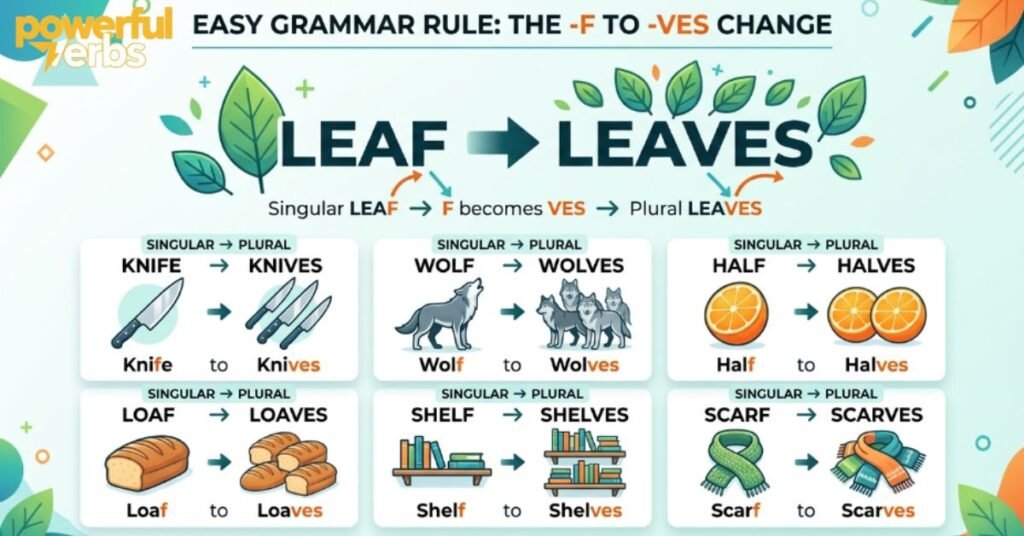
In English, words ending in -f or -fe follow a special plural rule. You drop the f for fe and add “-ves” instead. This applies to a whole group of common words—not just “leaf.” It is a rule that every English learner should know because it comes up very often in writing and speaking.
The Rule in Simple Words
Drop the -f and add -ves. That’s it. Leaf → Lea + ves = Leaves.
Other Words That Follow This Rule
| Singular | Plural |
| Leaf | Leaves |
| Knife | Knives |
| Wife | Wives |
| Half | Halves |
| Wolf | Wolves |
| Shelf | Shelves |
| Loaf | Loaves |
| Thief | Thieves |
| Scarf | Scarves |
| Calf | Calves |
Exceptions to the Rule
Not every word ending in -f follows this rule. Some words just take a regular -s:
- Roof → Roofs
- Cliff → Cliffs
- Chef → Chefs
- Belief → Beliefs
- Proof → Proofs
These are exceptions that you simply have to memorize. But leaf is not one of them—leaf always becomes leaves.
Origin & Language Background
Origin of the Word “Leaf”
The word “leaf” comes from Old English “lēaf,” which meant the same thing it means today—a flat green part of a plant or tree. It is one of the oldest words in the English language and has stayed almost unchanged for over a thousand years.
How the Plural Form Evolved
In Old English, many words ending in -f naturally shifted their sound when made plural. The f sound softened into a v sound, and -es was added. Over time, this became a fixed grammar rule. So leaves are not a modern invention—they are a very old and well-established form.
British English vs American English Usage
Both British and American English use leaves as the plural of leaf. There is no regional difference here. Whether you are writing for a UK audience or a US audience, leaves is always correct. The word “leafs” is not accepted as the plural in either variety of English.
Is There Any Spelling Difference?
No. “Leaves” is spelled the same way in British English and American English. There is no alternate spelling, no regional version, and no accepted variation. The spelling is fixed: L-E-A-V-E-S.
Usage & Correctness
When to Use “Leaves”
Use leaves every time you are talking about more than one leaf. It does not matter if you are talking about tree leaves, book pages described as leaves, or gold leaf—the plural is always leaves.
- The leaves on the tree turned orange.
- She pressed the leaves between the pages of a book.
- The ancient book had only a few leaves remaining.
When “Leafs” Is Incorrect
Leafs is incorrect when used as the plural noun of “leaf” in any standard sentence. If someone writes, “I collected ten leafs from the garden,” that is a grammatical mistake. The correct sentence is “I collected ten leaves from the garden.” This error is common in student writing, blog posts, and social media captions.
Is “Leafs” Ever Correct?
Yes — but only in three very specific situations.
1️⃣ Proper Nouns (Names & Titles) The most famous example is the Toronto Maple Leafs, an NHL hockey team. Team names are proper nouns and do not follow regular grammar rules. The team chose this name, so it stays as Leafs, but this does not make Leafs correct as a common plural noun.
2️⃣ Technical or Mechanical Context In some technical fields, “leaf” is used to describe flat mechanical parts—like leaf springs in vehicles. In this narrow context, leafs can appear, but it is very rare and field-specific.
3️⃣ Verb Form: Leaf can also be a verb. When someone quickly flips through pages, they leaf through them. In the third-person singular present tense, you say, “He leafs through the magazine.” Here, leafs is a verb—not a plural noun. This is completely correct.
Examples Section
Simple Examples of Leaves (Correct Usage)
- The autumn leaves covered the ground in red and gold.
- She collected leaves for her science project.
- The old tree had thousands of leaves on its branches.
- Green leaves are a sign of a healthy plant.
- The leaves fell slowly in the evening wind.
Incorrect Examples Using “Leafs”
- ❌ The tree has many leafs.
- ❌ I picked up some leafs from the park.
- ❌ There are dry leafs on the road.
- ❌ We saw colorful leafs in autumn.
Real-Life Sentences (Easy to Understand)
- The kids jumped into a pile of leaves after school.
- She saved a few leaves from her grandmother’s garden.
- The leaves of this tree stay green all year long.
- He leafs through the newspaper every morning. (verb — correct)
- The Toronto Maple Leafs won the game last night. (proper noun — correct)
Everyday Usage Context
Leaves in Nature & Plants
When talking about trees, plants, herbs, or flowers, you will almost always use leaves. Every plant-related conversation uses this word—from gardening to botany to simple everyday talk. “The plant lost all its leaves in winter” is a perfectly natural sentence.
Leaves in Seasons & Weather
Autumn is the most common season in which the word “leaves” appears in conversation and writing. People talk about falling leaves, colorful leaves, and leaves on the ground. Weather articles, poems, and seasonal content all use “leaves” heavily—making it one of the most searched English plurals during fall months.
Leaves in Books & Paper
Historically, individual pages of a book are called leaves. One page = one leaf. Two pages = two leaves. This usage still appears in formal writing, literature, and library science. When you say “a manuscript with 200 leaves,” you are using the word in its bookish meaning.
Leaves in Education & Writing
Students writing essays, reports, or nature journals need to use leaves correctly. Teachers and professors mark “leafs” as a mistake in academic writing. Using leaves properly shows grammar awareness and improves the quality of any written work.
Common Mistakes
Common Mistakes with Leafs and Leaves
This section covers the four most common errors people make with this word. Knowing these mistakes helps you avoid them in your own writing.
Mistake 1: Adding “s” Like Regular Nouns
Most people learn that you just add “-s” to make a plural—dog → dogs, table → tables. So they write “leaf” → “leafs.” This is the most common mistake. Remember: “leaf” belongs to the -f → -ves group, not the regular group.
Mistake 2: Confusing Noun and Verb Forms
“He leafs through the book” is correct—here “leafs” is a verb. But “I saw three leafs” is wrong—here a plural noun is needed, so it should be “leaves.” People get confused because they see leafs used correctly as a verb and then mistakenly apply it as a noun plural too.
Mistake 3: Using “Leafs” in Exams or Blogs
In exam essays, academic papers, and professional blog posts, writing leafs as a plural noun is a clear grammatical error. It signals a lack of knowledge about English plural rules. Always use leaves in any formal or semi-formal written context.
Mistake 4: Overthinking the Rule
Some people hear about the Toronto Maple Leafs or read Leafs in a technical document and start to doubt themselves. They wonder if maybe Leafs is sometimes correct as a plural. Keep it simple: for everyday use, leaves are always right. The exceptions are very narrow and specific.
Writing & Contextual Usage
Leafs vs Leaves in Emails
In professional emails, always use leaves. Whether you are writing about a plant, a book page, or seasonal decoration, leaves are the correct and expected form. Writing leafs in a work email may seem like a small error, but it reduces the credibility of your writing.
Leafs vs Leaves on Social Media
On social media, people often write quickly and make casual spelling errors. “Leafs” appears frequently in Instagram captions and tweets. While the tone is informal, using leaves correctly still makes your post look more polished and trustworthy—especially if you run a content page or blog account.
Leafs vs Leaves in Formal Writing
In essays, research papers, news articles, and reports, “leaves” is the only acceptable form when used as a plural noun. Formal writing has zero tolerance for this kind of error. Editors, teachers, and readers will notice immediately if you write leafs in a formal document.
Comparison Section
Leafs vs Leaves – Side-by-Side Comparison Table
| Feature | Leaves | Leafs |
| Part of Speech | Plural noun | Verb (3rd person) / Proper noun |
| Grammatically correct as a plural? | ✅ Yes | ❌ No |
| Used in formal writing? | ✅ Yes | ❌ No |
| Accepted in dictionaries as plural? | ✅ Yes | ❌ No |
| Example | The leaves are green. | He leafs through pages. |
Leaf vs Leaves vs Leafs (Quick Summary)
| Word | Type | Example |
| Leaf | Singular noun | One leaf fell. |
| Leaves | Plural noun | Many leaves fell. |
| Leafs | Verb (present tense) | He leafs through books. |
Easy Memory Trick to Remember the Correct Plural
Think of it this way: “The wind LEAVES no leaf behind.” The word “leaves” is already in this sentence as a plural. Every time you doubt yourself, repeat this sentence. Another trick: knife → knives, life → lives, leaf → leaves — they all follow the same pattern. Once you memorize one, you know them all.
Trend & SEO Section
Leaves vs Leafs – Google Trends & Search Intent
The search term “leafs or leaves“ gets thousands of searches every month, especially in autumn when people are writing about fall foliage. Most users searching this keyword are students, bloggers, ESL learners, and content writers who want to confirm the correct spelling before publishing.
Why Users Search This Keyword
People search for this because the word leafs looks logical—it follows the common “+s” plural rule. The confusion is completely understandable. The search intent is almost always informational — people want a quick, confident answer with a clear explanation and examples they can trust.
Keyword Variations and Related Searches
- leafs or leaves correct
- plural of leaf
- is leafs a word
- leaf plural form
- leaves vs leafs grammar
- why is it leaves, not leafs
- leafs through pages, meaning
Keyword Comparison Table
| Keyword | Search Intent | Correct Answer |
| plural of leaf | Informational | Leaves |
| leafs or leaves | Informational | Leaves (noun plural) |
| he leafs through pages | Informational | Correct (verb form) |
| Toronto Maple Leafs | Navigational | Proper noun — correct |
| leaves grammar rule | Informational | -f → -ves rule |
Extra Value Section
When NOT to Use “Leafs”
Never use “leafs” as the plural of “leaf” in any of these situations:
- Academic essays or school assignments
- Blog posts about nature, gardening, or seasons
- News articles or journalism
- Formal emails or professional communication
- Any sentence where “leaf” is used as a noun
Can “Leafs” Be Used in Formal Writing?
As a plural noun — no, never. As a verb (“she leafs through documents”)—yes, that is grammatically correct and acceptable in formal writing. The key is knowing whether you are using “leaf” as a noun or a verb in your sentence.
Tips to Improve English Plurals
- Learn the -f → -ves rule and memorize 5 examples
- Always check irregular plurals in a dictionary when unsure
- Practice with word lists: leaf, knife, wife, wolf, shelf
- Read English content daily — patterns become natural over time
- Use grammar tools like Grammarly to catch plural errors before publishing
Commonly Confused Plural Words
| Singular | Wrong Plural | Correct Plural |
| Leaf | Leafs | Leaves |
| Knife | Knifes | Knives |
| Child | Childs | Children |
| Mouse | Mouses | Mice |
| Goose | Gooses | Geese |
| Foot | Foots | Feet |
| Tooth | Tooths | Teeth |
| Woman | Womans | Women |
Conclusion
The answer is simple and clear: “leaves” is the correct plural of “leaf,” and this rule has no exceptions in everyday writing. Whether you are writing a school essay, a blog post, or a social media caption, always choose leaves over leafs.
The only time Leafs is correct is when it acts as a verb (he leafs through pages) or appears in a proper noun like the Toronto Maple Leafs. Outside of those two cases, stick with leaves—and you will never make this mistake again.
Frequently Asked Questions
1. What is the correct plural form of the word leaf?
The correct plural of “leaf” is leaves. “Leafs” is only used as a verb, meaning to flip through pages, as in “she leafs through the book.”
2. When should I use “leaves” instead of “leafs” in a sentence?
Use “leaves” when referring to more than one leaf on a plant or tree. For example, “The autumn leaves fell gently to the ground” is grammatically correct.
3. Can “leafs” ever be correct in the English language?
Yes, “leafs” is correct only when used as a third-person singular verb, such as “He leafs through the magazine every morning.” It is never the plural noun form of leaf.
4. Why do so many people get confused between leafs and leaves?
People confuse leafs and leaves because English plurals are usually formed by adding an “s,” but words ending in “-f” or “-fe” often change to “-ves,” making “leaves” the correct plural noun.
5. How do I remember whether to write “leafs” or “leaves” in my writing?
A simple trick: if you’re talking about things on a tree, always use “leaves.” If you’re describing someone flipping through pages, use “leafs.” When in doubt, ask yourself if it’s a noun or a verb.
6. Is “leafs” used differently in Canadian English or sports contexts?
Yes! “Leafs” is famously used in the name of the NHL hockey team, the Toronto Maple Leafs, which intentionally breaks the standard grammar rule as part of its official branding.
7. What are some everyday sentence examples using leaves and leafs correctly?
Use “leaves” as a noun: “The leaves on the oak tree turned orange.” Use “leafs” as a verb: “My dad leafs through the newspaper every Sunday morning after breakfast.”
8. Does the word “leaves” have more than one meaning in English?
Yes, “leaves” is a homonym—it can mean the plural of “leaf” (tree leaves), or it can be the third-person present tense of “leave,” as in “She leaves for work at 8 AM.”
9. Are there other English words that follow the same plural pattern as leaf to leaves?
Absolutely! Words like knife → knives, wife → wives, wolf → wolves, and half → halves all follow the same “-f to -ves” plural rule that changes “leaf” to “leaves.”
10. What grammar rule explains why the plural of “leaf” is “leaves” and not “leafs”?
The rule is called the “-f to -ves” pluralization rule in English. When a noun ends in “-f” or “-fe,” you typically drop the “-f” and add “-ves” to form the plural, which is why “leaf” becomes “leaves.”

Liam Johnson is a dedicated language expert with 4 years of professional experience. He specializes in Grammar, Vocabulary, and Sentence structure.
