

The term “body count” is one of those phrases that means very different things depending on where you hear it. It can show up in a news report, a history class, or a casual conversation between friends. Understanding the right meaning in the right place matters a lot.
This article breaks down every use of the term clearly and simply. Whether you are curious about its history, its role in dating culture, or why it sparks debate, you will find all the answers here.
Introduction
Why the term “body count” is widely discussed today
The phrase “body count” has gone from news headlines to everyday conversations very quickly. People use it in completely different ways, and that creates a lot of confusion. It is now one of the most searched and talked-about terms on social media.
How its meaning changes depending on context
In a war report, body count refers to the number of people who died. In a casual conversation between young people, it usually refers to something personal about romantic history. The same two words carry very different weight depending on who is speaking and where.
What readers will learn
This article will walk you through every major context where this term appears. You will understand its history, its modern slang meaning, the debate around it, and how culture shapes the way people feel about it.
What Does “Body Count” Mean?
The term “body count” has more than one meaning, and both are used regularly today. The meaning depends entirely on the situation and the people involved in the conversation. Knowing both meanings helps you avoid confusion.
Traditional Meaning
Traditionally, “body count” referred to the number of deaths in a specific event. It was used in military reports, disaster coverage, and news journalism. The term was serious, factual, and meant to provide a count of casualties.
Modern Slang Meaning
In modern slang, especially among younger generations, “body count” refers to the number of people someone has had sexual relations with. It is commonly used in dating conversations and on social media. This usage is casual but often carries emotional weight.
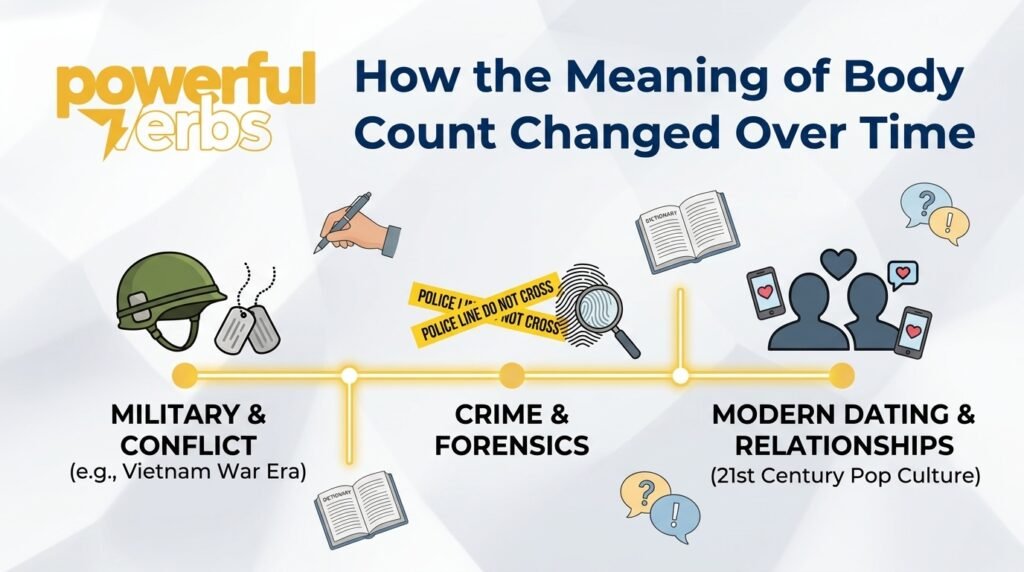
How the Meaning of Body Count Changed Over Time
Original use in serious contexts
For decades, “body count” was strictly used in serious reporting. Journalists and military officials used it to track deaths in wars and conflicts. It was a neutral, factual term with no personal or social meaning attached.
Shift into casual and dating conversations
Somewhere in the late 1990s and early 2000s, the term started appearing in casual social conversations. People began using it humorously or directly when talking about romantic history. Over time, it became a widely understood slang term in relationships.
Role of internet culture in the change
The internet, especially forums, social media, and memes, played a huge role in spreading the slang version. Viral posts and trending conversations made the term familiar to millions of people worldwide. Internet culture gave old words new meanings faster than ever before.
Different Contexts Where the Term Is Used
Military and Conflict Reporting
In military settings, body count is used to record the number of enemy soldiers or civilians killed in a conflict. Governments and news agencies report these numbers during wars and armed operations. It is a formal term in this context and is treated with seriousness.
Statistics and Data Usage
Beyond war, the term sometimes appears in crime reports, health data, or emergency management. Officials may refer to a “body count” after a natural disaster or mass casualty event. In these settings, the term is clinical and informational.
Social and Casual Conversations
In everyday social settings, especially among younger people, the term is used informally to mean romantic or sexual history. It often comes up when friends are talking about dating and relationships. The tone is usually casual, sometimes joking, and sometimes serious.
Body Count in Dating and Relationships

What people mean in modern usage
When someone asks about “body count” in a dating context, they are asking how many sexual partners the other person has had. It is a direct and often personal question. Some people ask it early in a relationship; others never ask at all.
Why is it discussed in relationships
Some people believe knowing their partner’s history helps them feel more secure or informed. Others see it as a form of emotional honesty and openness. For some, it is simply a curiosity that comes up naturally in deep conversations.
How is it interpreted differently
Some people answer the question without hesitation, while others feel it is private and unnecessary. The same number can be seen as too high by one person and completely normal by another. Interpretation is deeply personal and tied to individual values.
Why People Ask About Body Count
Curiosity
Sometimes people ask simply because they are curious about their partner’s past. It is a natural human tendency to want to know the people we are close to more fully. Curiosity does not always come from judgment—sometimes it is just interest.
Trust and relationship concerns
Some people ask because they feel that honesty about the past builds trust in the present. They may want to feel that their partner is open with them about personal details. For these people, the answer matters less than the willingness to share.
Social influence
Peer pressure and social norms play a big role in why people ask or answer this question. Friends, media, and online culture create expectations around what is normal to know. Many people ask simply because they feel like it is expected of them.
Views and Opinions Around Body Count

Why Some People Think It Doesn’t Matter
Many people believe that a person’s past does not affect who they are in a current relationship. What matters, they argue, is how someone treats their partner now. They see the question as outdated, unfair, and unnecessary.
Why Some People Consider It Important
Others believe that knowing a partner’s history is part of understanding them fully. For some, it relates to values, lifestyle alignment, or health and safety concerns. They see it as a legitimate question in a serious relationship.
Changing social attitudes
Social attitudes around this topic have shifted significantly over recent generations. Younger generations tend to be more open and less judgmental about romantic history. Acceptance and privacy are both more valued now than they were decades ago.
Emotional and Social Impact of the Question
Pressure in conversations
Being asked about body count can create sudden pressure, especially in a new relationship. The person being asked may feel they need to answer perfectly or face judgment. This pressure can make an otherwise open conversation feel uncomfortable or unsafe.
Fear of judgment
Many people fear that their honest answer will be judged negatively. They may worry that a high number will make them seem irresponsible or that a low number will seem unusual. This fear often leads people to lie, avoid the question, or feel anxious.
Privacy concerns
Some people feel that their romantic history is private and belongs to them alone. They may not see it as relevant information to share with a partner. Respecting someone’s decision to keep this private is a healthy part of any relationship.
Psychology Behind Body Count Discussions
Social comparison
Humans naturally compare themselves to others, and body count conversations often trigger this behavior. People may measure themselves against their partner’s past, even when it is not helpful. Social comparison in this context can lead to unnecessary insecurity.
Self-esteem factors
How someone feels about their own number often reflects their deeper self-esteem. A person who feels confident and secure will usually approach the topic differently than someone who feels ashamed. Self-worth should never be tied to a number.
Cultural conditioning
Culture teaches people from a young age what is considered acceptable behavior. Many people carry those early messages into adult relationships without questioning them. Understanding where your beliefs come from can help you approach the topic more fairly.
Body Count and Modern Dating Culture
Influence of Hookup Culture
The rise of hookup culture, especially on college campuses and in urban areas, has made this topic more common. Casual relationships are more widely accepted than in previous generations. As a result, body counts are higher on average and discussed more openly.
Role of Dating Apps
Apps like Tinder, Bumble, and Hinge have changed how people meet and connect. These platforms make it easier to date multiple people in a short period of time. They have contributed to changing attitudes around romantic history and what counts as “normal.”
Changing relationship norms
Traditional relationship timelines have become less common. People now take longer to commit, date more people before settling down, and define relationships in new ways. These shifts naturally affect how the body count conversation is received.
Generational Differences in Understanding the Term

Older vs younger interpretations
Older generations are more likely to take the question seriously and tie it to character or values. Younger generations tend to view it as a personal number that does not define a person. These differences can create tension when people from different age groups discuss the topic.
Cultural differences
Different cultures around the world have very different attitudes toward romantic history. In some cultures, the question would be seen as deeply inappropriate or offensive. In others, it is discussed openly without stigma or shame.
Health and Safety Considerations
When discussions relate to health
In some conversations, asking about sexual history is genuinely tied to health and safety. Knowing a partner’s history can relate to discussions about sexually transmitted infections and testing. This is a completely valid and important reason to have honest conversations.
Importance of safe practices
Regardless of body count, practicing safe sex and getting tested regularly is what actually protects health. A person’s number tells you very little about their current health status. Open conversations about health should always be encouraged between partners.
Misconceptions people have
Many people mistakenly believe that a lower body count means safer or healthier behavior. This is not always true, because health depends on practices, not numbers. Judging someone’s health based on their body count alone is both inaccurate and unfair.
Body Count in Media and Pop Culture
How celebrities influence the term
Celebrities and public figures often spark body count conversations in tabloids and interviews. When a famous person reveals or jokes about their number, it becomes trending news. These moments shape how the public thinks about and discusses the topic.
Social media discussions
Platforms like Twitter, TikTok, and Instagram constantly feature debates about body count. Viral posts often turn the topic into a heated public conversation. Social media has made a once-private subject into a very public discussion.
Meme culture’s impact
Memes have played a surprising role in how the body count conversation developed. Funny or relatable memes about the topic spread quickly and make it feel lighter and more approachable. At the same time, memes can also reinforce unhealthy stereotypes and double standards.
Misunderstandings About Body Count
Confusing slang vs literal meaning
A major misunderstanding happens when someone uses the slang version of the term in a serious or formal setting. The two meanings are so different that the wrong context can create serious confusion. Always pay attention to the setting before interpreting the phrase.
Overgeneralizing numbers
People often make big assumptions based on a single number without knowing the full story. A number alone cannot explain the circumstances, the person’s values, or how they have grown. Reducing a person to a number is always an oversimplification.
Moral judgment issues
Many people attach moral judgments to body count that are simply not fair or logical. A higher number does not make someone a bad person, and a lower number does not make someone better. Moral character is shown through actions and values, not statistics.
The Controversy Around the Term
Why does it create debate
The term creates debate because it touches personal values, privacy, gender roles, and social norms all at once. People have strong and conflicting feelings about whether it is relevant in a relationship. That makes any conversation about it potentially charged and emotional.
Privacy vs openness
Some people believe complete openness is the foundation of a healthy relationship, including sharing past numbers. Others believe privacy is equally important and that some things do not need to be shared. Both perspectives have value, and neither is automatically right.
Social stigma discussion
There is a well-documented double standard in how body count is judged for men versus women. Women are often judged more harshly for higher numbers than men are for the same number. This double standard is widely criticized and is slowly being challenged by younger generations.
When the Term Is Used in Serious Contexts
Casualty Reporting in News
When journalists cover wars, conflicts, or mass tragedies, they often report a body count to communicate the scale of loss. This usage is factual and meant to inform the public. It is important to treat these numbers with respect, as each one represents a real human life.
Military usage explanation
Military commanders and analysts use body count as a metric to measure success or assess damage in a conflict. It has been used officially in wars throughout modern history, most notably during the Vietnam War. The term became controversial in that era due to claims of inflated or inaccurate numbers.
Ethical Considerations in Usage
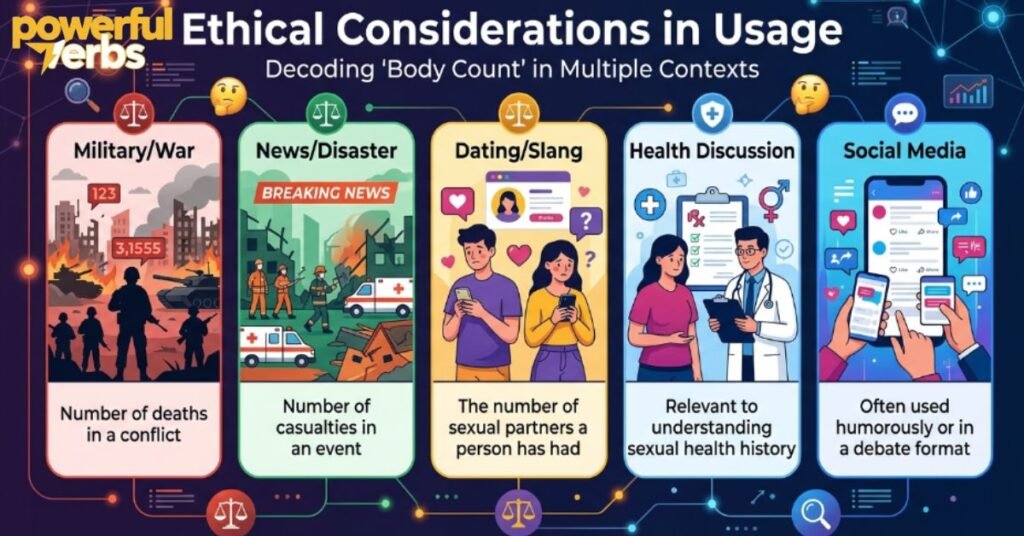
Sensitivity in serious contexts
When the term is used in a military or casualty context, it should always be handled with care and respect. Reducing human lives to a number can feel dehumanizing if not approached thoughtfully. Language around death should reflect the gravity and seriousness of the situation.
Respectful communication
In personal and social contexts, asking about body count should be done with empathy and without pressure. No one owes anyone this information, and demanding it or making someone feel guilty for not sharing is disrespectful. Healthy conversations require mutual respect and understanding.
Avoiding harmful assumptions
Never assume what a person’s body count means about their personality, health, or values. Assumptions based on numbers cause harm and reinforce unfair stereotypes. Every person deserves to be understood as a whole human being, not a statistic.
Common Questions People Have
What does body count mean in slang? In slang, body count means the number of people someone has had sexual relations with. It is commonly used in dating conversations, especially among younger people. The term is casual but often emotionally loaded.
Is it a negative term? It depends entirely on context. In serious settings like war or disaster reporting, it is a neutral but grave term. In slang, it can be neutral, judgmental, or even humorous, depending on who is using it and how.
Does it matter in relationships? That is a personal decision that varies from person to person. Some people feel it matters for trust or alignment of values, while others feel it is completely irrelevant. What matters most is that both partners feel comfortable and respected in the conversation.
Why do people ask it? People ask for many reasons, including curiosity, trust-building, social expectations, or genuine health conversations. Sometimes it is asked out of insecurity or comparison, which can lead to unnecessary conflict. Understanding your own motivation before asking can make the conversation healthier.
Quick Summary
| Context | What Body Count Means |
| Military / War | Number of deaths in a conflict |
| News / Disaster | Number of casualties in an event |
| Dating / Slang | The number of sexual partners a person has had |
| Health Discussion | Relevant to understanding sexual health history |
| Social Media | Often used humorously or in a debate format |
- The term has two very different meanings that depend entirely on context
- In serious settings, it refers to casualties and death tolls
- In modern slang, it refers to a person’s romantic or sexual history
- Double standards around the term are widely criticized today
- Health, privacy, and respect should guide any conversation about it
- A number alone never defines a person’s character or worth
What Does “Body Count” Mean Sexually?
When people specifically ask what body count means sexually, they are asking for the most direct, unambiguous version of the slang definition — with no military or news context attached. In this specific sexual meaning, body count refers strictly to the total number of people someone has had sexual intercourse with over their lifetime. It does not include kissing, dating, or emotional relationships that never became physical; it is a numeric count tied specifically to sexual activity.
This sexual meaning of body count is the version most commonly asked about in dating apps, group chats, and TikTok comment sections. Because the phrase can sound clinical or blunt, some people prefer softer alternatives like “how many people have you been with” or “your number,” but body count remains the most widely recognized term for this exact idea. Understanding this precise, sexual definition helps clear up the confusion that happens when the same phrase appears in a completely different, non-sexual context like a news report.
Body Count Meaning for a Girl vs. a Boy
One of the most searched variations of this term asks whether body count means something different for a girl compared to a boy. The literal definition does not change — for both a girl and a boy, body count still refers to the number of sexual partners a person has had. What changes is how that number is socially judged.
Body count meaning for a girl often carries a heavier social judgment. Research and everyday commentary alike point to a persistent double standard where a woman with a higher number is more likely to be criticized, while the same number in a man is treated as unremarkable or even admirable.
Body count meaning for a boy (or a guy) typically comes with less social penalty. A higher number is more often shrugged off or normalized, even though the definition of the term itself is exactly the same regardless of gender.
This gap between the neutral definition and the gendered reaction to it is a big part of why the term generates so much debate online — the word means the same thing for everyone, but the judgment attached to it does not.
Body Count Meaning in Texts, Snapchat, and TikTok Slang

When the term shows up in a text, DM, or Snapchat conversation, it is almost always being used in its sexual-partner sense rather than its military one. In chat contexts, people often shorten the phrasing into quick, casual lines rather than a formal question, such as asking someone directly for “your number” or dropping the phrase mid-conversation as a joke or a genuine question about dating history.
On TikTok specifically, the term frequently appears attached to street-interview style videos, reaction content, and debate threads where users argue about what an “acceptable” body count is. On Snapchat, the term tends to come up in more private, one-on-one conversations, often between people who are getting to know each other romantically. In all of these chat and app contexts, the underlying meaning stays consistent: it is asking about someone’s sexual history, phrased casually for a casual platform.
Body count isn’t the only piece of texting slang that trips people up — abbreviations like sfs meaning and js meaning in chat cause similar confusion when they show up out of context in a DM or group chat.
Zero Body Count and High Body Count — What the Extremes Mean

At one end of the spectrum, a zero body count meaning simply refers to someone who has never had a sexual partner. This is sometimes stated with pride, sometimes with self-consciousness, depending on the person and the social circle they’re in — but the definition itself is straightforward: zero sexual partners to date.
At the other end, the highest body count meaning conversations usually revolve around debates over what number should be considered unusually high, and why. There is no fixed, universal cutoff — what one person considers high, another considers ordinary — which is exactly why “what’s a high body count” remains such a common and inconclusive online debate. Both extremes get discussed heavily online not because the numbers themselves are meaningful on their own, but because people use them as shorthand to make judgments about a person’s character, which most relationship experts caution against.
Body Count Meaning Around the World
The term “body count” has spread far beyond English-speaking spaces, which is why searches for it appear in other languages too — including body count معنى in Arabic-speaking regions and body count betyder among Scandinavian speakers searching for a translation of the phrase. In every case, the core question being asked is the same: people encountering the English slang term for the first time and wanting a clear translation or explanation of what it means in their own language. This global spread shows how quickly internet slang can cross language barriers through social media, even when a direct translation for the phrase doesn’t naturally exist in the other language.
Body Count Definitions, Examples, and Quotes You’ll Find Online
Searching for a straightforward definition of body count or a body count example online usually leads to two very different types of results. Formal dictionary-style definitions describe it as a count of deaths or casualties, reflecting the term’s original, serious usage. Sites like Urban Dictionary, on the other hand, define it almost exclusively in the modern slang sense — as a running total of someone’s sexual partners — often illustrated with example sentences showing how the term gets used in casual conversation, such as someone asking a new partner directly about their number early in a relationship.
You’ll also come across body count quotes online — short, often meme-style lines that joke about the term, poke fun at the double standard between how men and women are judged, or comment on how normalized the question has become in modern dating. These quotes rarely add new meaning to the term itself, but they reflect just how deeply the slang usage has embedded itself into everyday pop culture and online humor.
Conclusion
The term “body count” carries very different meanings depending on where and how it is used. From war reports to relationship conversations, the phrase has traveled a long and complicated road. Understanding its many contexts makes you a more informed and thoughtful communicator.
No matter which meaning is being used, the most important thing is always how we treat other people. Whether discussing casualties in a conflict or personal history in a relationship, respect, empathy, and honesty should guide every conversation. A word is just a word — how we use it reflects who we are.
Frequently Asked Questions
1. What does “body count” mean when someone asks about it in a relationship?
In a relationship context, “body count” refers to the number of sexual partners a person has had in their lifetime. It’s commonly used in dating conversations to discuss romantic history.
2. Why do people ask about body count before getting into a serious relationship?
People ask about body count before committing to a relationship because they want to understand their partner’s sexual history, personal values, or compatibility—though many experts advise that this number rarely defines a person’s worth or character.
3. What is the original meaning of “body count” in military and law enforcement?
Originally, “body count” was a military and law enforcement term used to refer to the number of enemy combatants killed in battle or the number of casualties recorded at a crime scene or disaster site.
4. How is the term “body count” used differently in rap and hip-hop music?
In rap and hip-hop culture, “body count” is used both to reference the number of people someone has slept with and, in a more street context, the number of people involved in violent altercations—often used as a flex or lyrical boast in songs.
5. Does having a high body count affect a relationship negatively, according to relationship experts?
According to most relationship experts, a high body count does not automatically damage a relationship. What matters more is honesty, communication, and mutual respect between partners rather than a specific number.
6. What does “body count” mean in a true crime or news context?
In true crime reporting and news media, “body count” refers to the total number of confirmed deaths linked to a specific crime, criminal, natural disaster, or mass casualty event.
7. Is asking someone about their body count considered rude or invasive?
Yes, many people consider asking about someone’s body count invasive or judgmental, especially early in a relationship, as it can imply that a person’s value is tied to their sexual history rather than their character or emotional maturity.
8. What is the “Body Count” band, and how does the name relate to the term’s meaning?
Body Count is a heavy metal band co-founded by rapper Ice-T, and the name deliberately references both street violence and the raw, provocative nature of their lyrics—blending the term’s violent connotation with a rebellious musical identity.
9. How has the meaning of “body count” changed in modern slang compared to its traditional definition?
Traditionally, “body count” strictly referred to the number of deaths in a military or criminal context. In modern slang—especially among Gen Z and millennials—it has shifted primarily to mean the number of sexual partners someone has had, showing how language evolves with cultural trends.
10. Should you be honest about your body count if your partner asks you directly?
Most relationship counselors recommend being honest if your partner sincerely asks, as trust and transparency are foundational to healthy relationships — though you also have the right to set boundaries around personal information you’re not comfortable sharing.
What does body count mean sexually?
It refers specifically to the number of people a person has had sexual intercourse with, without including non-physical relationships or dating history that never became sexual.
Does body count mean something different for a girl than for a boy?
No — the definition is identical for everyone. What differs is the social judgment; women are often judged more harshly for higher numbers than men are for the same number.
What does a zero body count mean?
It means the person has not had any sexual partners yet. There is no single “normal” number — zero is simply one point on a wide personal spectrum.
What does body count mean on Snapchat or in texting?
In texting and chat apps, it almost always refers to someone’s sexual partner count, usually asked casually between people getting to know each other romantically.

Liam Johnson is a dedicated language expert with 4 years of professional experience. He specializes in Grammar, Vocabulary, and Sentence structure.
