800+ Collective Nouns List for People, Animals and Things
Spread the loveLearning collective nouns is one of the smartest steps you can take to improve your English writing and speaking skills. Whether you are a student, teacher, or content writer, knowing the right collective
Written by: Liam Johnson
Published on: May 22, 2026
Spread the love
Learning collective nouns is one of the smartest steps you can take to improve your English writing and speaking skills. Whether you are a student, teacher, or content writer, knowing the right collective noun instantly makes your language more precise and professional. This complete guide covers 800+ collective nouns for people, animals, things, food, nature, and more — with real sentence examples, NLP-rich context, and a full A–Z reference list.
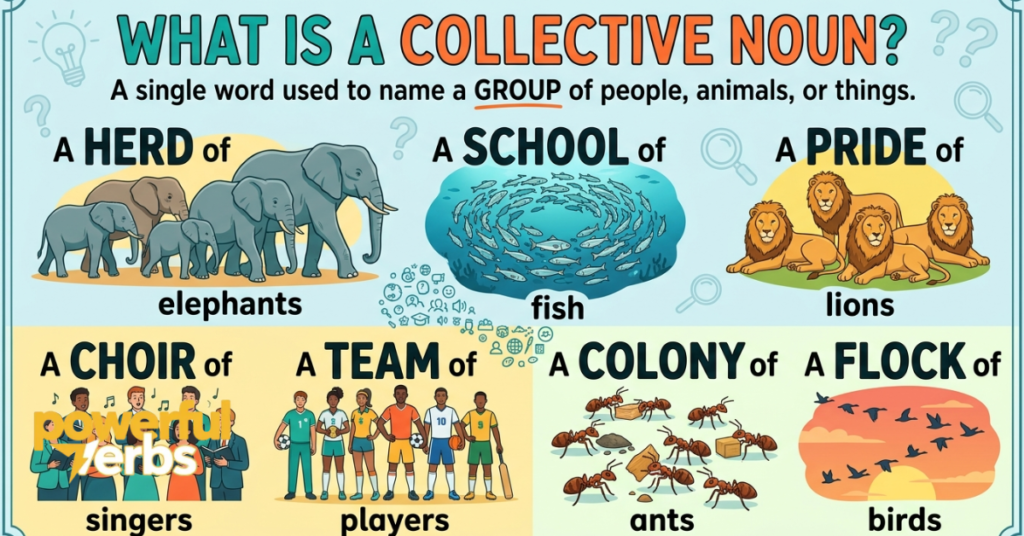
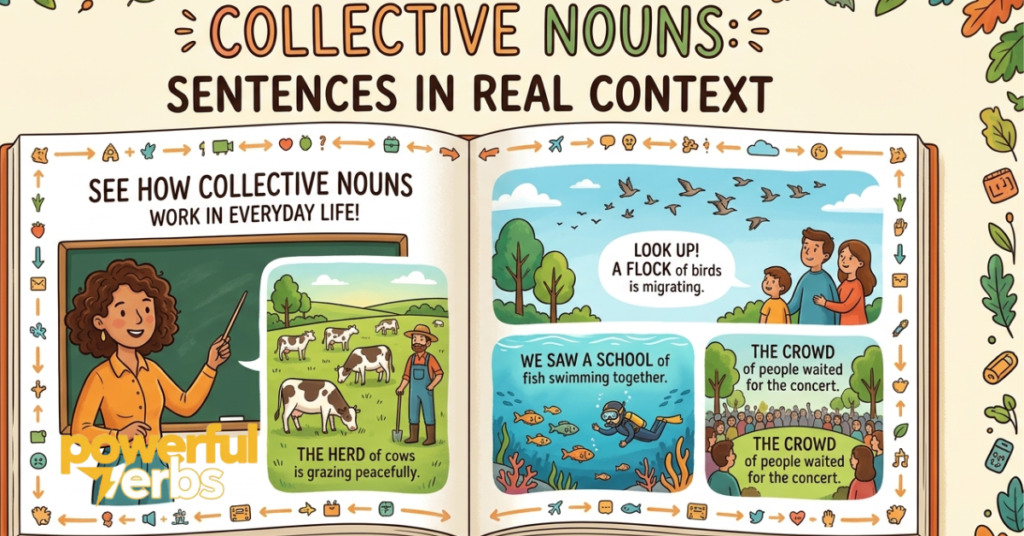
A collective noun is a single word that names a group of people, animals, or objects treated as one unit. Instead of writing “many wolves were running,” skilled writers say “a pack of wolves was running.” This small change improves clarity, reduces word repetition, and makes your writing sound more natural and authoritative.
Collective nouns are also called group nouns or aggregative nouns in formal grammar. They are widely used in academic writing, journalism, fiction, and everyday conversation.
Key grammar point: In American English, collective nouns usually take a singular verb. In British English, they can take plural verbs when referring to individual members acting separately.
Example
American English
British English
The team
The team is winning.
The team are winning.
The committee
The committee has decided.
The committee have decided.
Collective Nouns for People
People form many different types of groups depending on their profession, activity, or shared purpose. Here are the most important collective nouns used for people in English:
Professional Groups
Collective Noun
Group of People
A board
directors or trustees
A staff
employees or teachers
A panel
judges or experts
A faculty
professors or lecturers
A cabinet
ministers or advisors
A crew
sailors, pilots, or workers
A cast
actors or performers
A troupe
dancers or entertainers
A brigade
firefighters or soldiers
A regiment
military soldiers
A platoon
army soldiers
A squad
police officers or athletes
A bench
judges sitting together
A delegation
official representatives
A company
soldiers or business staff
A corps
trained military personnel
A caravan
merchants or travelers
A syndicate
business partners
A consortium
organizations working together
A commission
government-appointed members
Social and Community Groups
Collective Noun
Group of People
A crowd
spectators or onlookers
A mob
rioters or protesters
A congregation
worshippers in a church
A parish
members of a local church
A clan
members of a family tribe
A tribe
indigenous community members
A dynasty
rulers from one family line
A community
residents of an area
A neighborhood
people living nearby
A gathering
people meeting informally
A assembly
citizens or members meeting
A party
friends or political members
A posse
a group chasing someone
A gang
friends or criminals together
A circle
close friends or colleagues
A clique
an exclusive group of friends
A fellowship
a brotherhood or society
A fraternity
male social members
A sorority
female social members
A society
organized group of members
Educational Groups
Collective Noun
Group of People
A class
students learning together
A cohort
students in the same year
A school
students and teachers together
A lecture
students attending a talk
A seminar
students in a guided discussion
A study group
students preparing together
A batch
graduates finishing together
A intake
new students admitted together
Performance and Arts Groups
Collective Noun
Group of People
A choir
singers performing together
A band
musicians playing together
A orchestra
classical musicians
A ensemble
small group of musicians
A quartet
four musicians or singers
A duo
two performers
A troupe
traveling performers
A cast
actors in a production
A company
theater performers
A chorus
group singers in a musical
Collective Nouns for Animals
Animal collective nouns are among the most fascinating in the English language. Many are ancient, poetic, and specific to individual species. Knowing them makes your nature writing vivid and accurate.
A collective noun is one word that refers to a whole group. For example, “team” means a group of players working together.
Is “family” a collective noun?
Yes. Family is a collective noun because it refers to a group of related people treated as one unit. Example: My family is planning a vacation.
What is a group of crows called?
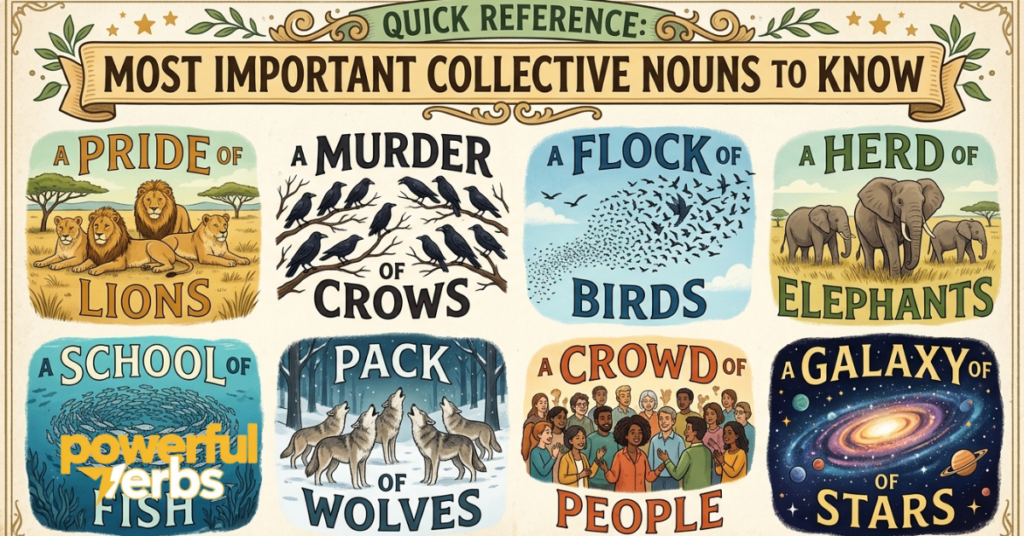
A group of crows is called a murder. Example: A murder of crows gathered on the rooftop at dusk.
What is a group of dolphins called?
A group of dolphins is called a pod. Example: A pod of dolphins swam alongside the ferry.
What is a group of cats called?
A group of cats is called a clowder. Example: A clowder of cats sheltered under the bridge.
Can collective nouns be plural?
Collective nouns are grammatically singular but can be used with plural verbs in British English when members act individually. Example: The team are arguing among themselves.
What is the difference between a flock and a gaggle?
A flock refers to any birds flying together. A gaggle specifically refers to geese on the ground. When geese fly, they are called a skein.
Is “group” always a collective noun?
Yes. Group is one of the most universal collective nouns and can be used for people, animals, or things. Example: A group of tourists visited the museum.
What is a group of fish called?
A group of fish swimming together in a coordinated way is called a school. A looser gathering of fish is called a shoal.
What is a group of stars called?
A small group of stars is called a cluster. A very large group forming a system is called a galaxy. Stars arranged in a recognizable pattern in the sky are called a constellation.
As a content writer with 3 years of hands-on experience, I understand the real problems English learners face. That’s why I built Powerful Verbs - to make English learning simple, practical, and confidence-boosting.