

Every English sentence needs a verb. And when you want to describe something in the present tense — a person, a feeling, a place, a situation — you almost always need one of three small but powerful words: is, am, or are.
These three words are all forms of the verb “to be.” They are among the most frequently used words in the English language. Yet many learners — even those who have studied English for years — still make mistakes with them.
This guide gives you a complete, practical understanding of when and how to use is, am, and are correctly. You will find clear rules, detailed examples, grammar tips, common error corrections, and exercises that build real confidence.
Quick Reference Chart: Is, Am, Are at a Glance
| Verb Form | Used With | Example |
| Am | I | I am a doctor. |
| Is | He, She, It, Singular Noun | She is kind. |
| Are | You, We, They, Plural Noun | They are students. |
Part 1: Complete Guide to Using “AM”
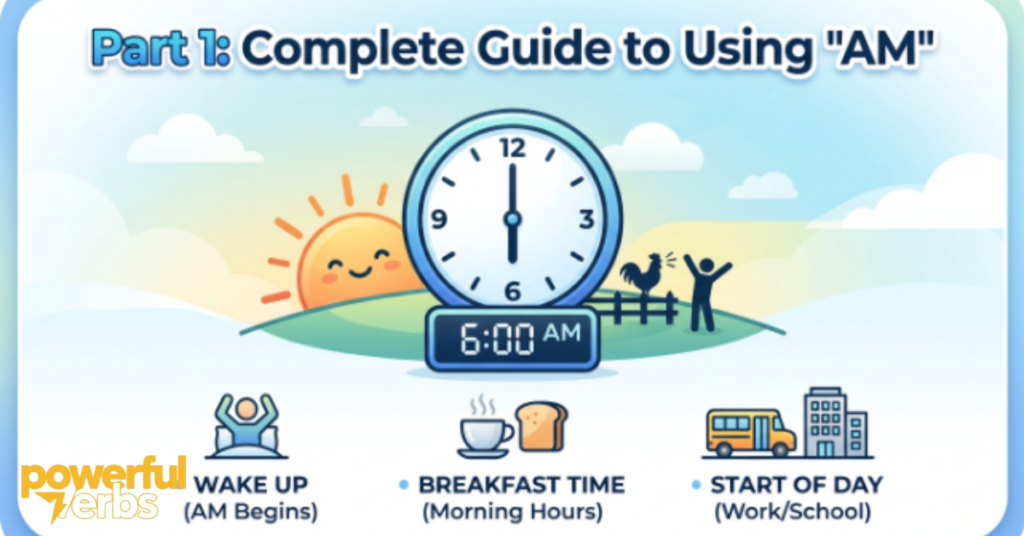
The Golden Rule of AM
AM is used only and always with the pronoun “I.”
This is the simplest rule in English grammar. No other subject — not he, not she, not they — can use “am.” When you speak or write about yourself, “am” is your verb.
AM in Simple Present Tense (Affirmative Sentences)
Use “am” to describe your identity, profession, nationality, feelings, or current state.
Examples:
- I am a software engineer.
- I am Pakistani by nationality.
- I am twenty-five years old.
- I am excited about the new project.
- I am your class teacher this year.
- I am responsible for this mistake.
- I am the only child in my family.
Grammar Tip: “Am” connects the subject “I” directly to information about that subject. The noun or adjective that follows “am” is called a predicate complement.
AM in Negative Sentences
To make a negative sentence with “am,” simply add “not” after it.
- I am not tired right now.
- I am not your enemy.
- I am not satisfied with this result.
- I am not able to attend the meeting.
- I am not from this city.
Contracted form: I’m not (very common in spoken English)
AM in Questions
In questions, “am” moves before the subject “I.”
- Am I late for the lecture?
- Am I on the right track?
- Am I included in the guest list?
- Am I supposed to call first?
Note: Questions using “am” are less common than those using “is” or “are,” but they appear in formal writing and polite speech.
AM in Present Continuous Tense
“Am” is used with the -ing form of a verb to describe an action happening right now.
Structure: I + am + verb-ing
- I am reading an interesting book.
- I am waiting for the bus.
- I am thinking about your suggestion.
- I am working on a new design.
- I am feeling much better today.
AM in Short Responses
In spoken English, short answers often use “am.”
- “Are you coming?” — Yes, I am.
- “Are you a teacher?” — No, I am not.
Part 2: Complete Guide to Using “IS”
The Core Rule of IS
IS is used with singular subjects — he, she, it, and all singular nouns.
A singular subject refers to one person, one place, one thing, or one idea.
IS with Third-Person Singular Pronouns (He, She, It)
The pronouns he, she, and it always take “is.”
With He:
- He is the principal of our school.
- He is working late tonight.
- He is not feeling well.
With She:
- She is an experienced lawyer.
- She is preparing for her exams.
- She is not available on weekends.
With It:
- It is a beautiful morning.
- It is raining heavily outside.
- It is not my responsibility.
IS with Singular Nouns
Any single person, place, or object uses “is.”
- The child is sleeping in the next room.
- My phone is on the kitchen counter.
- The hospital is two kilometers away.
- This problem is more complex than it looks.
- Your suggestion is very valuable.
- The meeting is scheduled for Monday.
IS with Uncountable Nouns
Uncountable nouns — things we cannot count individually — are always treated as singular and take “is.”
Common uncountable nouns: water, milk, rice, information, furniture, advice, news, knowledge, happiness, traffic
Examples:
- The water is not clean enough to drink.
- This information is highly confidential.
- The furniture is arranged perfectly.
- The news is shocking for everyone.
- His knowledge is impressive for his age.
- The traffic is terrible at this hour.
Grammar Tip: If a noun has no plural form or cannot be preceded by “a/an,” it is almost always uncountable — use “is.”
IS in Negative Sentences
Add “not” after “is” to form a negative.
- The store is not open on Sundays.
- She is not interested in this offer.
- It is not what I expected.
- The answer is not correct.
Contracted form: isn’t (common in everyday speech)
IS in Questions
“Is” moves to the beginning of yes/no questions.
- Is the doctor available right now?
- Is your sister coming to the event?
- Is this the correct address?
- Is it too late to apply?
- Is the restaurant nearby?
IS in Present Continuous Tense
Structure: Subject (singular) + is + verb-ing
- The teacher is explaining the lesson carefully.
- My brother is learning to drive.
- The company is expanding into new markets.
- The baby is crying in the other room.
- He is trying his best to improve.
IS with Names and Titles
When a person’s name or title is the subject, use “is.”
- Fatima is the head of the department.
- Mr. Ahmed is a renowned professor.
- Lahore is the cultural capital of Pakistan.
- Karachi is the largest city in the country.
Part 3: Complete Guide to Using “ARE”
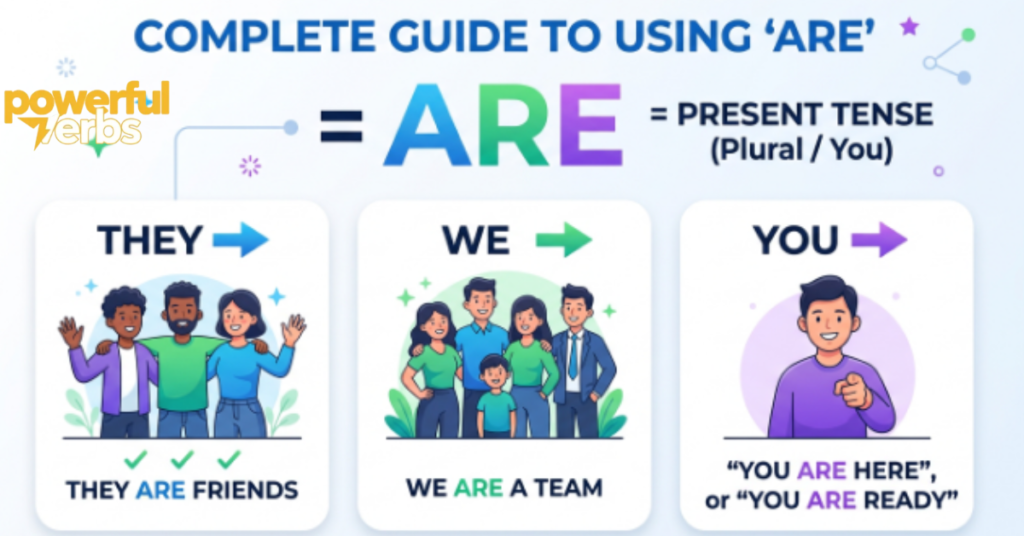
The Core Rule of ARE
ARE is used with plural subjects and the pronouns you, we, and they.
A plural subject refers to more than one person, place, or thing.
ARE with the Pronoun YOU
“You” always takes “are” — whether you are speaking to one person or a group.
- You are an excellent communicator.
- You are not wrong in your thinking.
- Are you ready to begin?
- You are doing a great job.
Important: Even when speaking to a single individual, “you are” is always correct. Never say “you is.”
ARE with WE
“We” represents a group that includes the speaker.
- We are a team of dedicated professionals.
- We are not responsible for this error.
- We are planning a trip next month.
- Are we on the same page?
ARE with THEY
“They” refers to a group of people or things not including the speaker.
- They are the best players in the league.
- They are not aware of the latest update.
- They are working on the solution.
- Are they joining us for dinner?
ARE with Plural Nouns
When the subject is more than one person or thing, use “are.”
- The students are preparing for their final exams.
- The roads are blocked due to construction.
- The results are better than expected.
- These documents are confidential.
- The children are excited about the holiday.
- Your shoes are in the cupboard.
Grammar Tip: Plural nouns usually end in -s or -es. If the noun is plural, the verb should be “are.”
ARE with Collective Nouns (When Members Act Separately)
In British English, collective nouns (team, staff, committee, audience) can take “are” when the members are acting as individuals.
- The staff are expressing their concerns.
- The committee are divided in their opinions.
- The audience are leaving their seats.
Note: In American English, collective nouns usually take “is.”
ARE in Negative Sentences
Add “not” after “are” to make negatives.
- They are not prepared for the challenge.
- We are not in agreement on this issue.
- The files are not organized properly.
- You are not making any sense right now.
Contracted form: aren’t (common in conversation)
ARE in Questions
“Are” moves to the beginning of yes/no questions.
- Are you feeling better today?
- Are they still waiting outside?
- Are the reports ready to submit?
- Are we meeting tomorrow?
- Are your parents in the city?
ARE in Present Continuous Tense
Structure: Subject (plural/you/we/they) + are + verb-ing
- The engineers are developing a new system.
- We are looking for a reliable solution.
- The students are asking excellent questions.
- You are making real progress this week.
- They are discussing the proposal right now.
Part 4: Special Situations and Tricky Cases
Sentences with “There Is” and “There Are”
Use “there is” for a single item and “there are” for multiple items.
| Singular | Plural |
| There is a problem with the system. | There are several problems to fix. |
| There is a café near my office. | There are two cafés on this street. |
| There is a reason for this rule. | There are many reasons to learn English. |
Sentences Starting with “Here”
- Here is your ticket.
- Here are the files you requested.
Compound Subjects (Joined by AND)
When two subjects are joined by “and,” they become plural — use “are.”
- Ali and Sara are best friends.
- The manager and his assistant are in the meeting.
- Honesty and hard work are the keys to success.
Either/Or and Neither/Nor
When two subjects are joined by “either…or” or “neither…nor,” the verb agrees with the subject closest to it.
- Either the teacher or the students are responsible.
- Neither the students nor the teacher is at fault.
- Either she or I am going to the conference.
Subjects That Look Plural but Are Singular
Some words look plural but refer to a single thing — they use “is.”
- The news is difficult to hear.
- Mathematics is my favorite subject.
- Physics is a challenging discipline.
- The United States is a large country.
Part 5: Common Mistakes and How to Fix Them
Learning from common errors is one of the fastest ways to improve. Here are the most frequent mistakes learners make with is, am, and are:
Mistake 1: Using “is” with plural subjects
The students is working hard. The students are working hard.
Mistake 2: Using “are” with a singular noun
The book are on the shelf. The book is on the shelf.
Mistake 3: Using “am” with any subject other than “I”
He am a doctor. He is a doctor.
They am ready. They are ready.
Mistake 4: Forgetting agreement with uncountable nouns
The information are incorrect. The information is incorrect.
Mistake 5: Using “you is” instead of “you are”
You is my friend. You are my friend.
Mistake 6: Wrong verb in “there is/there are”
There is many opportunities available. There are many opportunities available.
Part 6: Practice Exercises
Exercise A — Fill in the Blank
Choose the correct form: is, am, or are.
- I ___ a second-year university student.
- The sky ___ unusually clear tonight.
- They ___ planning to launch a new product.
- You ___ always welcome in our home.
- She ___ the most experienced person on the team.
- We ___ not satisfied with the current arrangement.
- The prices ___ higher than last month.
- It ___ not easy to learn a new language.
- My parents ___ visiting next weekend.
- There ___ a solution to every problem.
Exercise B — Correct the Error
Find and correct the mistake in each sentence.
- He are my oldest friend.
- The children is playing in the park.
- I are from Lahore.
- The news are very surprising.
- You is absolutely right.
Answer Key
Exercise A:
- am | 2. is | 3. are | 4. are | 5. is | 6. are | 7. are | 8. is | 9. are | 10. is
Exercise B:
- He is my oldest friend.
- The children are playing in the park.
- I am from Lahore.
- The news is very surprising.
- You are absolutely right.
Part 7: Using IS, AM, ARE in Real-Life Conversations
Understanding grammar rules is important, but using them naturally in conversation is the real goal. Here are some everyday dialogues:
At School:
- Teacher: “Are you ready for today’s quiz?”
- Student: “Yes, I am. I am feeling confident.”
- Teacher: “Good. The questions are not very difficult.”
At Work:
- “Is the report ready?”
- “It is almost done. We are just reviewing the final section.”
Meeting Someone New:
- “Hi! I am Usman. I am from Multan.”
- “Nice to meet you. I am Sana. Are you new to this office?”
Talking About the Weather:
- “It is very hot today.”
- “Yes, the afternoons are unbearable this week.”
Part 8: IS, AM, ARE — Contracted Forms in Everyday English
In spoken and informal written English, contractions are very common.
| Full Form | Contraction |
| I am | I’m |
| You are | You’re |
| He is | He’s |
| She is | She’s |
| It is | It’s |
| We are | We’re |
| They are | They’re |
| is not | isn’t |
| are not | aren’t |
Examples in sentences:
- I’m studying for my exams.
- She’s one of the best writers I know.
- They’re not available today.
- It’s a fantastic idea.
- We’re on the same team.
Important: “It’s” (contraction of “it is”) is different from “its” (possessive pronoun). Do not confuse them.
FAQs
Q1: What is the main difference between is, am, and are?
They are all present-tense forms of “to be.” “Am” is used only with “I.” “Is” is used with singular subjects like he, she, it, or one noun. “Are” is used with plural subjects and with you, we, and they.
Q2: Can “am” be used with any pronoun other than “I”?
No. “Am” is exclusively paired with “I.” Using “am” with any other subject is a grammar error.
Q3: Is “you is” ever correct?
Never. Whether you are addressing one person or a group, “you are” is always the correct form.
Q4: Why do uncountable nouns use “is” and not “are”?
Uncountable nouns refer to things treated as a single unit or mass, not as individual countable items. Because they are grammatically singular, they use “is.”
Q5: What is subject-verb agreement in simple terms?
Subject-verb agreement means the verb must match its subject in number — singular subjects take singular verbs (is/am), and plural subjects take plural verbs (are).
Q6: How do I teach is, am, and are to beginners?
Start with “am” and the pronoun “I” since it has only one rule. Then introduce “is” with he, she, and it using real examples. Finally, teach “are” with they, we, and you. Use visual charts and spoken practice for the best results.
Q7: What are to is, am, and are?
Related terms include: verb to be, subject-verb agreement, present tense verbs, English grammar basics, linking verbs, predicate nominative, copula verbs, present continuous tense, and English sentence structure.
Summary: Key Rules to Remember
- AM → only with “I” — always, without exception
- IS → with he, she, it, and all singular nouns (including uncountable nouns)
- ARE → with you, we, they, and all plural nouns
- In questions, the verb comes before the subject
- In negatives, add “not” after the verb
- In present continuous tense, follow the pattern: Subject + is/am/are + verb-ing
- Contractions (I’m, she’s, they’re) are common in spoken and informal English
Final Words
Mastering is, am, and are is one of the most important steps in building strong English grammar. These three words appear in nearly every sentence you speak or write. Once you understand the simple rules — am with I, is with singular subjects, are with plural subjects — you will find that your English becomes clearer, more accurate, and more natural.
Practice regularly, review the examples in this guide, and pay attention to how native speakers use these words in conversations, books, and online content. The more you notice and practice, the more automatic your usage will become.

Liam Johnson is a dedicated language expert with 4 years of professional experience. He specializes in Grammar, Vocabulary, and Sentence structure.
