

Ever paused mid-sentence and wondered whether to write “he trys” or “he tries”? You’re not the only one. This exact question gets typed into Google every single day by students, content writers, ESL learners, and even native speakers who suddenly second-guess themselves. The good news is that the answer is short, the rule behind it is easy to remember, and once it clicks, you’ll never make this mistake again.
This guide breaks down the correct spelling, explains the grammar rule in plain English, compares British and American usage, and gives you real examples so you can use the word confidently in emails, essays, exams, and everyday conversation.
see also: 60 Purple Fruits List and Names with Pictures You Should Know
Quick Answer: Is It Trys or Tries?
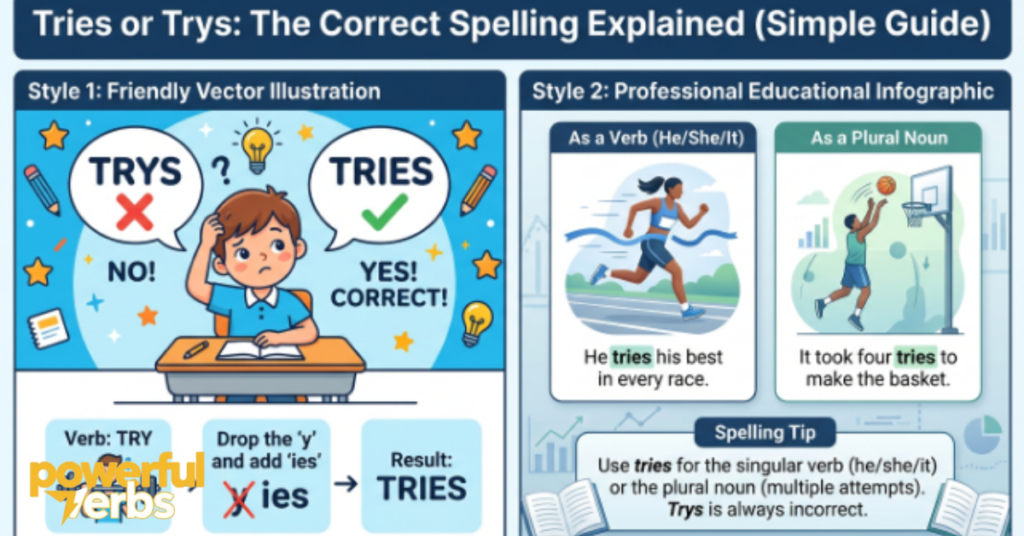
Tries is the only correct spelling. Trys is a spelling error and does not appear in any standard English dictionary.
- Correct: He tries his best in every match.
- Correct: She tries to wake up early.
- Incorrect: He trys his best in every match.
- Incorrect: She trys to wake up early.
If you remember nothing else from this article, remember this one line: tries is right, trys is wrong — always.
Why Do So Many People Write “Trys”?
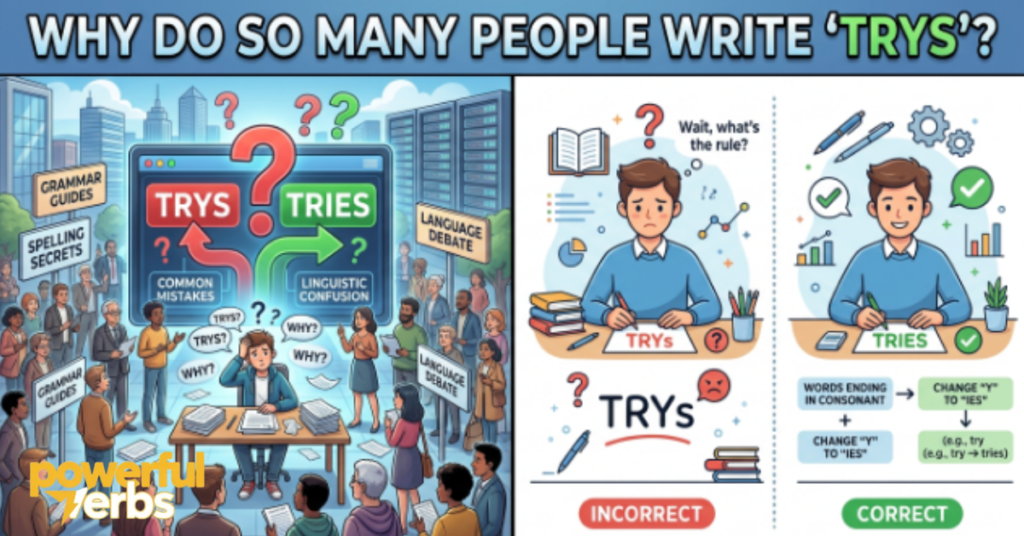
The confusion isn’t random; it actually comes from logical (but incorrect) reasoning. Most English verbs form their third-person singular present tense by simply adding -s: walk → walks, run → runs, play → plays. So it feels natural to assume try should follow the same pattern and become “trys.”
The problem is that try belongs to a different spelling family: verbs that end in a consonant + y. These verbs follow a separate rule, and that’s exactly where the mix-up begins.
The Grammar Rule Behind “Tries”
In English spelling, when a verb ends with a consonant immediately before the letter y, you must:
- Drop the y
- Add -ies instead of -s
So try (t-r-y, with the consonant r right before the y) becomes tries, not “trys.”
Compare it with verbs that end in a vowel + y, which simply take -s with no spelling change at all:
- play → plays (vowel + y, no change)
- stay → stays (vowel + y, no change)
- enjoy → enjoys (vowel + y, no change)
But for consonant + y verbs:
- try → tries
- cry → cries
- fly → flies
- deny → denies
- carry → carries
- study → studies
This single distinction — vowel-before-y versus consonant-before-y — is the entire secret to mastering this rule for hundreds of English verbs, not just try.
Where Does “Try” Come From?
The word try entered English from the Old French verb trier, originally meaning to sift, sort, or separate out. Over centuries its meaning shifted toward “to test” and eventually “to attempt,” which is the meaning we use today. The y-to-ies spelling convention, however, isn’t tied to the word’s French origin — it’s simply a spelling pattern that English settled on to keep pronunciation smooth and consistent across consonant-plus-y verbs.
American English vs British English: Does It Change Anything?
Here’s some reassuring news: this is one grammar rule that doesn’t split along regional lines. Unlike differences such as color vs colour or organize vs organise, the third-person form of try is identical everywhere English is spoken.
| Region | Correct Form | Incorrect Form |
| American English | tries | trys |
| British English | tries | trys |
| Australian English | tries | trys |
| Canadian English | tries | trys |
| Indian English | tries | trys |
Whether you’re writing a US college essay, a UK business email, or an Australian blog post, the spelling stays exactly the same: tries.
Tries vs Tried: A Related Mix-Up
Once writers nail down tries, a second question often pops up: what’s the past tense? The past tense and past participle of try is tried, not “tryed.” The same consonant-plus-y rule applies here too — drop the y, but this time add -ed instead of -ies.
- Present: She tries every recipe in the book.
- Past: She tried every recipe in the book.
- Present participle: She is trying every recipe in the book. (Note: before -ing, the y is kept, so it’s trying, not “tring.”)
Knowing all three forms together — try, tried, trying, tries — removes any future confusion about this verb for good.
Tries in Real Sentences
Seeing a word used naturally helps it stick far better than a rule on its own.
In conversation: “My brother always tries something new on the menu.”
In the workplace: “The support team tries to respond within a few hours.”
In writing and journalism: “The startup tries a fresh strategy every quarter to stay ahead.”
In academic writing: “The researcher tries multiple methods before drawing a conclusion.”
In sports commentary: “The young player tries to outpace every defender on the field.”
Other Verbs That Follow the Same Pattern
Once you understand the logic behind tries, you can apply it instantly to dozens of other common verbs. Here are a few you’ll run into often:
- apply → applies
- worry → worries
- hurry → hurries
- copy → copies
- reply → replies
- supply → supplies
Notice the pattern repeats every time: consonant before y, drop the y, add -ies.
A Simple Memory Trick
If the rule still feels abstract, try this shortcut: picture the y as fragile glass that breaks whenever a consonant stands right next to it, forcing it to turn into an i before -es can be added. Vowels, on the other hand, protect the y, so it survives unchanged. This small mental image is often enough to make the spelling automatic.
Common Mistakes to Avoid
| Mistake | Correction |
| He trys his hardest. | He tries his hardest. |
| She always trys new things. | She always tries new things. |
| The company trys to cut costs. | The company tries to cut costs. |
| He tryed twice. | He tried twice. |
Even a single instance of “trys” in a resume, email, or article can make writing look careless, so it’s worth double-checking before hitting send or publish.
Final Thoughts
The debate between trys and tries really isn’t a debate at all — it comes down to one consistent spelling rule that English applies across an entire group of verbs. Try ends in a consonant plus y, so the y converts to i before adding -es, giving you tries. Once that single principle is locked in, it instantly clears up similar verbs like cries, flies, carries, and applies as well.
Getting this small detail right does more than just satisfy a grammar rule — it makes your writing look polished, professional, and trustworthy, whether you’re sending a work email, writing a school essay, or publishing content online.
see also: Different Types of Guava Fruit & Pictures: 30 Guava Fruit Varieties
FAQs
Is “trys” a real word in any dictionary?
No major dictionary, including Merriam-Webster, Oxford, or Cambridge, lists “trys” as a valid word. It is treated purely as a misspelling of tries.
Why does the y change to i before adding -es?
English spelling avoids placing a consonant directly next to a final y when adding an ending, so the y converts to i to keep the word easier to read and pronounce.
Is “tries” used in past tense?
No, tries is present tense, used only with he, she, or it. The past tense form is tried.
Does the rule apply to all verbs ending in y?
Only to verbs where a consonant comes right before the y. Verbs with a vowel before the y, like play or stay, simply add -s without any spelling change.
Is “tries” also a noun?
Yes, in rugby, a try is a scoring action, and tries is its plural noun form, such as “the team scored three tries.”
Can “trys” ever be acceptable in informal texting or slang?
It may appear casually in texts or social media, but it remains grammatically incorrect in any formal, academic, or professional writing.

Liam Johnson is a dedicated language expert with 4 years of professional experience. He specializes in Grammar, Vocabulary, and Sentence structure.
