

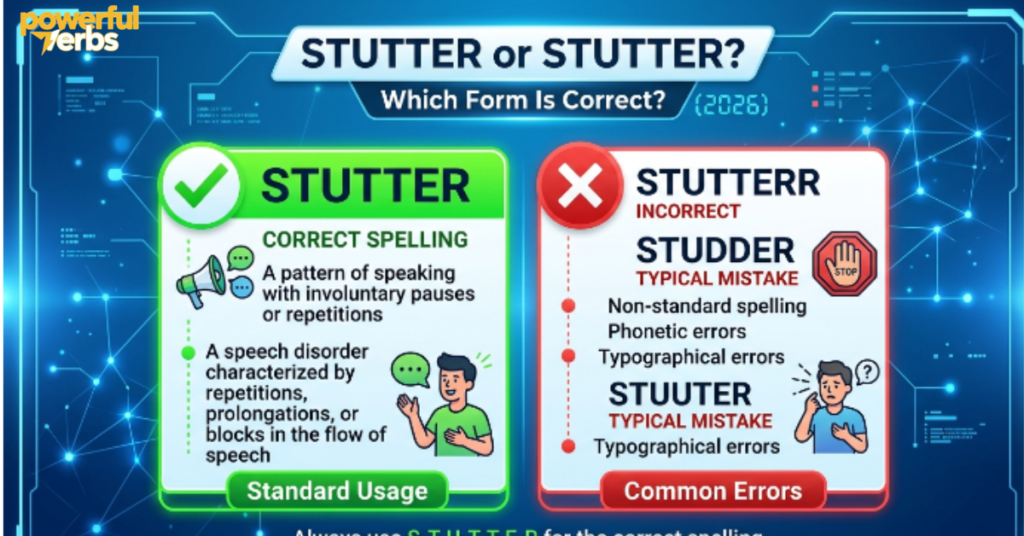
Typing a word and watching your spellchecker quietly switch it to something else is a strange little moment of doubt. That’s exactly what happens to a lot of people with studder — they type it, the system flags it, and suddenly they’re not sure if they ever knew how to spell this word at all. The short version is that studder isn’t a word at all, while stutter is the only form recognized by English dictionaries, speech professionals, and grammar tools alike.
This guide breaks down exactly why the confusion happens, where the real word comes from, how it behaves across different forms of English, and how to use it correctly in real writing — whether that’s an email, a school essay, or content about speech and language development.
see also: Basic Sentences for Grade 4: 250+ Easy Examples with Pictures
Quick Answer
| Spelling | Status |
| Stutter | Correct — listed in every major English dictionary |
| Studder | Incorrect — not a recognized word in any dictionary |
Example: Public speaking made him stutter through the first few lines of his speech. Not: Public speaking made him studder through the first few lines.
What “Stutter” Actually Means
At its core, to stutter is to speak with involuntary breaks — repeated sounds, stretched-out syllables, or sudden pauses that interrupt the natural rhythm of speech. The word works as both a verb and a noun:
- Verb: She stutters slightly when she’s put on the spot.
- Noun: He’s had a stutter since he was a young child.
In speech-language pathology, this pattern falls under what’s known as a fluency disorder — a disruption in the smooth flow of speech that can show up as sound repetitions, blocks, or prolonged syllables. That clinical background is part of why getting the spelling right matters more here than with an average word: this term shows up constantly in health, education, and therapy-related writing.
Why So Many People Write “Studder” Instead
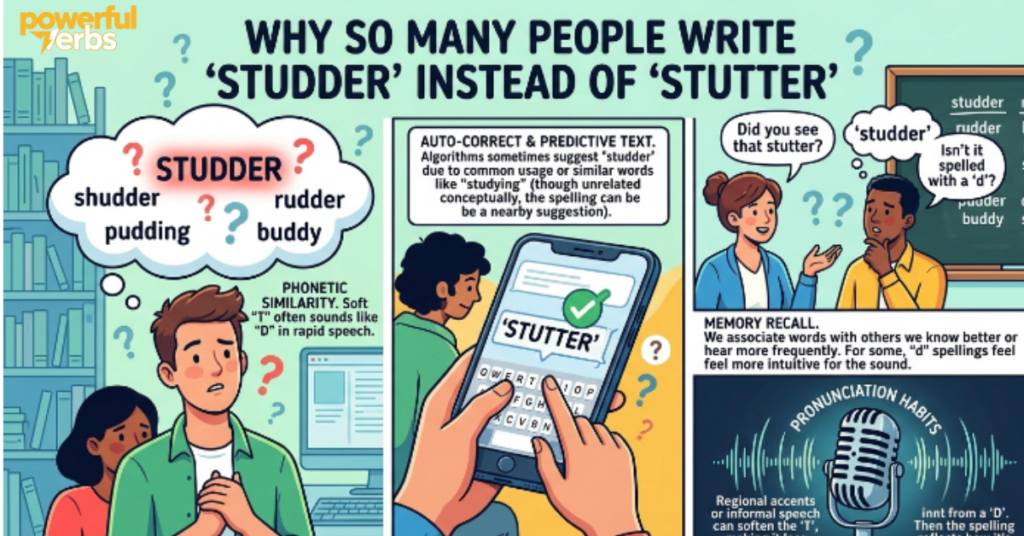
This isn’t really a case of bad spelling habits — it’s a pronunciation trap. A few things push people toward the wrong version:
- The double t in stutter softens in casual speech, landing somewhere between a “t” and a “d” sound.
- Certain regional accents naturally flatten that consonant even further.
- Many learners spell new vocabulary the way it sounds rather than the way it’s written, which works fine for phonetic languages but trips people up in English.
None of that makes studder acceptable in writing — it just explains why the mistake is so common.
Where the Word “Stutter” Comes From
Stutter has roots that stretch back several centuries in the English language, tracing to older West Germanic word forms tied to ideas of knocking, striking, or repeating a motion — the same root family that gave related languages their own words for halting speech, such as Dutch’s stotteren and German’s stottern. Over time, English settled on the doubled-t spelling we use today, and it has stayed remarkably stable ever since. Studder, by contrast, has no etymological lineage at all — it’s purely a modern misspelling, not an older or alternate form of the word.
Does British English Spell It Differently?
No — and that’s actually worth pointing out, because plenty of English words do split between American and British spelling (think colour/color or organise/organize). Stutter is not one of them.
| Region | Accepted Spelling |
| American English | Stutter |
| British English | Stutter |
| Australian English | Stutter |
| Canadian English | Stutter |
Wherever your audience is based, the spelling never changes.
Stutter vs. Stammer — Same Thing, Different Word Choice
Here’s a detail most spelling guides skip entirely: stammer is essentially the same concept, just favored in a different dialect. American English leans heavily on stutter, while British and Commonwealth English often reaches for stammer instead. Both describe the identical speech pattern — broken fluency, repeated sounds, involuntary pauses — and neither is more “correct” than the other. They’re regional preferences, not separate definitions.
see also: 550+ Common Nouns List A to Z | Examples in English
How the Word Changes Across Sentences
Like most English verbs, stutter shifts form depending on tense and usage:
| Form | Example |
| Stutter (base) | Try not to stutter during the interview. |
| Stutters (present, singular) | He stutters whenever he’s anxious. |
| Stuttered (past) | She stuttered through her first toast as maid of honor. |
| Stuttering (continuous) | The engine kept stuttering before it finally started. |
Notice that last example — stutter isn’t limited to human speech. It’s also used for anything that moves in a halting, irregular rhythm, from engines to internet connections to old film projectors.
Using “Stutter” Correctly in Real Writing
Casual/Social: Nerves got the better of me and I stuttered through the toast. News/Editorial: Early intervention and speech therapy can significantly reduce stuttering in young children. Academic/Clinical: The study examines disfluency patterns in adults who stutter. Workplace Email: He mentioned he tends to stutter under pressure, so we’ll keep the presentation low-key.
Related Words Worth Knowing (and Not Confusing)
A handful of terms tend to circle the same topic and are worth keeping straight:
- Stammer — British-leaning synonym for stutter
- Disfluency — the clinical umbrella term for any interruption in normal speech flow
- Speech impediment — a broader phrase covering stuttering along with other articulation issues
- Falter — a more general word for hesitating, not specific to speech disorders
- Block — a speech therapy term for a moment where sound gets fully stuck before release
Other Misspellings That Show Up Alongside “Studder”
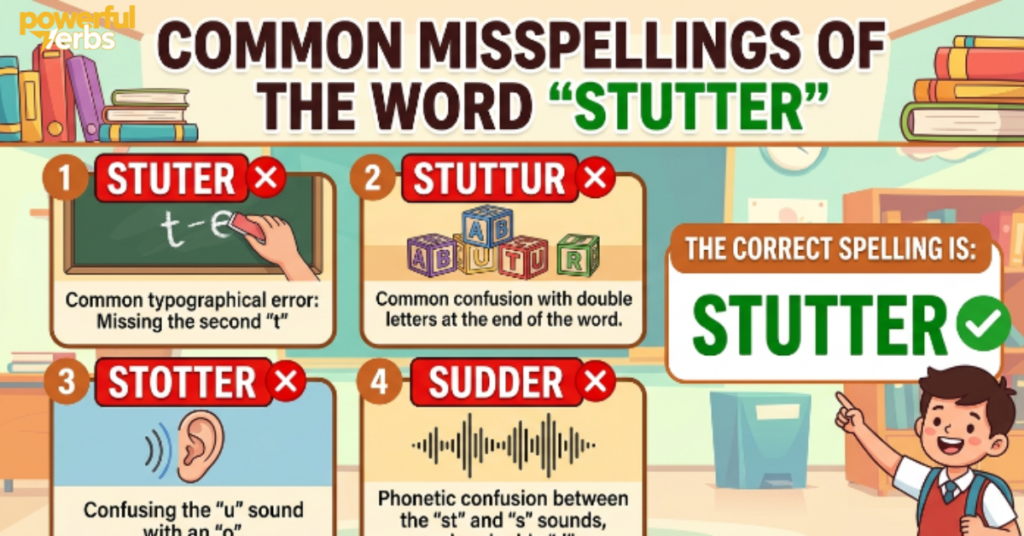
Studder isn’t the only variant that trips people up. Less common but still incorrect forms include stuter, stuttar, and studar — all of which trace back to the same pronunciation confusion. None of these appear in dictionaries, and all are flagged automatically by spellcheck tools.
Studder vs. Stutter at a Glance
| Category | Studder | Stutter |
| Dictionary status | Not listed | Listed in all major dictionaries |
| Used in medical/clinical writing | Never | Standard term |
| Accepted in US English | No | Yes |
| Accepted in UK English | No | Yes |
| Safe for professional or academic writing | No | Yes |
Conclusion
The mix-up between studder and stutter almost always comes down to how the word sounds rather than how it’s actually written. Once you know the rule, there’s nothing left to second-guess: stutter is the only spelling recognized in English, across every region, every dialect, and every style guide. Studder isn’t an alternate spelling, a regional variant, or an older form — it’s simply not a word.
When in doubt, remember the shape of the correct version: double t, no d, and it works the same whether you’re writing for a US audience, a UK audience, or anywhere else English is read.
see also: 150+ Simple Short Sentences for Grade 3 to Read and Write Easily
FAQs
Is “studder” a real word in any dictionary?
No. It doesn’t appear in Merriam-Webster, Oxford, Cambridge, or any other major dictionary — it’s treated purely as a misspelling.
Why does stutter sometimes sound like it’s spelled with a “d”?
The double-t sound naturally softens in fast or casual speech, which can make it sound closer to a “d” than it actually is.
Is the spelling different between American and British English?
No. Unlike many words with regional spelling splits, stutter is spelled exactly the same everywhere.
What’s the real difference between stutter and stammer?
There isn’t one in meaning — they describe the same speech pattern. Stutter is more common in American English, while stammer is preferred in British English.
Is stuttering considered a medical condition?
Yes. It’s classified as a fluency disorder in speech-language pathology and is commonly treated through speech therapy.
Does misspelling it as “studder” really matter in professional writing?
Yes. In health, education, or any content discussing speech and communication, an obvious misspelling can undercut the credibility of the entire piece.

Liam Johnson is a dedicated language expert with 4 years of professional experience. He specializes in Grammar, Vocabulary, and Sentence structure.
