

When you sit down to write a quick email, send a morning text, or craft a professional letter, a surprisingly common question stops many writers in their tracks: is “good morning” one word or two? The answer matters more than most people realize — especially in professional settings where spelling errors can quietly damage your credibility.
This comprehensive guide covers everything you need to know about the correct spelling of “good morning,” why the confusion exists, how it compares to similar greetings like “goodnight” and “goodbye,” and how to use it perfectly across every writing context.
The Direct Answer: “Good Morning” Is Always Two Words
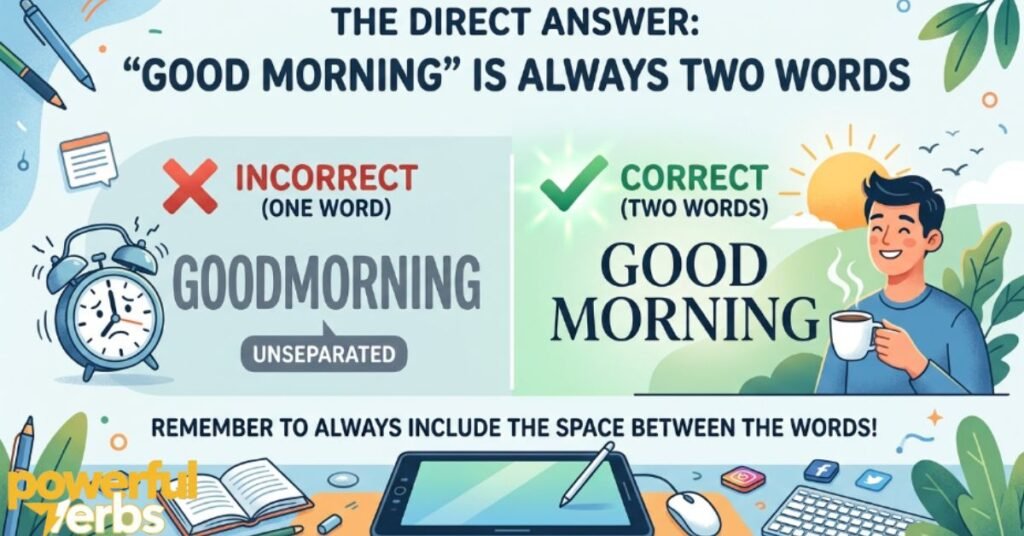
“Good morning” is written as two separate words — always, without exception, in every context.
“Goodmorning” as a single merged word does not exist in any standard English dictionary, including Merriam-Webster, Oxford, Cambridge, and Collins. It is a spelling error, not an informal variant or acceptable alternative. Whether you are writing a formal business email, a casual text message, a greeting card, or a social media caption, the correct form is always the two-word version: good morning.
Why “Good Morning” Is Two Words: The Grammar Explanation
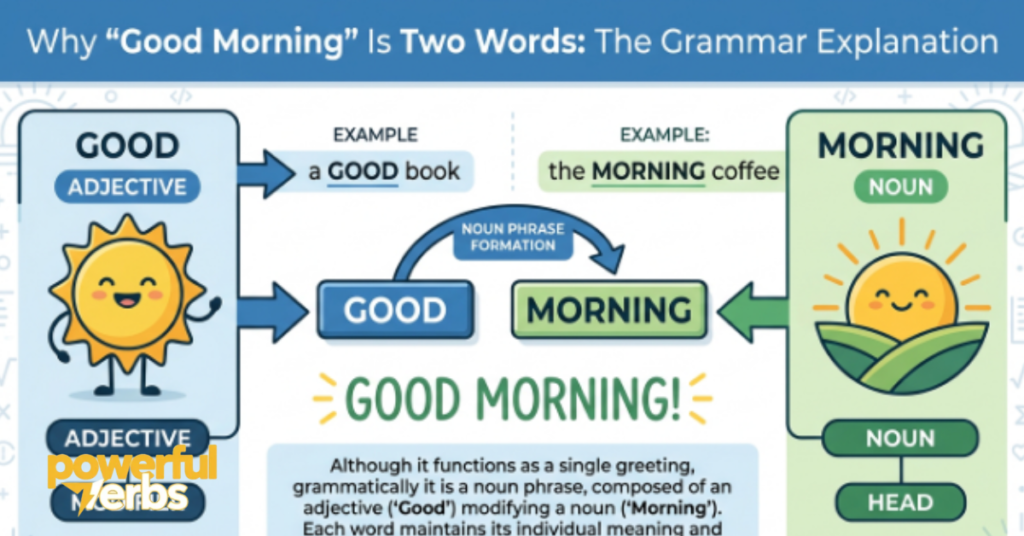
To understand why “good morning” stays as two words, you need to look at its grammatical structure. The phrase is built from two independently functioning words:
“Good” — an adjective meaning pleasant, favorable, or of high quality.
“Morning” — a noun referring to the early part of the day, typically from sunrise until noon.
Together, they form an adjective-noun phrase in which “good” describes the quality of the “morning” being referenced. Both words carry their own distinct meaning, and neither word has lost its original identity through the pairing. This is the key reason they remain separate.
Compare this to how you would use “good” with other nouns in everyday English. You write “good food,” “good weather,” “good news,” and “good advice” — never “goodfood,” “goodweather,” or “goodnews.” The same grammatical rule applies to “good morning.”
Linguists refer to this as an open compound — a multi-word expression in which the individual words maintain a space between them because they have not yet undergone lexical fusion. “Good morning” is, and has remained, an open compound throughout the history of the English language.
In plain terms, “good morning” simply means you’re wishing someone a pleasant, favorable start to their day — it’s a direct, literal combination of its two parts, which is exactly why the words never needed to fuse into one.
The History Behind the Phrase “Good Morning”

The phrase “good morning” has roots going back to Middle English. Historically, it was a shortened form of expressions like “I wish you a good morning” or “God give you a good morning.” Over centuries, the full expression contracted into the simple two-word salutation we use today.
Despite this compression, the phrase never merged into a single word the way some other English expressions did. Historians of English linguistics attribute this to the fact that “good morning” retained strong semantic transparency — both words continued to be understood separately by speakers, so there was no pressure to merge them.
This historical context also explains why the phrase appears consistently as two words across centuries of written English literature, legal documents, correspondence, and published works.
“Goodnight” vs. “Good Morning”: Why One Is One Word and the Other Is Two
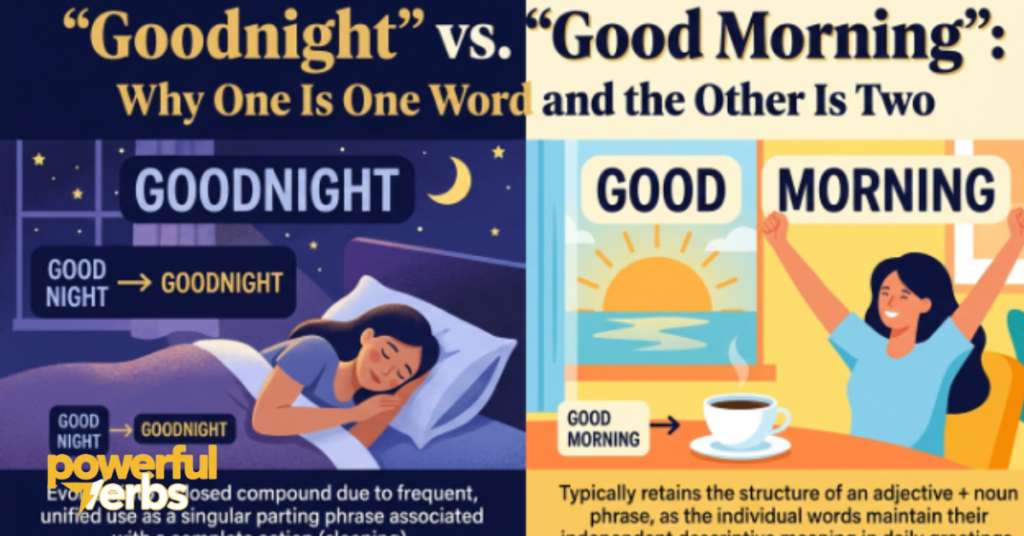
This is the single biggest source of confusion around this topic, and it deserves a thorough explanation.
“Goodnight” is commonly written as one word. “Good morning” is always two words. Why does this difference exist?
The answer lies in how each expression has evolved grammatically over time.
“Goodnight” underwent a process called lexical compounding — the fusion of two words into one — because it expanded beyond its role as a simple greeting. In modern English, “goodnight” functions as:
A noun: “She said her goodnights and left the party.”
A compound adjective: “He gave her a goodnight kiss on the cheek.”
A standalone expression: “Goodnight, room. Goodnight, moon.” (as in the famous children’s book title)
Because “goodnight” took on these additional grammatical roles beyond greeting alone, the two words fused together through repeated use. This process is common in English — when a phrase begins functioning as a single semantic unit across multiple grammatical categories, the words tend to merge.
“Good morning,” by contrast, functions almost exclusively as a salutation. It is used to greet someone in the morning — and that is essentially its only role. It does not function as a compound adjective (“a good morning kiss” keeps both words separate), and it rarely appears as a standalone noun in the way “goodnight” does. Because “good morning” has remained a pure greeting without expanding into other grammatical categories, the two words have not merged.
| Expression | Written Form | Primary Grammatical Function |
| Good morning | Two words | Salutation only |
| Good afternoon | Two words | Salutation only |
| Good evening | Two words | Salutation only |
| Good day | Two words | Salutation only |
| Goodnight | One word | Salutation + noun + compound adjective |
| Goodbye | One word | Farewell; fully fused compound |
The Full Pattern: All Time-of-Day Greetings Follow the Same Rule
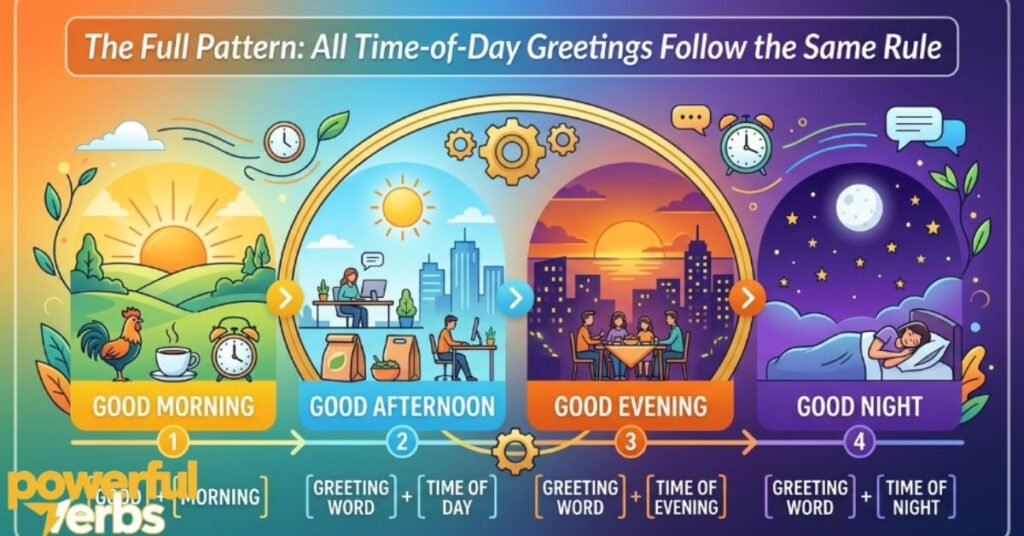
One of the clearest ways to remember the correct spelling of “good morning” is to recognize that it belongs to a consistent family of English time-of-day greetings — all of which are written as two words.
Good morning — used from roughly midnight to noon
Good afternoon — used from noon to approximately 5 or 6 PM
Good evening — used from early evening through the night when greeting someone
Good day — a more formal greeting used during daylight hours, common in British and Australian English
Every single time-of-day greeting in standard English follows the two-word pattern. There are no exceptions within this category. “Goodnight” is not a time-of-day greeting in the same functional sense — it is a farewell, and its grammatical evolution followed a different path.
Knowing this pattern means you never need to second-guess the spelling of any of these greetings again.
Capitalization Rules for “Good Morning”
Spelling it correctly as two words is essential, but capitalization is another area where writers frequently make errors.
At the start of a sentence — capitalize both words:
“Good morning, everyone. Please take your seats.”
As an email salutation — capitalize both words:
“Good Morning, Dr. Ahmed,” or “Good morning, Dr. Ahmed,” (both are acceptable; consistency matters more than which style you choose)
Mid-sentence — use lowercase:
“She walked in and said good morning before sitting down.”
As part of a title or heading — follow the capitalization style of the surrounding text (title case capitalizes both: “Good Morning”)
A common error is writing “Good Morning” with both words capitalized in mid-sentence contexts where only the first word should be capitalized (if it begins the sentence) or neither word should be capitalized (if it appears in the middle of a sentence).
Correct Usage Across Every Writing Context
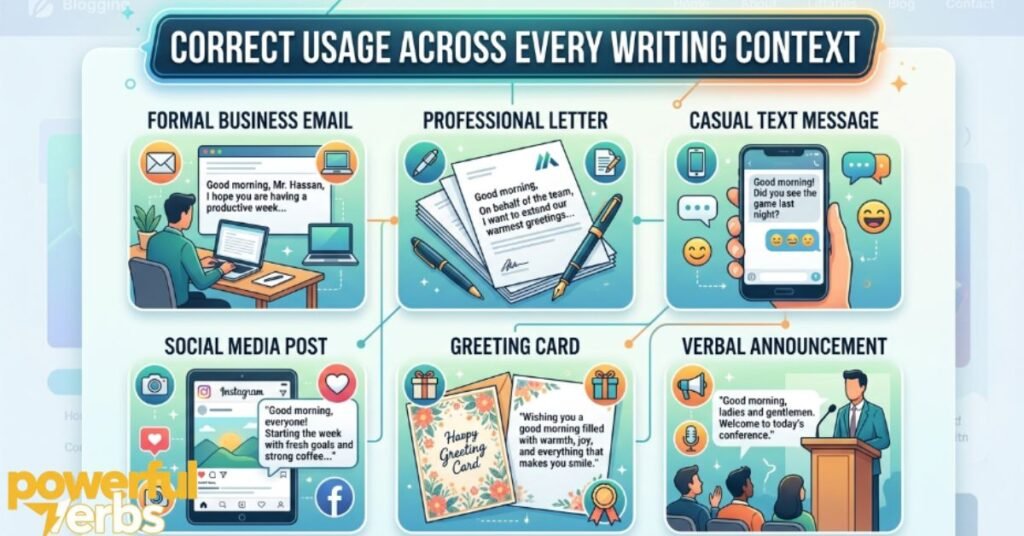
Formal Business Email
Good morning, Mr. Hassan,
I hope you are having a productive week. I am writing to follow up on the proposal submitted last Thursday.
Professional Letter
Good morning,
On behalf of the team, I want to extend our warmest greetings and express our gratitude for your continued partnership.
Casual Text Message
Good morning! Did you see the game last night?
Social Media Post
Good morning, everyone! Starting the week with fresh goals and strong coffee. What are you working on today?
Greeting Card
Wishing you a good morning filled with warmth, joy, and everything that makes you smile.
Verbal Announcement
Good morning, ladies and gentlemen. Welcome to today’s conference.
In every single context above, “good morning” appears as two words. There is no situation in standard written English where “goodmorning” as one word would be correct.
Other Ways to Say “Good Morning”
If you send the same greeting every day, switching it up occasionally keeps your messages from feeling like a template. A few natural alternatives:
- “Rise and shine!” — casual, upbeat
- “Top of the morning to you!” — playful, slightly old-fashioned
- “Hope you’re having a great start to your day” — professional, works well in emails
- “Morning!” — a shortened, informal version common in texts and Slack messages
- “Wishing you a wonderful morning” — warmer, suited to greeting cards or personal notes
None of these replace “good morning” as the standard, correct greeting — they’re simply variations worth having on hand when you want the message to feel less repetitive.
Spelling Mistakes to Avoid
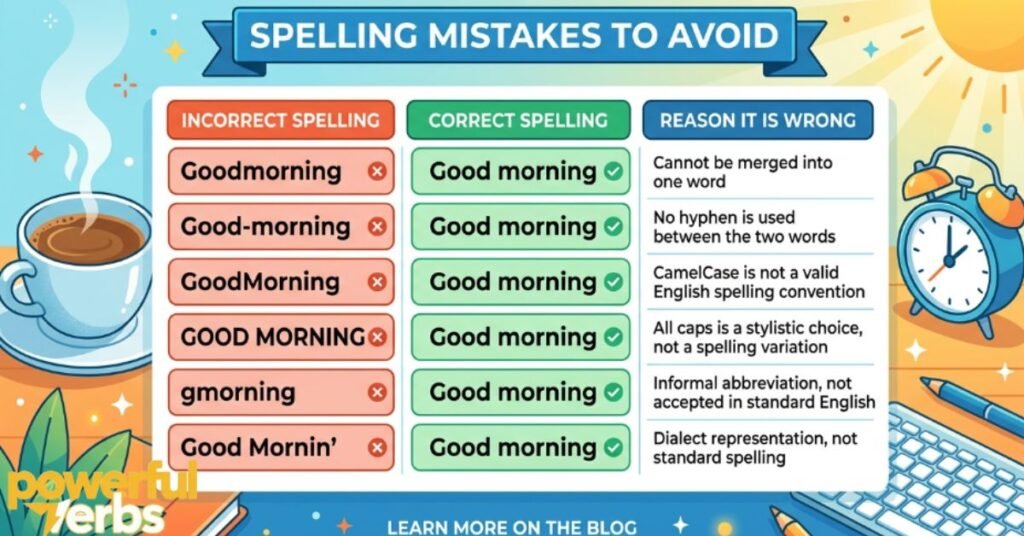
| Incorrect Spelling | Correct Spelling | Reason It Is Wrong |
| Goodmorning | Good morning | Cannot be merged into one word |
| Good-morning | Good morning | No hyphen is used between the two words |
| GoodMorning | Good morning | CamelCase is not a valid English spelling convention |
| GOOD MORNING | Good morning | All caps is a stylistic choice, not a spelling variation |
| gmorning | Good morning | Informal abbreviation, not accepted in standard English |
| Good Mornin’ | Good morning | Dialect representation, not standard spelling |
Small letter mix-ups trip people up across English — check our guide on Studder or Stutter for another one.
What Autocorrect Tells Us About the Correct Spelling

Modern autocorrect systems on smartphones, tablets, and computers consistently flag “goodmorning” as a misspelling and suggest “good morning” as the correction. This behavior is not arbitrary — these systems are built on large databases of standard English vocabulary drawn from dictionaries, published literature, and verified written sources.
The fact that autocorrect does not recognize “goodmorning” as a valid word is itself a reflection of how thoroughly the one-word version is excluded from standard English. If you have ever typed “goodmorning” and watched your phone correct it automatically, that correction is linguistically accurate.
A Simple Memory Method That Actually Works
If you want a reliable way to remember that “good morning” is always two words, use this mental check:
Say the full sentence: “I wish you a good morning.”
Notice that the word “a” appears between “wish you” and “morning.” That article (“a”) signals that “morning” is functioning as an independent noun — and an adjective cannot fuse with a noun that takes its own article in front of it. If you can place “a” between “good” and “morning,” they belong as two separate words.
Try it with the other greetings:
“I wish you a good afternoon.” ✔ Two words.
“I wish you a good evening.” ✔ Two words.
“I wish you a good day.” ✔ Two words.
This simple test works every time and removes all doubt.
Verb-form confusion is just as common — see our guide on Trys or Tries for another quick fix.
Summary
“Good morning” is two words — in every context, at every time of day, in every style of writing. The one-word version “goodmorning” is a misspelling with no standing in standard English grammar. The confusion with “goodnight” is understandable, but it comes from a fundamental difference in how the two expressions evolved grammatically over time.
By remembering that all time-of-day greetings follow the two-word pattern, and by using the “I wish you a good morning” test when in doubt, you will spell this common salutation correctly every single time.
FAQs
Is “good morning” one word or two words?
“Good morning” is always two separate words. The merged version “goodmorning” is a spelling error not recognized by any standard English dictionary.
Why is “goodnight” one word but “good morning” is two?
“Goodnight” expanded beyond a simple greeting to function as a noun and compound adjective, causing its two words to fuse over time. “Good morning” has remained a pure salutation, so its words have stayed separate.
Is “good morning” hyphenated?
No. “Good-morning” with a hyphen is not correct in standard English. The two words appear side by side with only a space between them, never a hyphen.
How should “good morning” be capitalized in an email?
As an email salutation, capitalize both words: “Good morning, [Name],” — followed by a comma. Mid-sentence, use lowercase: “She said good morning and sat down.”
Does the two-word rule apply to “good afternoon” and “good evening” too?
Yes. All time-of-day greetings in English — good morning, good afternoon, good evening, and good day — follow the same two-word pattern without exception.
Is “goodbye” one word or two?
“Goodbye” is one word. Unlike “good morning,” it has fully merged through centuries of use and is now universally written as a single compound word in standard English.

Liam Johnson is a dedicated language expert with 4 years of professional experience. He specializes in Grammar, Vocabulary, and Sentence structure.
