

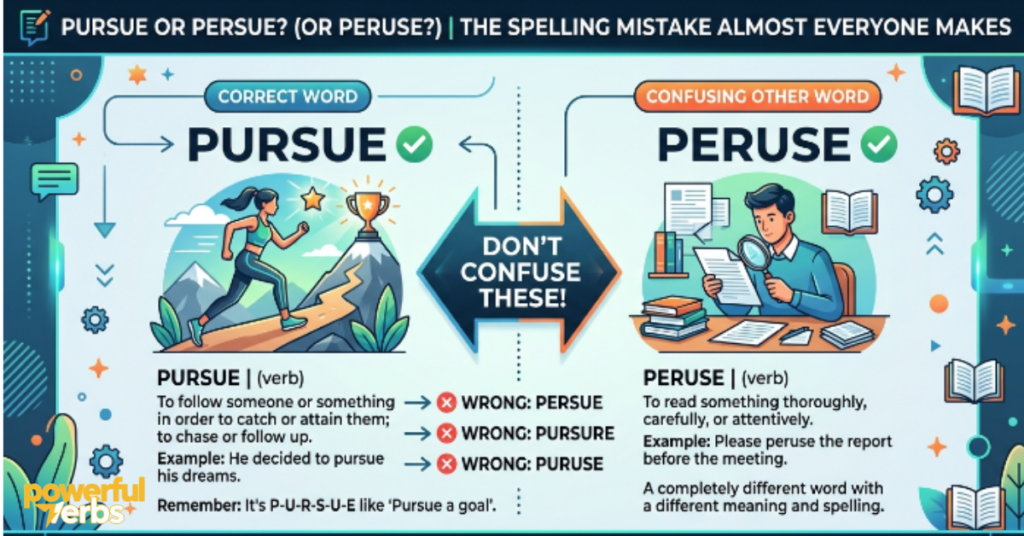
Open your phone, start typing the word that means to chase a goal with everything you’ve got, and there’s a good chance your fingers land on p-e-r-s-u-e before your brain catches the mistake. You’re not careless, and you’re definitely not alone. This is one of the most commonly misspelled words in English, and once you understand exactly why your brain keeps reaching for the wrong version, the correct spelling becomes almost impossible to forget.
see also: Eyeing vs Eying: Which Spelling Is Correct? (2026 Guide)
Pursue or Pursue?
Pursue is the only correct spelling. Persue is not a recognized word in any English dictionary, whether American, British, Canadian, or Australian. If you remember nothing else from this guide, remember that the letter R appears only once, right after the P, and never again later in the word.
Why Your Brain Wants to Write “Pursue” (And Why It’s Wrong)
English spelling and English pronunciation frequently disagree with each other, and pursue is a textbook example of that disconnect. When you say the word out loud, it sounds close to “per-soo,” with a faint hint of an R rolling through the middle. Your brain, trying to be efficient, spells what it hears rather than what the word actually looks like on the page.
The problem is that pursue inherited its spelling from a much older source language, not from how modern English speakers happen to pronounce it. That mismatch between sound and spelling is exactly why so many otherwise strong writers stumble on this one word.
What Does Pursue Actually Mean?

At its core, pursue describes the act of chasing after something with effort, intention, and follow-through. It can describe a literal chase, like a detective pursuing a suspect through city streets, or a figurative one, like a student pursuing a degree over several demanding years.
The word carries a sense of commitment that softer alternatives don’t always capture. Saying you pursue a goal suggests you’re actively moving toward it, not simply hoping it happens on its own.
Where Does the Word “Pursue” Come From?
Pursue traces back to the Old French word poursuivre, which itself descended from the Latin verb sequi, meaning to follow. That same Latin root also gave English words like sequence, consequence, and sequel, all of which share the underlying idea of one thing following another.
By the time the word settled into Middle English, its spelling had already absorbed influences from French scribes, which explains why pursue doesn’t follow a simple, phonetic English pattern. Its spelling is essentially a historical fossil, preserved long after its pronunciation shifted.
Pursue vs Persue: Side-by-Side Comparison
| Detail | Pursue (Correct) | Persue (Incorrect) |
| Recognized in dictionaries | Yes | No |
| Origin | Old French / Latin “sequi” | Not a real word, a phonetic guess |
| Acceptable in formal writing | Yes | Never |
| Why it appears | Correct historical spelling | Spelled the way it sounds |
Common Ways People Misspell Pursue
Persue isn’t the only variation that trips writers up. Some people drop a letter entirely and write pursu, leaving the word looking incomplete. Others rearrange the middle letters and land on something closer to puruse, which happens to look suspiciously similar to the unrelated word peruse, adding an extra layer of confusion since peruse actually means to read or examine closely, a completely different meaning altogether.
Recognizing these patterns helps you catch the mistake before autocorrect even gets a chance to flag it.
Pursue in Everyday Sentences
The word shows up constantly once you start paying attention. A recent graduate might pursue a first job in their field. A small business owner might pursue new clients through referrals. A runner training for a marathon might pursue a personal best through months of early mornings.
In each case, the verb signals ongoing effort rather than a single, finished action, which is part of why it appears so often in writing about goals, ambitions, and long-term plans.
Synonyms for Pursue and When to Use Them

Choosing the right synonym depends on tone. Chase feels energetic and immediate, suited to physical action or urgent goals. Seek leans more formal and reflective, often paired with abstract ideas like seeking wisdom or seeking approval. Strive for emphasizes effort and struggle, while go after feels casual and conversational, fitting for everyday speech rather than formal writing.
Swapping in the right synonym occasionally keeps writing from feeling repetitive, but pursue remains the strongest choice whenever you want to communicate sustained, purposeful effort.
Pursue in Professional, Academic, and Legal Writing
Few verbs cross over as smoothly between industries as pursue. In legal writing, prosecutors pursue cases and attorneys pursue settlements, language that signals a matter remains active rather than abandoned. In academic writing, researchers pursue grants, students pursue degrees, and institutions pursue accreditation, each instance pointing toward a long-term, deliberate process.
Business writing leans on it just as heavily, with companies pursuing partnerships, market share, or new revenue streams. Across all three fields, the word does double duty: it sounds professional while still clearly communicating effort and direction.
see aslo: Using or Using: Correct Spelling, Rules & Examples (2026)
Pursuing vs Pursuing: Does the Mistake Carry Over to Other Forms?
Yes, and this is where the error tends to multiply. Once someone misspells the base word as persue, the mistake naturally extends into related forms like persuing instead of pursuing, or persued instead of pursued. Every conjugated form of the verb inherits the same single, correctly placed R, so fixing the root spelling automatically fixes every other form built from it.
A Simple Trick to Never Misspell Pursue Again
Here’s a memory anchor that sticks. Picture the word as two small chunks: PUR, like the sound a contented cat makes, and SUE, like the common name Sue. Pur plus Sue equals pursue. That single mental image keeps the R locked in its correct position right after the P, and it becomes nearly impossible to accidentally slide it further into the word once you’ve pictured it that way.
FAQs
Is persue ever an acceptable alternative spelling of pursue?
No. Persue does not appear in any standard English dictionary and is considered an incorrect spelling in both American and British English.
Why does pursue sound like it has an R in the middle but doesn’t?
The R you hear comes from natural pronunciation patterns, but the word’s spelling preserves its Old French and Latin origins rather than following modern pronunciation.
Does the same spelling rule apply to pursuing and pursued?
Yes. Every form of the verb keeps the single R right after the P, so pursuing and pursued follow the same pattern as pursue.
What’s an easy way to remember the correct spelling?
Break the word into “pur,” like a cat’s purr, and “sue,” like the name. Together they form pursue, with the R staying close to the start of the word.
Is pursue considered formal or informal English?
Pursue works well in both contexts. It feels natural in casual conversation while also fitting comfortably into academic, legal, and professional writing.
Are there other English words with a similar spelling-versus-pronunciation mismatch?
Yes. Words like though, knife, and Wednesday all keep silent or unexpected letters that don’t match how they’re actually pronounced, much like pursue.
Final Thought
Pursue might feel like the more intuitive way to spell this word, but intuition and English spelling don’t always agree. Pursue carries centuries of linguistic history in its five letters, and once that single, correctly placed R clicks into your memory, you won’t have to pause and second-guess yourself again. Spelling it right is a small detail, but it’s exactly the kind of small detail that quietly signals careful, confident writing.

Liam Johnson is a dedicated language expert with 4 years of professional experience. He specializes in Grammar, Vocabulary, and Sentence structure.
