

Two words. One sounds fancy. One sounds like a rap lyric. But “bougie” and “boujee” are not the same—and mixing them up is one of the most common language mistakes on the internet today. This guide breaks down everything you need to know about both words, from their origins to how to use them correctly in 2026.
Whether you’re writing a caption, texting a friend, or just curious about modern slang, this guide covers it all—clearly and completely.
Introduction
Language never stops evolving. Every few years, new words enter everyday conversation—and sometimes two words that sound almost identical end up meaning completely different things. That is exactly what happened with “bougie” and “boujee.” One is rooted in European class politics. The other was born from hip-hop culture and Black American expression. Both are used daily on social media, in conversations, and even in news articles. But most people use them without really knowing the difference.
This guide is your complete reference. By the end, you will know exactly what each word means, where it came from, how to use it, and when to avoid it altogether.
Quick Answer (Featured Snippet Target)
Bougie = acting upper-class or snobby, often used in a teasing or negative way. It comes from the French word “bourgeois.”
Boujee = living a high-class, luxury lifestyle while staying true to where you came from. It was popularized by Migos’ hit song “Bad and Boujee” in 2016.
They sound almost identical but carry very different cultural meanings and tones. Using the wrong one in the wrong context can change your entire message.
Meaning & Basics
What Does “Bougie” Mean?
“Bougie” is a slang word used to describe someone who acts rich, pretentious, or above their actual social class. It often carries a slightly negative or teasing tone. When someone calls you “bougie,” they usually mean you are being unnecessarily fancy, snobby, or out of touch with regular people.
It is commonly used—like conversation—to poke fun at someone who takes simple things too seriously, like insisting on expensive coffee or turning their nose up at fast food.
Examples:
- “She won’t eat at any restaurant without a dress code. So bougie.”
- “He bought a $200 candle for his apartment. That’s very bougie of him.”
- “Don’t be bougie — just grab a seat wherever.”
What Does “Boujee” Mean?
“Boujee” means someone who has achieved a luxurious, high-quality lifestyle—nice clothes, nice places, high standards—but without losing their authentic, down-to-earth roots. In hip-hop culture and AAVE (African American Vernacular English), being “boujee” is often a compliment. It means you worked hard, you made it, and you enjoy the finer things—but you haven’t forgotten where you started.
Unlike “bougie,” being called “boujee” is usually something to be proud of.
Examples:
- “She grew up with nothing, and now she’s living boujee—that’s real success.”
- “We’re having a boujee night out — rooftop dinner and everything.”
- “His whole vibe is boujee, but he’s still the most down-to-earth person I know.”
Are Bougie and Boujee the Same?
No — they are not the same, even though they sound nearly identical when spoken aloud. “Bougie” comes from a French political term and is often used to mock or tease. “Boujee” comes from African American Vernacular English and is usually used as a compliment or positive self-description. Same sound, very different energy, very different cultural roots.
Key Difference Between Bougie vs Boujee
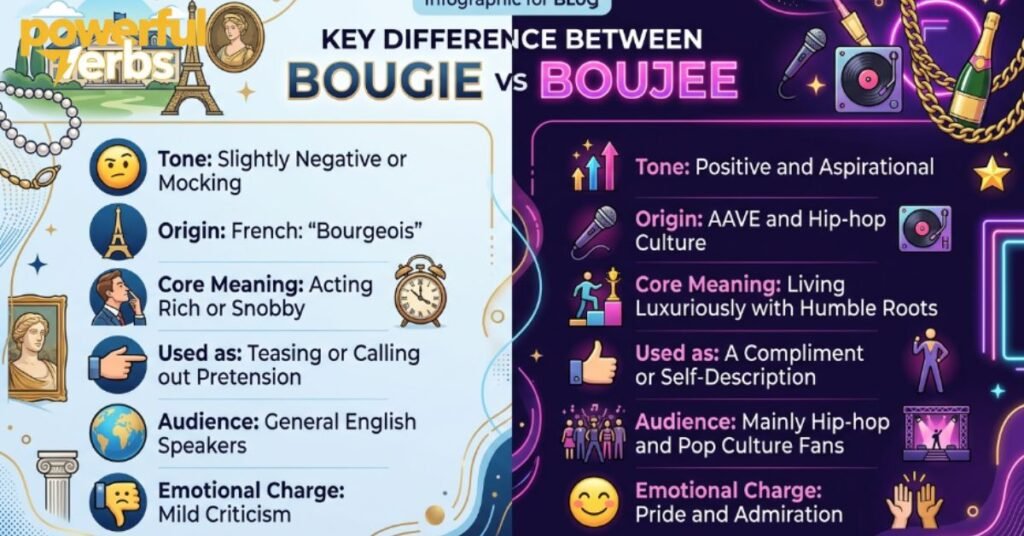
| Feature | Bougie | Boujee |
| Tone | Slightly negative or mocking | Positive and aspirational |
| Origin | French — “bourgeois” | AAVE and Hip-hop culture |
| Core meaning | Acting rich or snobby | Living luxuriously with humble roots |
| Used as | Teasing or calling out pretension | A compliment or self-description |
| Audience | General English speakers | Mainly hip-hop and pop culture fans |
| Emotional charge | Mild criticism | Pride and admiration |
Origin & Evolution
The Origin of Bougie (From “Bourgeois”)
“Bougie” is a shortened, informal version of “bourgeois”—a French word that originally described the middle and upper-middle class in European society. In political theory, especially in Marxist thought, the “bourgeoisie” referred to the wealthy class that owned property and businesses, as opposed to the working class.
Over time, “bourgeois” entered English as a way to describe materialistic, status-obsessed behavior. By the late 20th century, it was being shortened to “bougie” in casual American speech. Today, it no longer carries any political meaning — it simply means someone who acts fancy, privileged, or out of touch.
How “Boujee” Became Popular in Slang
“Boujee” existed in African American communities long before it went mainstream. It was a variation of “bourgie”—itself a slang spin on “bourgeois”—but with a distinct cultural twist. In AAVE, the word evolved to mean something different: not pretension, but earned luxury.
The word exploded globally in late 2016 when Atlanta rap group Migos released “Bad and Boujee.” The song reached number one on the Billboard Hot 100 and introduced the spelling “boujee” to millions of people worldwide. From that point, the word became a permanent fixture of internet culture, music, fashion, and everyday slang.
How the Meaning Has Changed Over Time
Both words have shifted significantly over the decades. “Bougie” went from a political term to a lighthearted insult. “Boujee” went from niche slang to a global pop culture term. Today, in 2026, both words are widely understood—but their tones remain distinct. “Bougie” still carries a hint of mockery. “Boujee” still carries a sense of pride and self-celebration. The internet has blurred the lines somewhat, but the core emotional difference remains intact.
Usage & Context
How to Use Bougie in Sentences
Use “bougie” when you want to describe someone or something as unnecessarily fancy, pretentious, or out of touch. It works well in casual, humorous, or light teasing contexts.
- “This café charges $8 for toast. That is bougie.”
- “She’s too bougie to take the subway.”
- “I feel kind of bougie ordering sparkling water at a pizza place.”
- “They turned a simple birthday party into a bougie gala.”
How to Use Boujee in Sentences
Use “boujee” when you want to describe someone living their best, most elevated life—especially when they have worked hard to get there. It is most natural in complimentary or celebratory contexts.
- “We’re going full boujee this weekend—spa day, fancy dinner, the works.”
- “She’s boujee now but she never forgot her roots.”
- “That apartment is straight-up boujee — marble floors and everything.”
- “My whole mood this year is boujee and unbothered.”
Bougie vs Boujee in Everyday Conversation
In day-to-day talking, “bougie” is more common among people who want to tease a friend lightly. “Boujee” is more common in hip-hop-influenced speech, pop culture talk, and self-expression. You will hear “bougie” used by people of all backgrounds. “Boujee” is more closely tied to Black American culture and music communities, though it has spread widely into mainstream usage.
Bougie vs Boujee on Social Media
On platforms like Instagram, TikTok, and Twitter/X, both words appear constantly. “Boujee” dominates aesthetic content—luxury travel photos, fashion posts, restaurant check-ins. “Bougie” appears more in memes, jokes, and commentary posts calling something out as unnecessarily fancy. Hashtags like #boujeelife and #bougiethings both exist and pull very different types of content.
Spelling & Language Rules
British English vs American English Usage
Both words are primarily American in origin and usage. British English speakers are more likely to use “bourgeois” in its full form rather than either slang version. However, as American pop culture spreads globally, both “bougie” and “boujee” are now recognized in the UK, Australia, and beyond—especially among younger speakers.
Which Spelling Should You Use?
Use “bougie” when you mean pretentious or acting above your station. Use “boujee” when you mean luxurious living with an authentic, hip-hop-influenced connotation. Never swap the spellings — each one signals a specific meaning and cultural context. Using “boujee” when you mean the critical version, or “bougie” when you mean the celebratory version, sends the wrong message entirely.
Is “Boujee” Grammatically Correct?
“Boujee” is not a standard dictionary word in formal grammar—it is slang. However, slang is a valid and recognized form of language, especially in informal writing, social media, and creative content. “Boujee” is accepted in pop culture writing, lifestyle blogs, music journalism, and casual speech. Do not use it in academic papers or formal reports.
Examples Section
Bougie vs Boujee in Casual Conversations
- “Stop being so bougie and just order the regular coffee.”
- “We went full boujee last night — limo, rooftop bar, everything.”
- “He thinks he’s so bougie because he got a new car.”
- “She’s not stuck up—she’s just boujee. There’s a difference.”
Bougie vs Boujee in Social Media Posts
- Caption: “Feeling boujee today because I absolutely earned it.”
- Meme text: “Me pretending I’m not bougie while spending $15 on a smoothie.”
- Tweet: “Just booked a suite instead of a regular room. Boujee season activated.”
- Comment: “Sis is so bougie she irons her sweatpants.”
Bougie vs Boujee in Writing and Articles
In lifestyle, fashion, and culture writing, both words appear regularly. “Bougie” often shows up in critique pieces or humor articles. “Boujee” shows up in aspirational content, music reviews, and trend reports. Writers use them to signal tone quickly — one word tells the reader whether the subject is being praised or gently mocked.
Bougie vs Boujee in Professional Contexts
Neither word belongs in formal professional writing—resumes, cover letters, academic work, or business reports. In semi-professional contexts like creative writing, marketing copy, or brand voice content aimed at younger audiences, “boujee” can work if the brand tone supports it. “Bougie” can work in humorous marketing. Always consider your audience before using either word professionally.
Common Mistakes
Common Mistakes with Bougie and Boujee
The most common mistake is using the two words interchangeably, as if they mean the same thing. They do not. Another frequent error is spelling “boujee” as “bougie” in a context that clearly calls for the hip-hop slang version, which strips the word of its cultural meaning and origin.
Frequent Errors Students Make
- Writing “boujee” when they mean pretentious or snobby (should be “bougie”)
- Writing “bougie” in a celebratory context where “boujee” is clearly meant
- Using either word in formal essays or academic writing where neither is appropriate
- Assuming both words come from the same source or tradition
- Over-using either word in writing to the point where it loses impact
Correct Approach to Using Both Words
Ask yourself two questions before using either word. First: am I criticizing or complimenting? Second, is this a formal or informal piece of writing? If you are lightly mocking, use “bougie.” If you are celebrating, use “boujee.If you are writing something formal, use neither. Simple as that.
Trend & Popularity
Bougie vs Boujee – Google Trends & Usage Data
According to Google Trends data through 2025, “bougie” consistently outperforms “boujee” in global search volume. However, “boujee” sees massive spikes whenever music, celebrity culture, or luxury lifestyle content goes viral. Both words have maintained strong, steady usage since 2016—well above where they were before “Bad and Boujee” dropped.
Which Word Is More Popular in 2026?
In 2026, “bougie” remains the more widely searched and used term in general English conversation. It has broader cross-cultural recognition. “Boujee” is more popular within music culture, Gen Z social media spaces, and hip-hop-adjacent communities. In terms of raw Google searches, “bougie” wins. In terms of cultural coolness and social media energy, “boujee” holds its own.
Who Uses Bougie vs Boujee More?
“Bougie” is used across all age groups and cultural backgrounds — it has become general American slang. “Boujee” is used most heavily by Gen Z, millennials, hip-hop fans, and people deeply connected to Black American pop culture. Geographically, “boujee” is stronger in urban areas and among music-forward audiences. Both words are globally recognized thanks to streaming music and social media.
Comparison Section
Comparison Table: Bougie vs Boujee
| Category | Bougie | Boujee |
| Origin | French “bourgeois” | AAVE / Hip-hop |
| Tone | Mildly critical or teasing | Celebratory and proud |
| Popularity (2026) | Higher global search volume | Stronger in music/Gen Z culture |
| Formal use | Never | Never |
| Spelling alternative | Bourgie (older version) | No standard alternative |
| First mainstream use | 1980s–90s American slang | 2016 (Migos song) |
| Dictionary status | Some dictionaries include it | Informal / slang only |
Bougie vs Boujee vs “Fancy” (Quick Comparison)
| Word | Tone | Formality | Cultural roots |
| Fancy | Neutral to positive | Semi-formal | Standard English |
| Bougie | Mildly negative | Informal | French via American slang |
| Boujee | Positive / proud | Informal | AAVE / Hip-hop |
Synonyms and Related Slang Words
Related to Bougie:
- Snobby
- Pretentious
- Uppity
- Highfalutin
- Elitist
- Extra (in the sense of over the top)
Related to Boujee:
- Dripped out
- Living lavish
- Flexing
- Slay (in the achievement sense)
- That girl / That guy energy
- Main character energy
Lifestyle & Contextual Usage
What Is a Bougie Lifestyle?
A bougie lifestyle means spending money or acting in ways that seem unnecessarily fancy or status-driven. Think about designer brands on a normal budget, always needing the most expensive option, or refusing to do anything considered “common.” It is not always about actual wealth—it is more about the attitude and performance of wealth.
Bougie Food Meaning
“Bougie food” refers to meals or food choices that feel unnecessarily fancy or elevated. Think: truffle fries, $22 avocado toast, imported sparkling water, and charcuterie boards for a regular Tuesday night. The food itself is not wrong — it is the attitude around choosing it that makes it “bougie.”
Examples:
- “She ordered a $40 salad. Peak bougie.”
- “Who puts edible gold on a burger? That’s so bougie.”
- “Their menu is just regular food with bougie names and prices.”
Bougie Aesthetic Explained
The “bougie aesthetic” in visual culture—especially on Instagram and Pinterest—involves clean, minimalist luxury. Think neutral tones, white interiors, gold accents, fresh flowers, high-end coffee setups, and designer items casually placed in photos. It is the visual language of “effortless wealth,” whether real or performed.
When “Bougie” Is Positive vs Negative
“Bougie” can actually swing both ways depending on context and tone. When said affectionately among friends, it can be a playful compliment—”Oh, she’s so bougie, I love it.” When said critically, it means someone is being a snob. The difference is entirely in tone of voice, relationship, and context. In text or writing, always make sure the surrounding words clarify your intent.
Extra Value Sections
When NOT to Use Bougie or Boujee
- In academic or professional writing of any kind
- When writing for an audience that may not know the words
- In formal emails, reports, or presentations
- When addressing someone significantly older who may not recognize either word
- When the context is serious or sensitive, neither word fits a grave or emotional tone.
Can You Use Bougie in Formal Writing?
No. “Bougie” is informal slang and does not belong in academic papers, professional reports, formal letters, or journalistic writing (unless being discussed as a cultural term, as in this article). If you need to describe class-conscious or pretentious behavior in formal writing, use words like “pretentious,” “affected,” “status-conscious,” or “elitist.”
Tips to Use Slang Correctly
- Always know the cultural origin of slang before using it
- Use slang only when your audience will understand and appreciate it
- Do not use slang in formal writing or professional settings
- Be mindful of slang that originates from specific cultural communities—use it respectfully
- When in doubt, use the standard English equivalent instead
- Read the room—slang that works in a caption may not work in a comment under a professional post
Is Bougie Offensive or Acceptable?
“Bougie” is generally acceptable in casual conversation and informal writing. It is not considered a slur or offensive term. However, if used aggressively or repeatedly to put someone down, it can become mean-spirited. “Boujee,” being rooted in AAVE and Black American culture, should be used with cultural awareness—especially by people outside that community. Using it casually without understanding its origins can come across as appropriative or dismissive of its cultural roots.
Conclusion
“Bougie” and “boujee” might sound the same out loud, but they tell two very different stories. One mocks pretension. The other celebrates earned luxury. Knowing the difference does not just make you a better writer — it shows respect for the cultures and histories behind the words.
Use them wisely, use them in the right context, and you will always sound like you actually know what you are talking about.
Frequently Asked Questions
1. What is the difference between “bougie” and “boujee” in everyday language?
“Bougie” refers to someone acting upper-class or pretentious beyond their means, while “boujee” (from Cardi B’s “Bodak Yellow”) celebrates authentic wealth and luxury within hip-hop culture.
2. How do you correctly spell “bougie” or “boujee” when texting or writing online?
Use “bougie” when describing someone acting fancy or snobby, and “boujee” when referencing the hip-hop/pop culture slang for genuinely living lavishly—both spellings are widely accepted depending on context.
3. Where did the slang word “bougie” originally come from?
“Bougie” is a shortening of the French word “bourgeoisie,” referring to the middle or upper-middle class—it entered English slang to describe people who act wealthier or more refined than they actually are.
4. What does it mean when someone calls you “boujee” in 2026?
Being called “boujee” in 2026 is generally a compliment in pop culture — it means you have expensive taste, live luxuriously, and carry yourself with confidence and style.
5. Is “bougie” a negative word, or is it used as a compliment these days?
“Bougie” can go either way — it’s negative when implying someone is pretentious or fake-rich, but it’s used affectionately or humorously among friends to tease someone for splurging on fancy things.
6. How did Cardi B make the word “boujee” so popular in mainstream culture?
Cardi B’s 2017 hit “Bodak Yellow” and Migos’ “Bad and Boujee” brought the spelling “boujee” into mainstream pop culture, redefining it as a badge of authentic, self-made luxury and ambition.
7. Can “bougie” and “boujee” be used interchangeably, or do they mean completely different things?
They’re related but not interchangeable—”bougie” carries a slightly critical tone about pretentiousness, while “boujee” leans positive, celebrating real wealth and elevated lifestyle, especially in Black American slang.
8. What are some everyday examples of using “bougie” in a sentence correctly?
You could say, “She only drinks imported sparkling water—she’s so bougie,” or “Don’t be bougie about it, just grab fast food”—both show someone acting overly fancy or high-maintenance.
9. Is “boujee” only used in hip-hop culture, or has it crossed over into general everyday speech?
“Boujee” will have fully crossed over into mainstream everyday speech by 2026—you’ll hear it in casual conversation, social media captions, fashion, beauty, and lifestyle content far beyond just hip-hop circles.
10. Which spelling should I use in 2026 — “bougie” or “boujee” — to sound current and correct?
Use “bougie” for formal writing or when critiquing pretentiousness, and “boujee” for casual, pop-culture, or social media contexts where you want to sound current, cool, and culturally aware.

Liam Johnson is a dedicated language expert with 4 years of professional experience. He specializes in Grammar, Vocabulary, and Sentence structure.
