
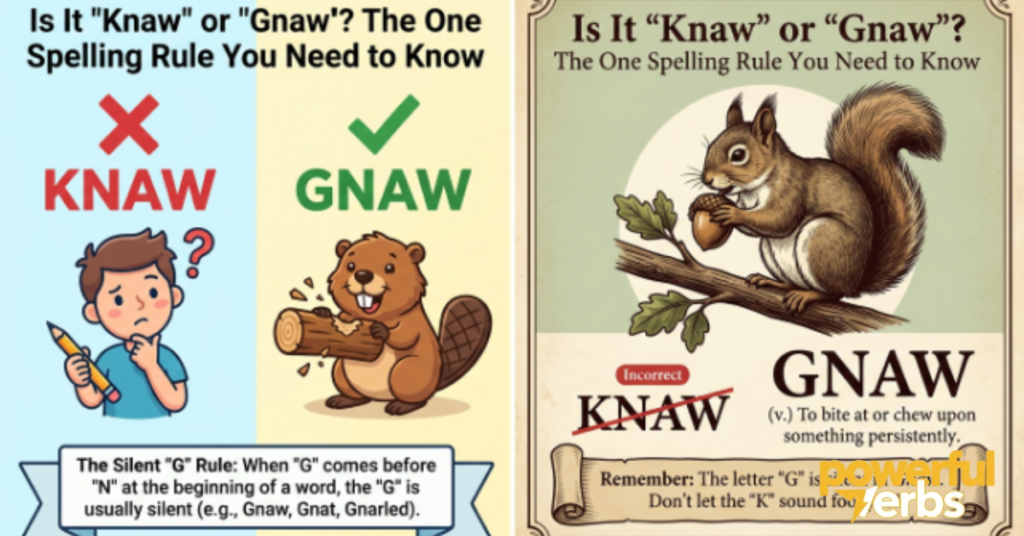
If you’ve ever typed “knaw” and then stared at it, unsure if it looked right, you’re dealing with one of English’s sneakiest silent-letter traps. The confusion makes complete sense once you understand why it happens — and the fix is permanent once you know the rule. The correct spelling is “gnaw.” The form “knaw” does not exist in standard English and is always a spelling mistake.
Let’s walk through exactly why this confusion happens, where the word comes from, and how to lock the correct spelling into memory for good.
see also: “Knaw” or “Gnaw”? The One Spelling Rule You Need to Know
Why So Many People Write “Knaw” by Mistake
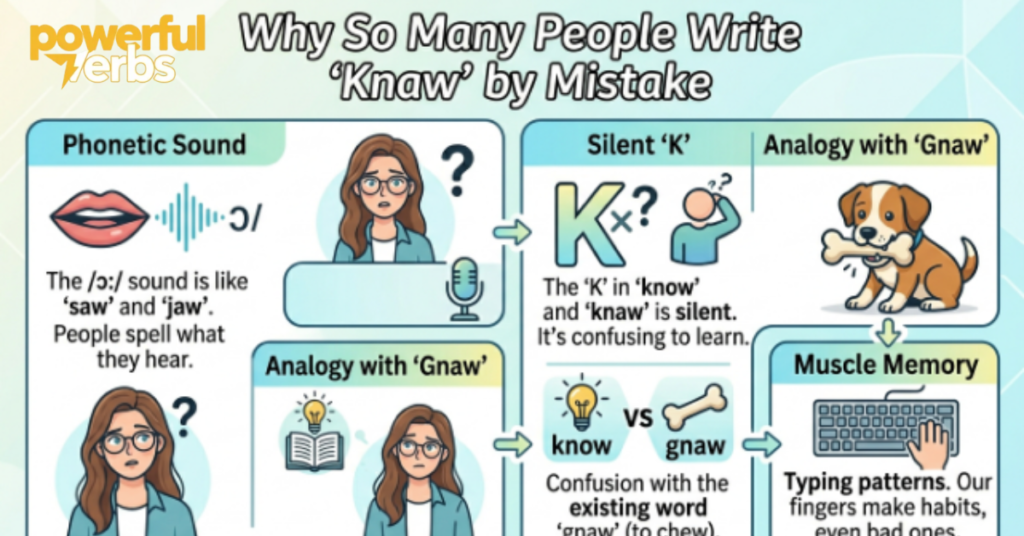
The root of this mix-up is pronunciation, not logic. When “gnaw” is spoken aloud, the “g” disappears completely — it sounds like “naw.” Since your ears never hear the “g,” your brain sometimes assumes the word must start with “k” instead, since “kn-” is a familiar silent-letter pattern in English (think “knife” or “knee”).
But assumption isn’t the same as accuracy. Dictionaries, style guides, and every recognized English reference consistently use only one spelling: gnaw.
What Does “Gnaw” Actually Mean?
“Gnaw” describes the act of biting or chewing on something repeatedly, usually in small, persistent bites rather than one large bite.
Literal usage:
- The puppy loves to gnaw on its chew toy.
- Beavers gnaw through tree trunks to build their dams.
Figurative usage:
- Doubt began to gnaw at her confidence before the interview.
- A nagging worry gnawed at him throughout the night.
In both senses — physical and emotional — gnaw conveys something persistent and repetitive, slowly wearing away at its target.
Where “Gnaw” Comes From
This word traces back to Old English “gnagan,” meaning to bite or chew. Several other English words share this same “gn-” origin, and all of them keep the silent “g” in their modern spelling:
- gnaw
- gnat
- gnash
- gnome
Notice the pattern — every single one keeps that silent “g” intact, even though none of them pronounce it. “Knaw” never existed historically; it’s purely a modern guess based on how the word sounds rather than how it’s actually written.
Gnaw vs Knaw — Quick Comparison
| Feature | Gnaw | Knaw |
| Recognized spelling | Yes | No |
| Appears in dictionaries | Yes | No |
| Historical origin | Old English “gnagan” | None |
| Used in formal writing | Yes | Never |
| Example | “Rats gnaw through wires.” | Not valid usage |
Does British English Spell It Differently?
No — there’s no regional variation here. Unlike words such as “colour” versus “color,” gnaw stays identical across every English-speaking region.
| Region | Correct Spelling |
| American English | Gnaw |
| British English | Gnaw |
| Australian English | Gnaw |
| Canadian English | Gnaw |
No matter your audience or location, gnaw is the only acceptable form.
A Simple Trick to Never Forget the Spelling
Here’s an easy way to lock this in permanently:
Group it with words you already know — gnat and gnash.
If you already trust the spelling of “gnat” (a tiny flying insect) or “gnash” (to grind your teeth), then “gnaw” follows that exact same silent-g pattern. Once you connect all three in your memory, the correct spelling becomes automatic.
Common Mistakes and Their Fixes
| Incorrect | Correct |
| The dog began to knaw on its bone. | The dog began to gnaw on its bone. |
| Anxiety started to knaw at her thoughts. | Anxiety started to gnaw at her thoughts. |
| Termites can knaw through wooden beams. | Termites can gnaw through wooden beams. |
Every single instance follows the same fix — replace the “k” with a silent “g,” and the spelling becomes correct instantly.
“Gnaw” in Everyday Writing
This word shows up across a wide range of contexts, both literal and figurative:
Nature and wildlife: “Beavers gnaw through bark to build their lodges.”
Health and emotions: “Stress can gnaw at your mental clarity over time.”
News and journalism: “Uncertainty continues to gnaw at investor confidence.”
Everyday conversation: “My dog won’t stop gnawing on the furniture.”
Formal and academic writing: “Long-term doubt may gnaw away at institutional trust.”
Because the word fits so naturally into both casual and professional writing, getting the spelling right matters across nearly every type of content.
Grammar Details Worth Knowing
“Gnaw” functions as a verb, and like most English verbs, it changes form depending on tense:
- Present tense: gnaw — “The mouse gnaws on the cardboard.”
- Past tense: gnawed — “The mouse gnawed through the box overnight.”
- Present participle: gnawing — “The mouse is gnawing on the wire.”
None of these forms ever revert to the incorrect “knaw” spelling, regardless of tense or sentence structure.
Why This Small Detail Actually Matters
Spelling accuracy directly affects how polished and credible your writing appears. Compare these two sentences:
- “Worry began to gnaw at his focus.” — clean, professional, and correct.
- “Worry began to knaw at his focus.” — instantly flags as an error to any careful reader.
A single misspelled word can distract readers from your actual message, especially in published content, academic submissions, or professional communication.
conclusion
Whenever you’re describing repeated biting, chewing, or a persistent feeling that wears away at something, the correct word is always gnaw, never “knaw.” This isn’t a matter of regional preference or writing style — it’s a fixed spelling rule with no accepted exceptions anywhere in English. The confusion exists purely because the “g” disappears in pronunciation, not because two valid spellings exist. Once you connect gnaw to familiar relatives like gnat and gnash, the silent-g pattern becomes impossible to forget. Remember that this single rule applies identically across British, American, and every other variety of English. Apply it consistently, and you’ll spell this word correctly in every context, from casual texting to formal academic writing. With this rule fully understood, you’ll never hesitate over knaw or gnaw again.
see also: “Shown” or “Showed”? Past Tense vs Past Participle Explained Simply
FAQs
Is “knaw” ever an accepted spelling?
No, it’s not recognized in any English dictionary or style guide.
Why is the “g” silent in “gnaw”?
It comes from the word’s Old English origin, where the “gn-” combination has always been pronounced without the “g” sound.
What part of speech is “gnaw”?
It’s a verb, describing the act of biting or chewing repeatedly.
Can “gnaw” be used in a figurative sense?
Yes, it’s often used to describe persistent worry or doubt, such as “guilt gnawed at her conscience.”
What is the past tense of “gnaw”?
The past tense is “gnawed,” as in “the dog gnawed on its toy all afternoon.”
Does British English spell this word differently than American English?
No, both varieties use the identical spelling: gnaw.

Liam Johnson is a dedicated language expert with 4 years of professional experience. He specializes in Grammar, Vocabulary, and Sentence structure.
