

If you have ever typed a sentence like “we need to build repore with the client” and felt a tiny doubt creep in, you are not the only one. This is one of the most searched spelling confusions in business and academic English, and the reason is simple: the word sounds nothing like it looks.
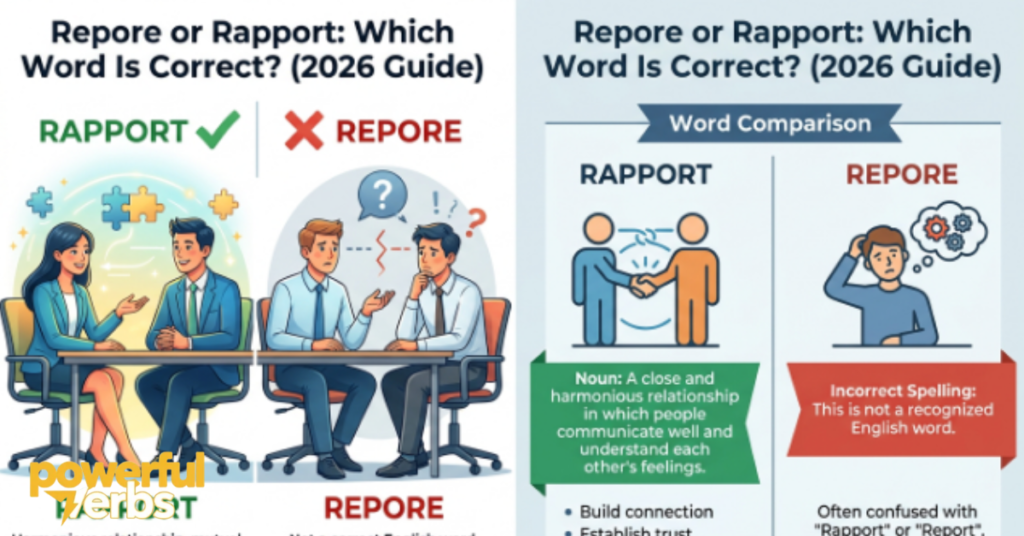
The short answer is this — rapport is the only correct spelling. Repore does not exist in any English dictionary, in any region, in any context. By the end of this guide, you will not only know which word to use, you will understand exactly why the confusion happens, how to pronounce the word correctly, and how to use it naturally in real conversations, emails, and professional writing.
see also: Knaw or Gnaw: Which Spelling Is Correct? (2026 Guide)
Quick Answer: Repore vs Rapport
| Word | Correct? | Meaning |
| Rapport | Yes | A close, trusting, and harmonious relationship between people |
| Repore | No | Not a recognized English word; a common misspelling |
Correct: She built instant rapport with her new colleagues. Incorrect: She built instant repore with her new colleagues.
There is no formal, informal, British, or American situation in which “repore” is acceptable. It is purely a spelling error born from pronunciation.
What Does “Rapport” Actually Mean?

At its core, rapport describes a state of mutual understanding and ease between two or more people. It is what allows a conversation to flow naturally, builds trust between strangers, and forms the foundation of strong relationships — whether between a manager and an employee, a therapist and a client, or two friends catching up after years apart.
Rapport is not just liking someone. It involves:
- A sense of shared understanding
- Open and comfortable communication
- Mutual respect and trust
- A feeling of being “on the same page”
When someone says they “have rapport” with another person, they mean the interaction feels effortless, genuine, and connected.
Why Do So Many People Write “Repore” Instead?
The confusion comes down to one thing: pronunciation. “Rapport” is pronounced ruh-POR, with a silent “t” at the end — a leftover feature from its French origin. Because English speakers are used to spelling words the way they sound, many people instinctively write “repore,” assuming the word follows standard phonetic rules.
This mistake is especially common among:
- Non-native English speakers learning business vocabulary
- Students writing essays or psychology papers
- Professionals drafting emails quickly without proofreading
- Anyone who has heard the word spoken far more often than they’ve seen it written
Once you know the word borrows its spelling directly from French, the mystery disappears.
The French Origin of “Rapport”
“Rapport” entered the English language from French, where it carries a similar meaning of connection, relation, or harmony. It comes from the French verb rapporter, meaning “to bring back” or “to relate something to something else.” English absorbed the word largely unchanged in the 19th century, along with its silent final consonant — a pattern you’ll also notice in other French loanwords.
This is precisely why “rapport” doesn’t follow typical English phonetic logic. It was never meant to.
Is There a British vs. American Spelling Difference?
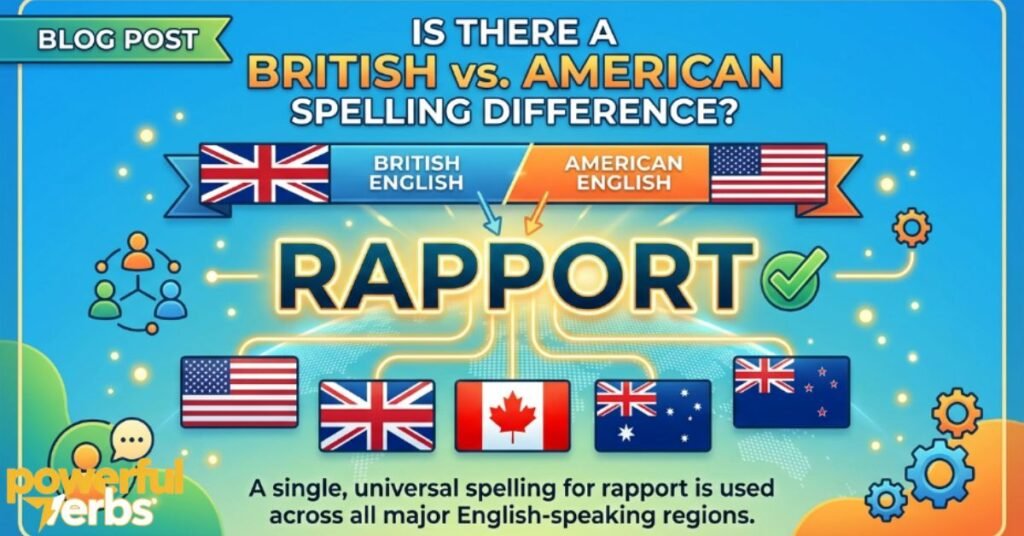
No. Unlike words such as “colour/color” or “organise/organize,” rapport has a single universal spelling used identically across British English, American English, Australian English, and every other major English-speaking region.
| Region | Accepted Spelling |
| United States | Rapport |
| United Kingdom | Rapport |
| Canada | Rapport |
| Australia | Rapport |
No matter your audience, the spelling never changes.
How to Pronounce “Rapport” Correctly
Getting the pronunciation right makes the spelling much easier to remember. Say it as:
ruh-POR (rhymes with “for”)
The final “t” is silent — do not pronounce it the way you would in an everyday English word like “support” or “report.” This silent ending is the single biggest clue that the spelling won’t match how it sounds.
Repore or Rapport: Common Errors and Corrections

Below are real-world examples of how this mistake typically shows up, alongside the corrected version.
Incorrect: “We focus on creating repore with every new customer.” Correct: “We focus on creating rapport with every new customer.”
Incorrect: “Good teachers know how to build repore with students.” Correct: “Good teachers know how to build rapport with students.”
Incorrect: “The interviewer had great repore-building skills.” Correct: “The interviewer had great rapport-building skills.”
Incorrect: “Therapists spend the first session establishing repore.” Correct: “Therapists spend the first session establishing rapport.”
Notice that “repore” never appears in published books, news articles, academic journals, or edited content of any kind — it shows up only in rough drafts, informal posts, and unedited writing.
Rapport in Real-World Contexts
Seeing the word used correctly across different settings helps cement the spelling in memory.
In business and sales: Top-performing salespeople rarely lead with a pitch — they lead with rapport, building trust before asking for anything in return.
In psychology and counseling: A therapist’s ability to establish rapport in the first few sessions often determines how open a client will be throughout treatment.
In education: Teachers who build rapport with their students typically see higher engagement and better classroom behavior.
In leadership: Managers who invest time in rapport with their teams tend to retain employees longer and foster stronger collaboration.
In everyday life: Even casual interactions — a friendly barista, a chatty neighbor, a new acquaintance at a party — rely on small moments of rapport to feel warm and human.
How Rare Is “Repore” in Published English?

Corpus data confirms just how one-sided this spelling debate really is. Large-scale English text databases show “rapport” appearing thousands of times more often than “repore,” which shows up almost exclusively in unedited drafts, forums, and casual typing. This mirrors a pattern seen with other frequently searched spelling questions — much like the amount or ammount debate, where one spelling dominates published writing so completely that the incorrect version barely registers outside of search queries checking for it.
Repore, Repoire, Rapor — Other Misspelled Variants
“Repore” isn’t the only incorrect version floating around. Some writers also type “repoire,” “rapor,” “raport,” or “rappor,” all attempting to match the word’s sound rather than its French-derived spelling. None of these variants appear in any dictionary. The safest approach is memorizing the one correct form rather than guessing at phonetic alternatives — the same advice that applies to other unpredictable English spellings, such as the openned or opened confusion, where writers double a letter that was never meant to double in the first place.
Don’t Confuse “Rapport” with “Pore”
Occasionally, “repore” gets mentally linked to the unrelated word “pore” — a small opening in skin, or a verb meaning to study something closely. The two words share no connection in meaning or origin. Rapport comes from French and relates entirely to human connection, while “pore” traces back to Greek and Latin roots tied to biology and close study. Mixing up unrelated words because they sound similar is common in English — it’s the same instinct behind mistakes like phoenix vs pheonix, where an unfamiliar foreign-rooted spelling gets reshaped into something that feels more intuitive but isn’t correct.
Synonyms and Related Words (So You Never Run Out of Options)

If you want to vary your vocabulary while keeping the same meaning, consider these alternatives:
- Connection
- Bond
- Affinity
- Understanding
- Harmony
- Chemistry
- Camaraderie
- Empathy-driven relationship
These words can often substitute for “rapport” depending on tone and context, especially in writing where you want to avoid repeating the same term too often.
How to Build Genuine Rapport (Beyond Just Spelling It Right)
Knowing the correct word is only half the picture — using the concept well matters just as much. A few proven ways people build rapport include:
- Active listening: Giving someone your full attention rather than waiting for your turn to speak
- Finding common ground: Mentioning shared interests, experiences, or goals
- Mirroring tone and energy: Subtly matching someone’s pace and enthusiasm in conversation
- Showing genuine curiosity: Asking thoughtful follow-up questions instead of generic small talk
- Consistency over time: Trust and rapport deepen through repeated, reliable interactions — not a single conversation
Mastering both the word and the skill it describes will serve you well in interviews, client meetings, classrooms, and everyday relationships alike.
A Simple Trick to Never Misspell It Again
Here’s an easy memory trick: think of rapport as borrowed luggage from French — it keeps its silent “t,” just like words such as “ballet” or “buffet.” If you remember that rapport “came from France and brought its silence with it,” the correct spelling becomes much easier to recall the next time you write it.
Final Thoughts
The debate between repore or rapport isn’t really a debate at all — rapport is correct, and repore is simply a misspelling shaped by how the word sounds rather than how it’s written. Since rapport itself represents trust, connection, and credibility, getting the spelling right is a small but meaningful way to reinforce the very message you’re trying to send.
The next time you’re writing an email, a resume, or a report and need the right word for a strong human connection, you’ll know exactly which one to reach for — and exactly why.
see also: Combating vs Combatting: Which Spelling Are You Getting Wrong?
FAQs
Is “repore” a real word in any dictionary?
No. It does not appear in any major English dictionary and is considered a misspelling of “rapport” in every context.
Why is the “t” silent in rapport?
Because the word comes from French, where final consonants like “t” are commonly silent, and English kept that pronunciation when it adopted the word.
Can “rapport” be used in casual conversation, or is it only formal?
It works naturally in both. You’ll hear it in everyday chats as easily as in academic or business writing.
Does spellcheck usually catch “repore”?
Yes, most modern spellcheckers and grammar tools flag “repore” as an error and suggest “rapport” instead.
Is rapport mainly a psychology term?
It originated heavily in psychology and counseling, but today it’s widely used in business, education, leadership, and everyday communication.
What’s the fastest way to remember the correct spelling?
Associate it with its French roots — remembering that it “arrived from France” helps explain both the spelling and the silent final letter.

Liam Johnson is a dedicated language expert with 4 years of professional experience. He specializes in Grammar, Vocabulary, and Sentence structure.
