

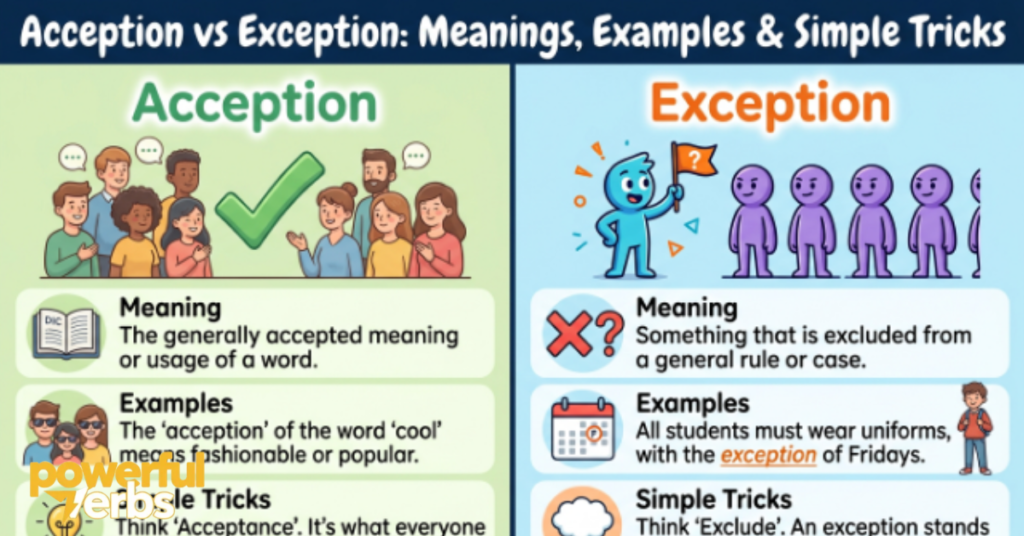
Two words. One letter apart. Completely different jobs in a sentence. If “acception vs exception” keeps stopping you mid-sentence, you’re dealing with one of English’s sneakiest near-twins — and by the end of this guide, the confusion will be gone for good.
The Short Answer First
Exception is the word almost everyone needs. It names something that breaks a rule or falls outside a general pattern — “every employee, with one exception, signed the form.”
Acception is a real but extremely uncommon word. It shows up in old dictionaries and linguistic writing to describe a particular sense or meaning that a word carries in context — not something that breaks a rule.
If you’re not writing about lexicography or historical English texts, you almost certainly want exception.
Exception: Meaning and Everyday Use

An exception is a person, item, or situation left out of a general statement or rule. It’s one of the most frequently used abstract nouns in English, appearing in legal writing, business policies, academic papers, and casual conversation alike.
How Exception Works in a Sentence
- Every student must wear a uniform; transfer students are the only exception.
- The airline waives baggage fees for first-class passengers as an exception to its standard policy.
- Out of forty applicants, only one was rejected — a rare exception in a strong pool.
Phrases Built Around “Exception”
- make an exception
- with the exception of
- without exception
- the exception proves the rule
- a notable exception
These collocations are standard in both American and British English, and they’re exactly the kind of phrasing search engines associate with this topic — which is why they deserve a place in any thorough explanation of the word.
see also: Amount or Ammount: Which Spelling Is Right? (2026 Guide)
Acception: Meaning and Origin
Acception traces back to the Latin acceptio, the same root that gave English “accept.” Centuries ago it carried two narrow meanings:
- The act of receiving or agreeing to something — a sense now almost entirely replaced by “acceptance.”
- A specific meaning or sense in which a word is understood, close to what modern linguists call a word’s “sense” or “reading.”
Example of Acception in Modern Use
- In one acception of the word “court,” it refers to a legal body; in another, it refers to a royal household.
- Theologians sometimes debate the proper acception of a scriptural term across translations.
Outside dictionaries, etymology essays, and academic linguistics, you’ll rarely — if ever — encounter this word in print.
Acception vs Acceptance: Don’t Mix These Up
This is where most real-world confusion actually starts. Writers often mean acceptance and accidentally type acception instead.
| Word | Meaning | How common is it? |
| Acceptance | The act of agreeing to, receiving, or approving something | Very common |
| Acception | A specific sense or meaning of a word (archaic) | Very rare |
| Exception | Something excluded from a general rule | Very common |
If your sentence is about agreeing to an offer, a job, or a condition, the word you want is acceptance — not acception.
Side-by-Side Comparison
| Feature | Exception | Acception |
| Frequency | Extremely common | Extremely rare |
| Field | General, legal, business, academic | Linguistics, lexicography, theology |
| Function | Marks what’s excluded from a rule | Marks a word’s particular sense |
| Sample sentence | “There are no exceptions to this rule.” | “In its older acception, the word meant something else.” |
| Safe to use casually? | Yes | No |
Why These Two Words Get Confused
Shared ending. Both finish in “-ception,” which the eye groups together automatically.
Similar sound when spoken fast. The opening syllables blur together in casual speech.
Overlap with “acceptance.” Many people are actually reaching for “acceptance,” and the typo slips past spellcheck because acception is a legitimate — if obscure — dictionary entry.
Common Errors and Their Corrections
Wrong: Everyone qualifies for the discount, no acception. Right: Everyone qualifies for the discount, no exception.
Wrong: There was one acception made to the dress code. Right: There was one exception made to the dress code.
Wrong: He showed acception of the terms. Right: He showed acceptance of the terms.
A simple rule of thumb: if you’re describing something left out of a rule, write exception. If you’re describing agreeing to something, write acceptance. Reach for acception only when discussing the meaning of a word itself.
American English vs British English
There’s no spelling or usage gap between the two dialects here:
- Exception — identical in US and UK English.
- Acceptance — identical in US and UK English.
- Acception — equally rare and equally archaic on both sides of the Atlantic.
This isn’t a regional spelling dispute like “color” vs “colour” — it’s purely a matter of vocabulary precision.
When Acception Actually Belongs in Your Writing
Reserve it for:
- Linguistics or semantics papers discussing word senses
- Historical or archival English texts
- Dictionary and etymology entries
- Theological or philosophical discussions of textual meaning
For blog posts, emails, resumes, reports, and everyday content, skip it entirely.
Exception and Acceptance in Real Writing
Business context
- Correct: This offer applies to every customer, without exception.
- Correct: We received her acceptance of the contract this morning.
- Incorrect: We do not make acception for late submissions.
Academic context
- Correct: Few exceptions exist to this economic theory.
- Correct: In one acception of the term “value,” it refers strictly to monetary worth.
Related Words and Synonyms
Synonyms for exception: exclusion, anomaly, irregularity, special case, deviation, outlier, departure
Word family for exception: except, exceptional, exceptionally, unexceptional
Word family for acceptance: accept, acceptable, acceptability
Using these related terms naturally — instead of repeating the same word over and over — strengthens both readability and the topical depth of your writing.
A Quick Memory Trick
Think: Exception = EXits the rule. Both words start with “ex,” and an exception is something that exits, or steps outside, the expected pattern. Acception has no such shortcut — which is exactly why it stays rare.
Conclusion
At first glance, acception and exception look like close cousins, but they belong to entirely different worlds. Exception is the everyday workhorse — it marks whatever breaks a rule, and you’ll reach for it constantly in business writing, academic work, and casual conversation. Acception, on the other hand, is a niche, almost forgotten word that survives mainly in dictionaries and linguistic discussions about word meaning, not rule-breaking.
The safest approach for any writer is simple: default to exception when something is being excluded or left out, default to acceptance when something is being agreed to or approved, and save acception only for the rare moment you’re genuinely discussing how a word is being interpreted. Keep that one filter in mind, and you’ll never second-guess these two words again.
see also: 22th or 22nd: Which Is Correct? Grammar Guide (2026)
FAQs
Is “acception” an actual word?
Yes. It’s a genuine but archaic English word, found mainly in older or unabridged dictionaries, referring to a specific sense of a word.
What’s the real difference between acception and acceptance?
Acceptance means agreeing to or receiving something. Acception refers to a particular meaning a word carries — they aren’t interchangeable.
Can I substitute acception for exception?
No. They describe completely different concepts — one is about word meaning, the other about rule-breaking.
Why does spellcheck sometimes accept “acception”?
Because it technically exists in the dictionary, even though it’s almost never the word a modern writer actually intends.
Does British English use “exception” differently than American English?
No. Spelling and meaning are identical in both varieties.
Is “exception” formal or casual?
Both. It works comfortably in legal documents, business writing, academic papers, and everyday conversation alike.

Liam Johnson is a dedicated language expert with 4 years of professional experience. He specializes in Grammar, Vocabulary, and Sentence structure.
