


When you’re typing out a date, a birthday, or an anniversary, you’ve probably paused at some point and wondered whether the number 22 should be written as 22th or 22nd. It’s one of those small grammar details that trips up native speakers and English learners alike, and a quick glance at search engines shows just how often people ask this exact question.
Here’s the short answer before we go any further: 22nd is correct, and 22th does not exist in proper English. The rest of this guide breaks down exactly why that is, how ordinal numbers work, where people go wrong, and how you can get it right every single time without having to think twice.
see also: Are Violet, Indigo, and Purple the Same Color? The Answer Will Surprise You
The Quick Answer
The number 22 takes the ordinal suffix “nd,” turning it into 22nd — pronounced “twenty-second.” You’ll never see a properly edited piece of writing, a published book, a newspaper, or a style guide use “22th.” It simply isn’t a recognized form of the word.
A few correct examples:
- The wedding is on October 22nd.
- He just celebrated his 22nd birthday.
- Our office is located on the 22nd floor.
- The deadline falls on the 22nd of this month.
And here’s what incorrect usage looks like, so you know what to avoid:
- ~~22th wedding anniversary~~
- ~~The deadline is March 22th~~
- ~~He turned 22th years old~~
Why English Uses “nd” Instead of “th” for 22
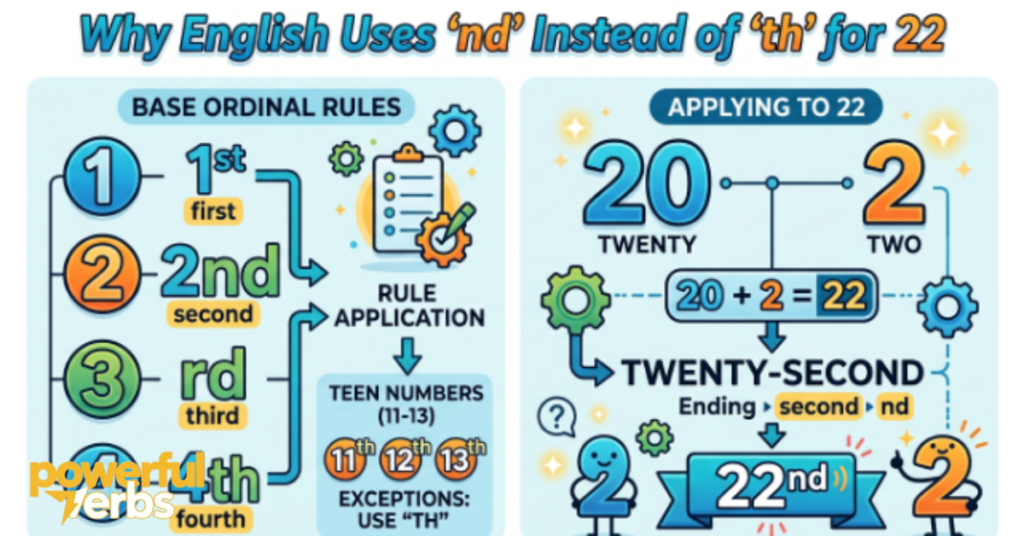
To understand the logic, it helps to look at how ordinal numbers are built in English. Ordinal numbers tell us about position or rank — first, second, third, fourth, and so on — rather than quantity. Most of them take the ending “th,” which is why people often assume every number should follow suit. But four small numbers break that pattern: 1, 2, 3, and any number that ends in those digits (with one notable exception covered below).
| Final Digit | Suffix | Examples |
| 1 | st | 1st, 21st, 31st, 41st |
| 2 | nd | 2nd, 22nd, 32nd, 42nd |
| 3 | rd | 3rd, 23rd, 33rd, 43rd |
| 4–9 and 0 | th | 4th, 15th, 20th, 100th |
Since the number 22 ends in the digit 2, it inherits the same suffix as the number 2 itself — “second” becomes “2nd,” and “twenty-second” becomes “22nd.” This is consistent throughout the entire counting system, no matter how large the number gets. That’s why you’ll also see 102nd, 222nd, and 1,002nd follow the identical rule.
The One Exception Most People Forget: 11th, 12th, and 13th
If the rule were applied without any exceptions, you’d expect 11 to become “11st,” 12 to become “12nd,” and 13 to become “13rd.” But English doesn’t work that way. Numbers between 11 and 13 always take “th,” regardless of their final digit:
- 11th (not 11st)
- 12th (not 12nd)
- 13th (not 13rd)
This is a holdover from older English number patterns, and it’s the main reason the “last digit” rule sometimes feels inconsistent. The good news is that 22 isn’t part of this exception group, so the standard rule applies cleanly — 22 always becomes 22nd, with zero exceptions.
Why So Many People Accidentally Write “22th”
This mistake is far more common than you’d think, and it’s not really a sign of poor grammar — it’s just pattern overcorrection. Most ordinal numbers in everyday use (4th, 5th, 9th, 10th, 18th, 100th) end in “th,” so the brain naturally starts treating “th” as the default ending for everything. When a number like 22 comes along, the same habit gets applied automatically, even though it doesn’t follow that pattern.
Autocorrect tools and fast typing make this worse, since “22th” doesn’t always get flagged the way a misspelled word would. It looks close enough to “correct” at a glance that many people never catch it before hitting send.
22nd in American English vs. British English
Unlike some grammar and spelling differences between US and UK English (think “color” vs. “colour” or “organize” vs. “organise”), ordinal number suffixes are identical on both sides of the Atlantic. There’s no regional variation here:
| Region | Correct Form |
| American English | 22nd |
| British English | 22nd |
| Australian/Canadian English | 22nd |
| International/Global English | 22nd |
This makes it one of the easier grammar rules to apply consistently, since you don’t need to adjust your spelling based on your audience’s location the way you might with other words.
Where You’ll See 22nd Used in Real Writing
Ordinal numbers like 22nd show up constantly in daily communication, and getting them right matters more than people realize — especially in professional or academic contexts where small errors can affect how polished your writing looks.
Dates and scheduling: “The board meeting has been moved to the 22nd of next month.”
Birthdays and milestones: “She’s turning 22nd this weekend” is wrong — instead, write “She’s turning 22 this weekend” or “It’s her 22nd birthday this weekend.” (Note: when referring to age alone, you typically use the cardinal number “22,” not the ordinal “22nd.” The ordinal form is reserved for describing the birthday itself, the floor number, the date, or the position in a sequence.)
Anniversaries: “They’re celebrating their 22nd wedding anniversary in June.”
Buildings and floors: “The conference room is on the 22nd floor.”
Academic and formal writing: “The treaty was signed on the 22nd of November, 1963.”
Sports and rankings: “He finished in 22nd place overall.”
A Simple Trick to Never Get It Wrong Again
If you ever pause and second-guess yourself, here’s a quick mental shortcut: connect the ending of 22 to the word “second.” Since “second” naturally ends in “-nd,” every number ending in 2 follows the same pattern — 2nd, 12th (exception), 22nd, 32nd, 42nd, and so on, skipping only the 11–13 range.
Another way to check yourself: say the number out loud in full word form. “Twenty-second” sounds correct, while “twenty-twoth” sounds immediately off. Your ear will usually catch the mistake faster than your eyes will.
Other Ordinal Numbers People Frequently Misspell
Once you understand the rule for 22, it becomes much easier to apply it to similar numbers that cause the same confusion:
| Correct | Common Mistake |
| 21st | 21th |
| 23rd | 23th |
| 32nd | 32th |
| 42nd | 42th |
| 52nd | 52th |
| 62nd | 62th |
| 72nd | 72th |
| 82nd | 82th |
| 92nd | 92th |
Notice the pattern — every single one of these follows the same last-digit rule that applies to 22.
Conclusion
The rule behind “22nd” isn’t arbitrary, even though it can feel that way at first glance. English ordinal numbers are built around the final digit of the number, and 22 ends in 2 — the same digit that gives us “second.” That single detail is the entire explanation for why “22th” never appears in correct, professionally edited English.
Once this rule clicks, you’ll find yourself applying it automatically across dates, birthdays, anniversaries, rankings, and addresses, without needing to second-guess your spelling again.
see also: Hola or Ola? The Real Difference You’ve Been Getting Wrong
FAQs
Is “22th” ever acceptable in informal writing?
No. Even in casual texting or social media captions, “22th” is considered a spelling mistake rather than an accepted informal variation.
What is the word form of 22nd? The word form is “twenty-second.”
Does the “nd” rule apply to bigger numbers like 122 or 1,022?
Yes. Any number ending in 2 (except those in the 11–13 range) takes “nd,” so you’d write 122nd and 1,022nd.
Why do 11th, 12th, and 13th break the pattern?
These three numbers are a long-standing exception in English and always use “th,” regardless of their final digit.
Should I write “22nd” or just “22” when talking about someone’s age?
Age is usually written as a cardinal number, like “she is 22 years old,” while “22nd” is used for birthdays, dates, floors, or rankings.
Is there a difference between how UK and US English handle this rule?
No. Both use “22nd” with no regional variation, unlike many other spelling differences between the two dialects.

Liam Johnson is a dedicated language expert with 4 years of professional experience. He specializes in Grammar, Vocabulary, and Sentence structure.
