

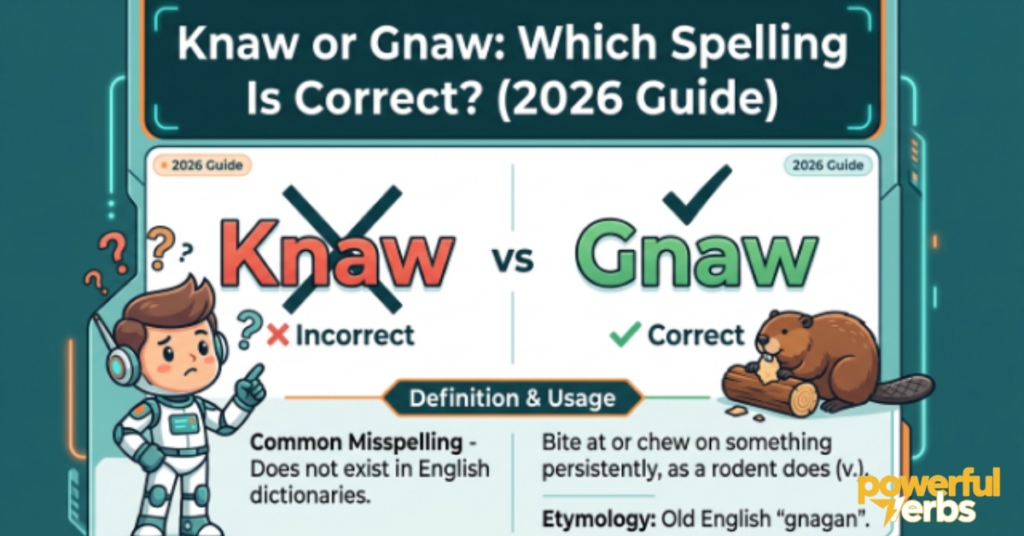
If you typed “knaw or gnaw” into Google, you’re not alone. This is one of the most commonly mistyped words in English, and the confusion makes complete sense once you understand why it happens. The short answer: gnaw is the only correct spelling. Knaw does not exist in any English dictionary.
In this guide, you’ll learn why this mix-up happens, where the word comes from, how to use it correctly in real sentences, and a simple trick to make sure you never misspell it again.
see also: Is “Good Morning” One Word? Here’s the Definitive Answer
Quick Answer: Gnaw Is Correct
- Gnaw — the real, dictionary-approved spelling
- Knaw — a spelling error with no meaning in English
Example: The puppy loves to gnaw on its chew toy.
There’s no situation — formal, casual, academic, or conversational — where “knaw” is acceptable. If you’ve been using it, simply swap it out for “gnaw” going forward.
Why Do People Misspell Gnaw as Knaw?
The mix-up isn’t really about grammar — it’s about sound. English has several words where a leading consonant is written but never pronounced, and “gnaw” is one of them. When spoken, the g is completely silent, so the word sounds like “naw.”
Because the brain processes spoken language phonetically, writers sometimes guess at a spelling based on sound alone. Since “kn-” is a familiar silent-letter pattern in English (think know, knee, knife), it’s an easy — but incorrect — guess. The real silent-letter family that “gnaw” belongs to is different: it’s the “gn-” group, not the “kn-” group.
Does “Knaw” Mean Anything?
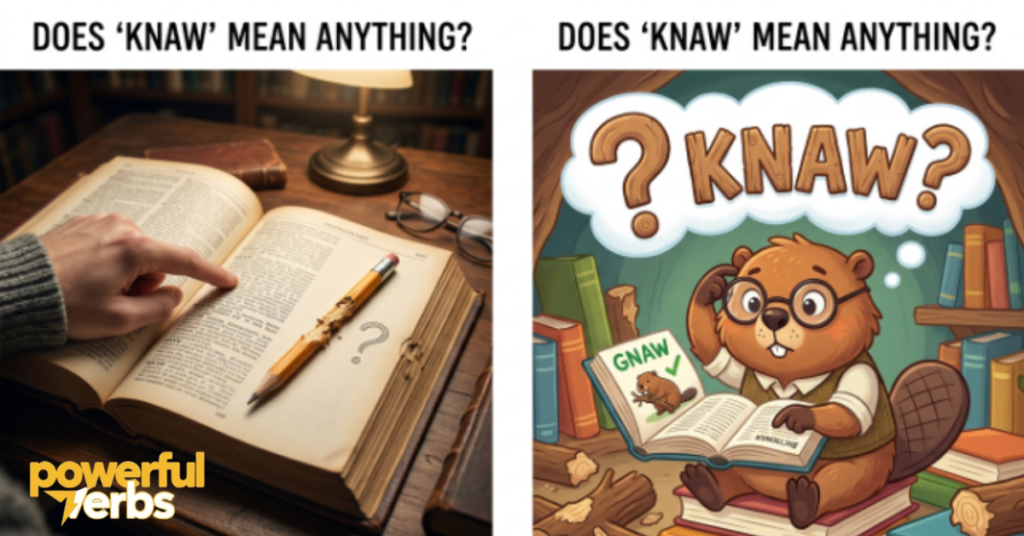
No. Knaw has zero meaning in standard English. It isn’t an alternate spelling, a regional variant, or an old form of the word — it’s purely a typo that has become common enough to trend in search engines. Dictionaries such as Merriam-Webster, Cambridge, and Oxford list only “gnaw,” with no cross-reference to “knaw.”
What Does Gnaw Actually Mean?
Gnaw (verb) means to bite, chew, or nibble persistently on something, often wearing it down gradually. It applies to both literal and figurative situations:
- Literal use: Animals gnawing on bones, wood, or wires.
- Figurative use: A feeling — like doubt, guilt, or worry — that slowly affects someone’s mind.
Examples:
- Beavers gnaw through tree trunks to build their dams.
- A nagging sense of doubt began to gnaw at her confidence.
The History Behind the Silent G
“Gnaw” traces back to the Old English word gnagan, meaning to bite or chew. In Old English, the “g” sound at the start of words like this was actually pronounced. Over centuries, English pronunciation shifted and simplified, dropping many of these harsh initial consonant sounds — but spelling stayed frozen in time, preserving the original letters.
This is why English still has a small but recognizable family of “gn-” words where the g is silent:
| Word | Meaning |
| Gnaw | To bite or chew repeatedly |
| Gnat | A tiny flying insect |
| Gnash | To grind the teeth together |
| Gnome | A small mythical creature |
| Gnarl | A twisted knot in wood |
Once you recognize this pattern, “gnaw” stops looking like an exception and starts looking like part of a logical (if old-fashioned) spelling family.
A Simple Memory Trick
To lock in the correct spelling, try this association:
Gnaw rhymes with Gnaw’s silent cousins — gnome and gnat. If you remember one “gn-” word, the others fall into place.
Another trick: connect “gnaw” with its past tense, gnawed. Saying the full sentence — “The dog gnawed the bone” — out loud a few times helps train your brain to associate the spelling with the sound.
British English vs. American English
Good news — there’s no transatlantic spelling battle here. Unlike words such as “colour/color” or “organise/organize,” gnaw is spelled identically in both British and American English.
| Region | Correct Spelling | Sample Sentence |
| British English | Gnaw | Mice gnaw through skirting boards. |
| American English | Gnaw | Stress can gnaw at your sleep. |
| Australian/Canadian English | Gnaw | Termites gnaw away at wooden beams. |
No matter your audience or region, the spelling never changes.
Gnaw in Everyday Writing
Seeing the word in different contexts makes it easier to remember correctly.
In casual conversation: “That comment has been gnawing at me all day.”
In nature or science writing: “Rodents gnaw constantly because their front teeth never stop growing.”
In news or journalism: “Rising costs continue to gnaw away at household budgets.”
In literature or storytelling: “A quiet fear gnawed at the edges of his thoughts.”
In business or formal writing: “Unresolved customer complaints can gnaw at brand trust over time.”
Common Mistakes to Avoid
Spelling it by sound alone. Since the “g” is silent, relying purely on pronunciation leads straight to the “knaw” error. Always picture the written word, not just how it sounds.
Assuming “knaw” is an informal variant. It isn’t recognized in casual writing, texting, or professional documents — autocorrect and spell-checkers will flag it every time.
Mixing it up with similar-sounding words. Words like “gnaw,” “nor,” and “naw” (a casual spelling of “no”) can blend together in fast speech, but they are entirely unrelated in meaning.
Forgetting the past tense form. The correct past tense is gnawed, not “knawed” or “gnawd.”
see also: I Analyzed Puting vs Putting: Here’s the Real Difference
Words Related to Gnaw (Synonyms & Similar Terms)
If you want to vary your vocabulary while keeping the same meaning, these words work well alongside or instead of “gnaw”:
- Nibble
- Chew
- Bite repeatedly
- Erode (for figurative use)
- Wear away
- Nag (for the figurative “worry” sense)
Using these naturally alongside “gnaw” in your writing also helps reinforce correct usage and avoids repetitive phrasing.
Why This Search Term Trends So Often
Search data consistently shows that “knaw or gnaw” is searched far more often by ear than by eye — meaning people hear the word in conversation, audiobooks, or videos before they ever see it written down. This is common among students, English learners, content writers, and anyone double-checking spelling before hitting publish. Once the correct spelling is learned, it tends to stick permanently, since the “gn-” pattern is easy to recognize once pointed out.
Conclusion
Between knaw and gnaw, only one is real: gnaw. The confusion comes entirely from pronunciation, not from any actual rule allowing multiple spellings. Once you connect “gnaw” to its silent-g word family — gnat, gnome, gnash — the correct spelling becomes second nature. Whether you’re writing about animals, insects, emotions, or everyday wear and tear, “gnaw” is always the right choice, in every English-speaking region, every time.
FAQs
Is “knaw” ever correct in any dialect of English?
No. It is not recognized in British, American, Australian, Canadian, or any other standard English dialect.
Why is the g silent in gnaw?
It comes from older English pronunciation that has since softened, while the spelling preserved the original Old English form.
What part of speech is gnaw?
It is a verb, used to describe biting, chewing, or — figuratively — a persistent worry.
Can gnaw be used for emotions or feelings, not just chewing?
Yes. It’s commonly used figuratively, as in “doubt gnawed at him” or “guilt gnaws at her conscience.”
What is the past tense of gnaw?
Gnawed, as in “the rat gnawed through the cable.”
Are there other English words with the same silent-g pattern?
Yes — gnat, gnome, gnash, and gnarl all share the same silent “g” at the start.

Liam Johnson is a dedicated language expert with 4 years of professional experience. He specializes in Grammar, Vocabulary, and Sentence structure.
