


If you have ever paused mid-sentence wondering whether to type “receive” or “recieve,” you are not alone. This is one of the most searched spelling questions in the English language. The two letters — “i” and “e” — sitting side by side create genuine confusion for students, professionals, and native speakers alike.
This guide settles the debate once and for all. You will learn the correct spelling, the golden rule behind it, how to use it in real sentences, and simple memory tricks that make the correct form stick forever.
see also: 200+ Adjectives to Describe Yourself | Unique Words for Every Situation
The Quick Answer: Receive or Recieve?
The correct spelling is “receive.”
The version “recieve” is always wrong. It is a typo — a common one, but still incorrect in every style of English writing. No dictionary, grammar guide, or style manual accepts “recieve” as a valid spelling.
Correct: I expect to receive the package by Thursday.
Incorrect: I expect to recieve the package by Thursday.
Why Do So Many People Write “Recieve”?
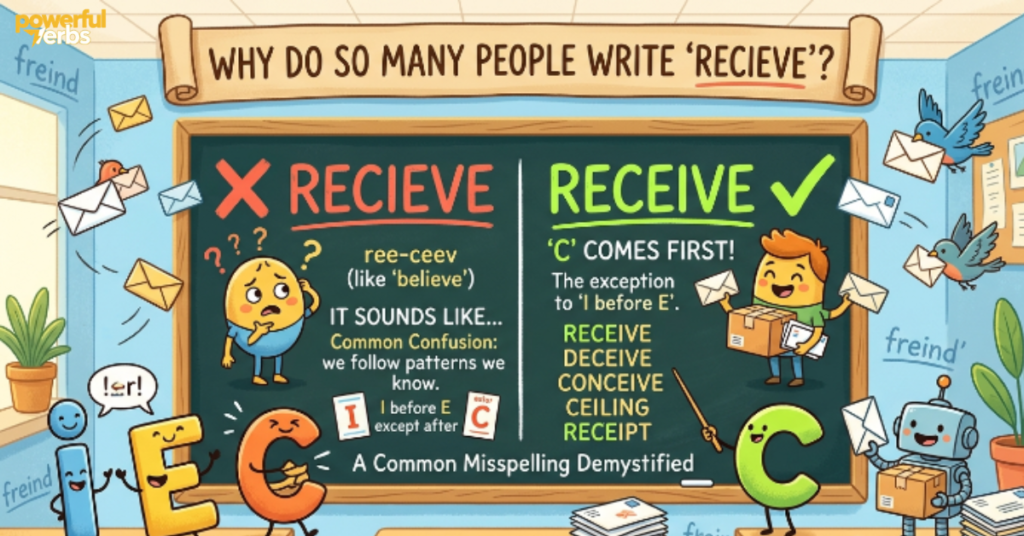
The confusion is completely understandable. English has a well-known spelling rule — “i before e” — which works in words like “believe,” “achieve,” and “piece.” Naturally, the brain wants to apply the same pattern to “receive” and write “recieve.”
However, the full rule is: “i before e, except after c.”
The word “receive” contains a “c” right before the “ie” combination. That makes it an exception. After the letter “c,” the correct order flips to “ei,” giving us rec-ei-ve, not rec-ie-ve.
This single rule is all you need to remember.
The “I Before E Except After C” Rule — Explained Simply
The rule applies to a specific group of English words where the letters “i” and “e” appear together and create the /iː/ sound (the long “ee” sound).
Words that follow the basic “i before e” pattern:
- believe
- achieve
- piece
- field
- chief
- grief
Words that follow the “except after c” part of the rule:
- receive
- perceive
- deceive
- conceive
- ceiling
Notice the pattern: every word in the second group has a “c” directly before the “ei.” That is the rule working exactly as intended.
see also: Nouns That Start with B: 1000+ Words with Pictures & Examples
Origin and Etymology of the Word “Receive”
Understanding where a word comes from often helps you spell it correctly.
“Receive” traces back to the Old French word “receivre” and further to the Latin “recipere,” which means “to take back” or “to accept.” The Latin root “re-” means “back” and “capere” means “to take.”
English borrowed this word in the late 13th century, and its spelling has remained stable ever since. The “ei” combination after “c” is a direct inheritance from its Latin and French origins — making the spelling historically consistent, not arbitrary.
“Recieve” has never appeared in any historical version of the word. It is purely a modern spelling error.
Receive in American English and British English
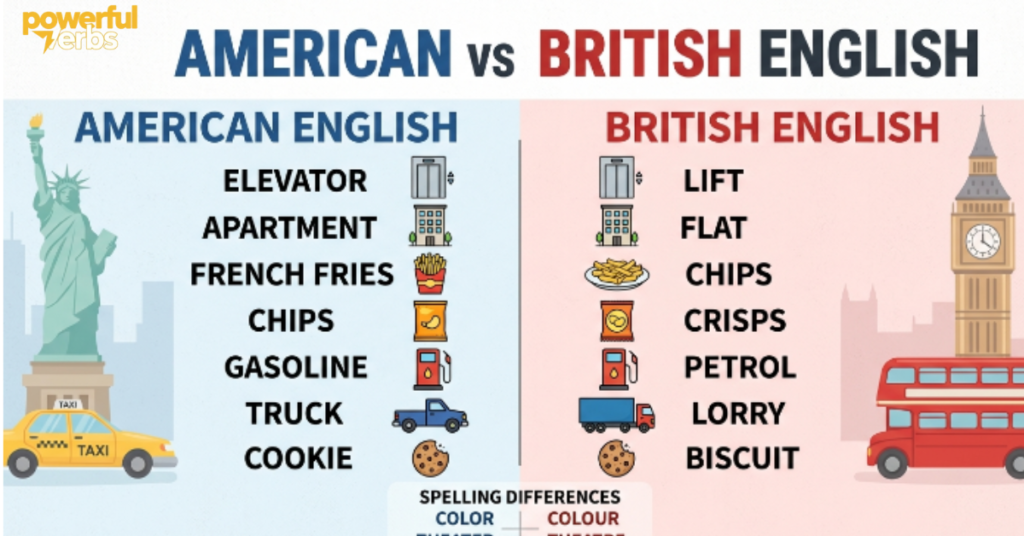
Some English spelling differences — like “colour vs. color” or “realise vs. realize” — cause genuine confusion between American and British writers.
“Receive” is not one of those words.
Both American English and British English spell it identically: receive.
| Spelling | American English | British English | Correct? |
| receive | Yes | Yes | Always |
| recieve | No | No | Never |
There is no regional variant, no informal exception, and no context in which “recieve” becomes acceptable. If you write for a global audience, a UK publication, or an American platform, the spelling is the same everywhere.
All Forms of the Word “Receive” — Spelled Correctly
The word “receive” appears in several grammatical forms. Here is every correct version:
receive — base form (present tense) I will receive your message shortly.
receives — third-person singular present She receives hundreds of emails every day.
received — past tense and past participle He received the award at the ceremony.
receiving — present participle They are receiving treatment at the clinic.
receiver — noun form (a person or device that receives) The receiver of the letter was surprised.
receipt — related noun (proof of receiving something) Keep your receipt for any future returns.
Note: “receipt” has a silent “p” — another irregular but fixed spelling inherited from Old French.
How to Use “Receive” in a Sentence — Real Examples
Seeing a word used naturally across different situations helps it feel familiar and easy to spell.
In professional writing: Applicants will receive a confirmation email within three business days.
In academic writing: Students are expected to receive feedback on their assignments before the final submission deadline.
In casual conversation: I cannot wait to receive the results of my test.
In formal correspondence: We are pleased to inform you that you will receive your certificate by post.
In digital and social media contexts: Did you receive the notification I sent you?
In business and commerce: The company will receive its first shipment of new inventory next week.
In legal and official language: The defendant will receive the court’s decision within thirty days.
Common Misspellings to Avoid
Several incorrect versions of “receive” appear regularly in written content. Knowing them helps you avoid them.
recieve — Most common typo. Letters “i” and “e” are reversed after “c.”
recive — Missing the second “e” entirely.
recevie — Letters shuffled incorrectly.
recived — Incorrect past tense form (correct: received).
recieved — Wrong past tense combining two errors.
recieveing — Wrong progressive form (correct: receiving).
Every one of these versions will be flagged by spell checkers and considered an error in professional, academic, and formal writing.
Memory Tricks to Always Spell “Receive” Correctly
If the “i before e except after c” rule still feels slippery, try one of these practical memory techniques.
Trick 1 — Say the rule out loud: “I before E, except after C.” Say it every time you are unsure. After a few repetitions, it becomes automatic.
Trick 2 — Break the word into parts: Re + ceive. Focus on “ceive” — it is the same ending as in “perceive,” “deceive,” and “conceive.” All four words end in -ceive, and all four are spelled with “ei.”
Trick 3 — Visualize the rule: Picture the letter “C” as a rule enforcer. Whenever “C” appears before “ie,” it flips the order to “ei.” C is in charge.
Trick 4 — Use a rhyme: “After C, it’s E before I — that is the rule, and here is why: receive, deceive, conceive, perceive.”
see also: Types of Passion Fruits: 30+ Varieties with Pictures & Complete Guide
Conclusion
The correct spelling is always receive — one word, one spelling, no exceptions.
“Recieve” is a typo that has fooled millions of writers, but now that you understand the “i before e except after c” rule and the word’s Latin origins, it should never trip you up again.
Whether you are writing a professional email, a university essay, a business proposal, or a social media post, the correct form is receive. Spelling it right is a small detail that says a great deal about the care and accuracy of your writing.
Keep the rule, trust the pattern, and you will always get it right.
FAQs
Is “recieve” ever correct in any form of English?
No. “Recieve” is always a spelling error. It is not accepted in American English, British English, Australian English, or any other recognized form of the language.
What is the rule that explains the spelling of “receive”?
The rule is “i before e, except after c.” Because “receive” has the letter “c” directly before “ie,” the order flips to “ei,” making the correct spelling r-e-c-e-i-v-e.
What is the past tense of “receive”?
The past tense is “received.” For example: She received the award last night.
Is there any difference between American and British spelling for this word?
No. Both American and British English spell it identically as “receive.” There is no regional variation for this word.
How do I remember whether it is “receive” or “recieve”?
Break the word into parts: re + ceive. The ending “-ceive” is shared by receive, perceive, conceive, and deceive — all spelled with “ei” after the “c.” Memorize that group and the confusion disappears.
Why do spell checkers sometimes miss “recieve”?
Some basic spell checkers flag it, but auto-correct tools on phones and less sophisticated editors may occasionally miss it. Always proofread manually in professional documents and important emails.

Liam Johnson is a dedicated language expert with 4 years of professional experience. He specializes in Grammar, Vocabulary, and Sentence structure.
