

Search engines show thousands of monthly searches for this exact question, and the confusion is completely understandable. Two words that sound like they belong together get typed together all the time. Yet only one version survives a grammar check, a college application, or a published news article. This guide breaks down the rule in plain language, backs it up with how dictionaries and style guides treat the phrase, and walks through the real situations where people slip up.
see also: Stared or Starred: Meaning, Origin, and Correct Usage (2026 Complete Guide)
The Quick Answer
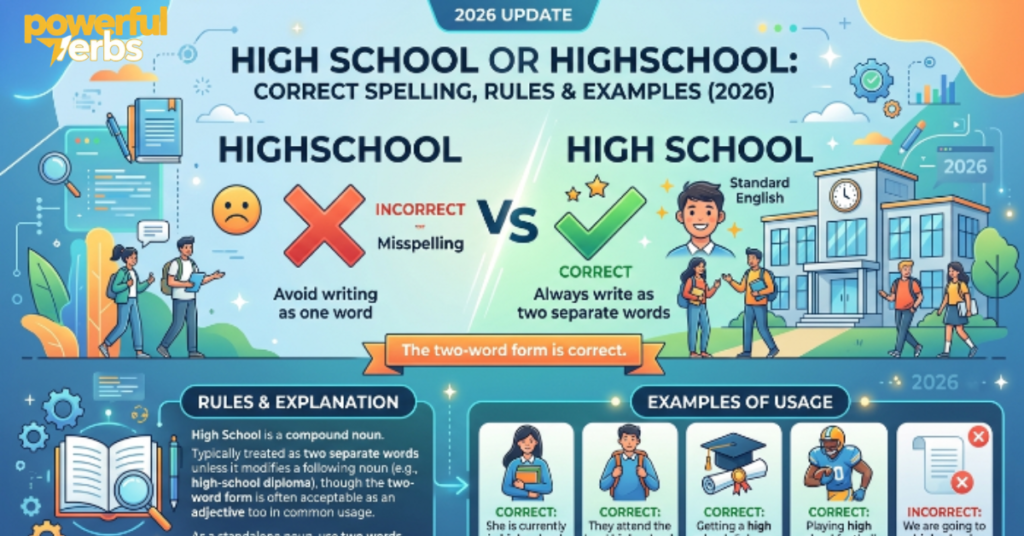
“High school” is the correct spelling, written as two separate words. “Highschool,” joined into a single word, is not recognized by any major English dictionary or style guide. Whether someone is writing a college essay, a resume, a text message, or a news headline, the two-word form is the one that holds up in 2026 and beyond.
A simple example shows the difference clearly. “She graduated from high school in May” is correct, while “She graduated from highschool in May” is not. The space between the words is not optional; it is part of the correct spelling itself.
Why So Many Writers Get Confused
English is full of word pairs that eventually fuse into one. “Week” and “end” became “weekend.” “Class” and “room” became “classroom.” Once a few examples like these become familiar, it feels natural to assume every two-word phrase will eventually do the same thing. “High school” looks like a perfect candidate for that kind of merger, especially since people see it typed as one word constantly on social media, in forum comments, and in casual messages where speed matters more than accuracy.
There is also a practical reason for the mix-up. Typing fast on a phone keyboard makes it easy to skip a space, and autocorrect does not always catch a missing gap between two real words. Once a person sees “highschool” enough times online, the incorrect version starts to feel familiar, even though familiarity is not the same as correctness.
The term itself is old — ‘high school’ has been used in English since at least the 1500s, long before today’s spelling debates existed.
The Grammar Rule Behind the Spelling
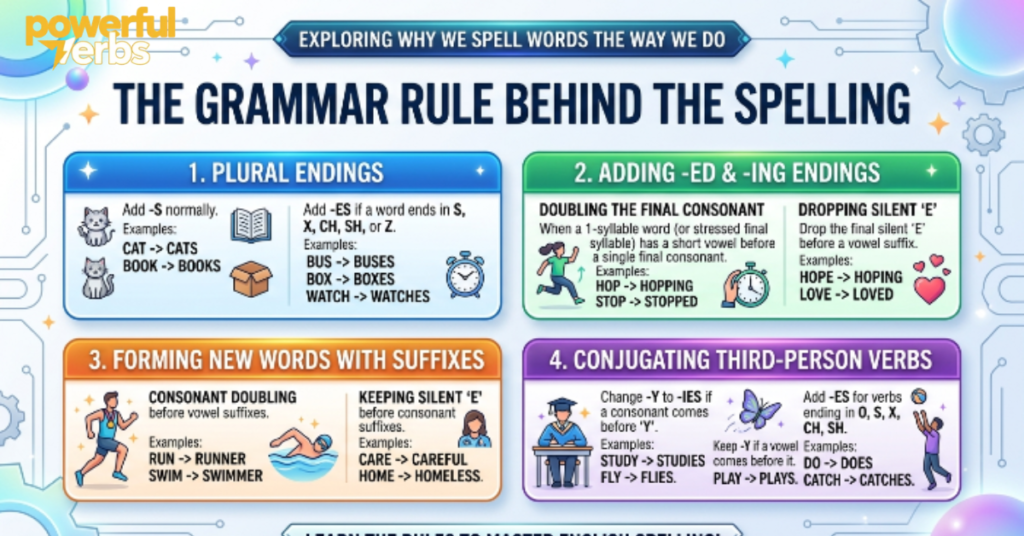
English compound nouns generally fall into three categories. Open compounds keep their words separate, like “ice cream” or “post office.” Closed compounds merge into a single word, like “bedroom” or “notebook.” Hyphenated compounds sit in between, connected by a dash, like “well-being” or “mother-in-law.”
“High school” belongs firmly in the open compound category, alongside other education-related terms such as “middle school,” “elementary school,” “junior college,” and “graduate school.” In each of these phrases, the first word describes the second, much like “red car” or “tall building.” English generally keeps a describing word and the noun it modifies separated by a space, which is exactly why “high school” has never shifted into a single word despite how often people see it written that way informally.
Where Does “High School” Come From?
The phrase has deep roots in English. “School” itself is centuries old, but the two-word combination “high school” first appeared in Middle English as far back as the 15th century, written then as “hyȝ scale” — literally meaning a school for higher-level learning. That early spelling eventually smoothed into the modern “high school” we use today, but the underlying structure — a describing word plus a noun — never changed.
It’s worth noting that open compounds don’t always stay open forever. Some genuinely do merge into single words over time, but only once a phrase becomes extremely common and the risk of ambiguity is low. A well-known example outside education is “online,” which was written as “on line” for decades, then briefly as “on-line,” before finally settling into one word as its usage exploded. “High school” simply hasn’t followed that same path — it’s been common for hundreds of years without ever needing to close up, likely because keeping “high” and “school” visually separate causes zero confusion, unlike the deliberate merges English makes elsewhere, similar to the settled certainty around words like knaw or gnaw, where only one spelling has ever been correct despite surface-level similarity to other words.
What Dictionaries and Style Guides Confirm
Major English dictionaries, including Merriam-Webster, Oxford, and Cambridge, all list the term as two separate words. Style guides used in journalism and publishing, such as the AP Stylebook and the Chicago Manual of Style, follow the same convention. No widely recognized dictionary or professional style guide currently lists “highschool” as an accepted alternative spelling, which means the one-word version has no formal backing anywhere in standard English, whether American, British, Canadian, or Australian.
This matters for anyone writing in a professional setting. A resume, a scholarship application, a published article, or a school report that uses “highschool” risks looking careless to a reader who already knows the correct form, even when the rest of the writing is strong.
see also: Phoenix vs Pheonix: Meaning, Spelling, and Key Differences (2026)
High School vs. Highschool at a Glance
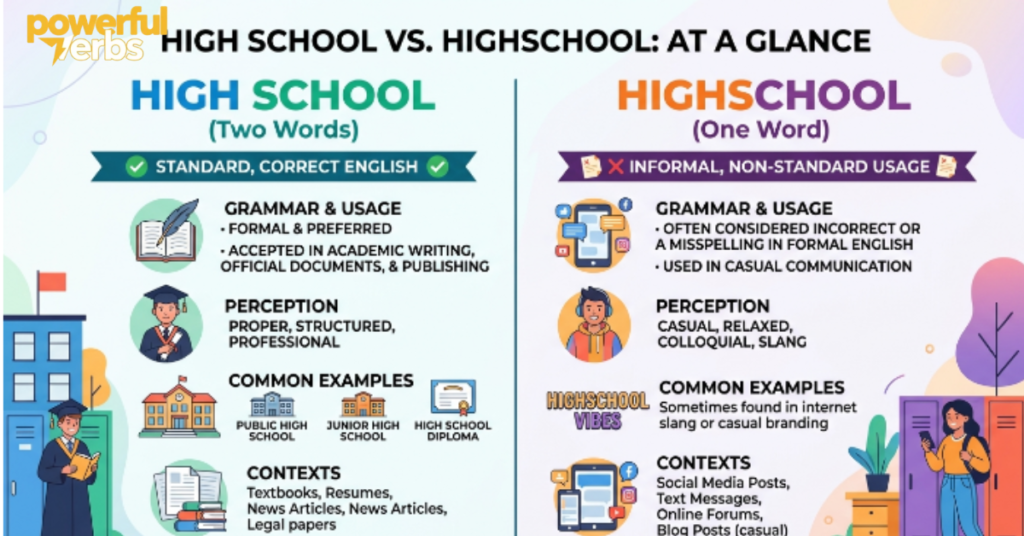
| Category | High School | Highschool |
| Recognized by major dictionaries | Yes | No |
| Accepted in formal and academic writing | Yes | No |
| Follows AP Style and Chicago Manual of Style | Yes | No |
| Appears in published books and news articles | Yes | Rarely, and treated as an error |
| Common in fast, informal typing | Occasionally misused | Mistakenly typed this way |
Using “High School” Correctly Across Different Kinds of Writing

In an academic essay, a student might write that their interest in biology started during their second year of high school. In a professional email, someone applying for a part-time job could mention that they are currently a high school student looking for weekend work. A news article covering a local event might note that the high school football team won its first game of the season. Even in a casual text message between friends, “can’t believe high school is almost over” reads naturally and correctly, with the two words kept apart exactly as they should be.
The pattern holds true everywhere: classroom assignments, job applications, personal essays, social captions, and printed books all use the same two-word structure. There is no context, formal or informal, where the merged spelling becomes acceptable simply because the writing is casual.
Common Mistakes and the Reasons Behind Them
The most frequent error is simply dropping the space, turning two correct words into one incorrect one through fast typing or a missed keystroke. A second common slip happens when writers see “preschool,” which really is written as one word, and assume every school-related compound follows the same pattern. A third source of confusion comes from informal internet writing, where spelling mistakes spread quickly because readers copy what they see rather than checking a dictionary. None of these reasons make the merged spelling correct; they simply explain why the mistake keeps showing up.
The Exception That Causes Extra Confusion: “Preschool”

“Preschool” is one of the few education-related terms that really is written as a single word, and this exception is part of why “highschool” feels plausible to so many writers. The difference comes down to history rather than logic: “preschool” entered common use as a single word early on, and dictionaries adopted it that way, while “high school,” “middle school,” and “elementary school” never went through that same shift. Knowing that this exception applies to exactly one term, rather than the whole category, removes a lot of the guesswork.
“Highschooler” or “High Schooler”?

A related question that often comes up is how to refer to a student at this level. “High schooler,” written as two words, is the form recognized by most dictionaries and used in mainstream publications. “Highschooler” appears informally online but is not treated as standard. The safest approach in any writing meant to look polished is to keep both the school term and its related noun form split into two words.
One Notable Stylized Exception
There’s a narrow case worth knowing about: some titles and brand names intentionally use “Highschool” as a single word for stylistic effect — the most well-known example being Highschool of the Dead, a Japanese manga and anime series whose English title merges the words on purpose. This isn’t a spelling rule being broken by accident; it’s a deliberate creative choice, similar to how a brand or username might stylize a word differently than a dictionary would. Outside of an exact title or trademark like that, though, the standard two-word form remains the only correct option in ordinary writing — the same firm distinction that applies when choosing carefully between commonly mixed-up words, like remembering the correct usage covered in eyeing vs eying, where only one spelling holds up in formal writing despite informal variations circulating online.
Capitalization: When the Words Stay Lowercase and When They Don’t

“High school” stays lowercase when referring to the general stage of education, as in “she attends high school” or “many students work part-time during high school.” It becomes capitalized only when it forms part of an official, proper name, such as “Lincoln High School” or “Roosevelt High School.” This distinction trips up some writers who capitalize the phrase out of habit, even when no specific school name is involved.
When “High-School” Gets a Hyphen
There’s one situation where a hyphen enters the picture: when “high school” functions as an adjective directly before a noun. “She’s taking a high-school math class” and “he earned a high-school diploma” both use the hyphenated form because “high school” is modifying “math class” and “diploma” as a single descriptive unit. Without the hyphen, a sentence like “a high school friend” can briefly read two ways — is “high” describing “school,” or is “high school” together describing “friend”? The hyphen removes that ambiguity. As a standalone noun, though — “she’s in high school,” “he graduated high school” — the hyphen disappears and the phrase goes back to being two plain words.
Does the spelling change between American and British English?
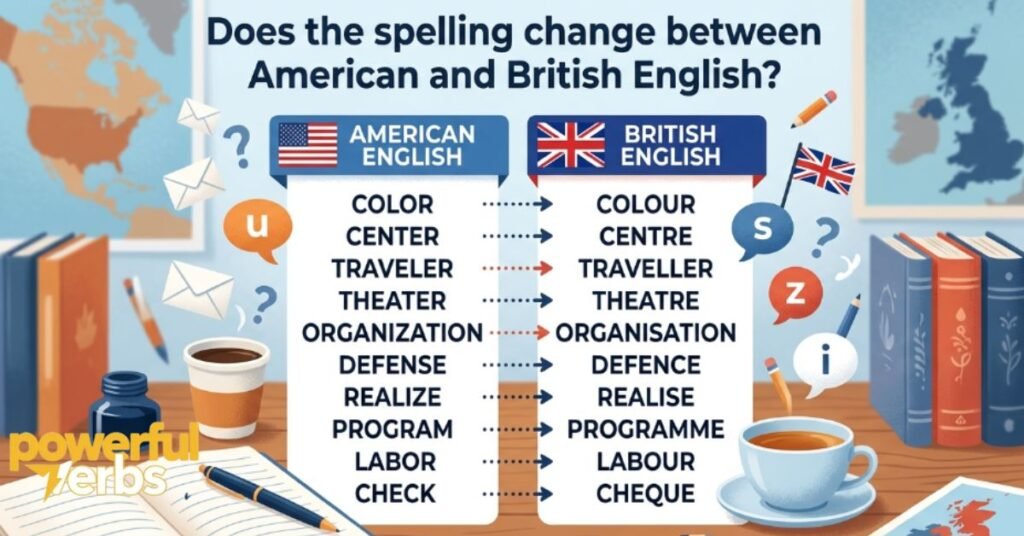
The term “high school” is used most often in American and Canadian English, while British English more commonly uses “secondary school” for the same stage of education. Even so, when British, Australian, or other English-speaking writers do use the phrase, perhaps in a school’s official name or when discussing American culture, the spelling stays exactly the same two-word form. There is no regional variation anywhere in the English-speaking world that makes “highschool” correct.
A Simple Trick to Remember the Spelling for Good
One easy test is to mentally swap “high” for another describing word, such as “old,” “new,” or “local.” “Old school,” “new school,” and “local school” all sound correct and obviously separate. Since “high” plays the same grammatical role in the phrase, “high school” should always be treated the same way: two words, never one.
Verb-ending confusion trips people up just as often — see our guide on Trys or Tries for another quick fix.
see also: Vender or Vendor? Here’s the Real Difference
FAQs
Is “highschool” considered correct in any English-speaking country?
No major dictionary in American, British, Canadian, or Australian English lists “highschool” as a standard spelling. The two-word form is the only version recognized everywhere.
Why does “highschool” sometimes show up on websites and social media?
It usually comes from fast typing, missed spacing, or writers copying a mistake they have seen elsewhere online rather than checking a dictionary first.
Is “high-school” with a hyphen ever correct?
A hyphen is occasionally used when the phrase works as a describing word directly before another noun in very formal writing, such as “high-school-aged children,” but the standalone term itself does not need a hyphen in everyday use.
What is the correct plural form?
The plural is “high schools,” following the standard rule for English nouns, since only the second word changes to show more than one.
Is “high schooler” written as one word or two?
“High schooler” is generally written as two words and is the form most dictionaries and publications recognize, even though “highschooler” sometimes appears informally.
Can autocorrect cause this mistake?
Yes. Some keyboard autocorrect settings fail to flag the missing space between “high” and “school,” especially on mobile devices, which lets the incorrect one-word version slip through unnoticed.
Final Thoughts
The rule behind “high school” turns out to be far simpler than the confusion around it suggests. The phrase follows the same open compound pattern as “middle school” and “elementary school,” supported consistently by dictionaries, style guides, and standard publishing across every major English-speaking country. Writing it as two separate words is correct in every context, from a casual text message to a formal college application, and remembering that single rule is enough to avoid the mistake for good.

Liam Johnson is a dedicated language expert with 4 years of professional experience. He specializes in Grammar, Vocabulary, and Sentence structure.
