

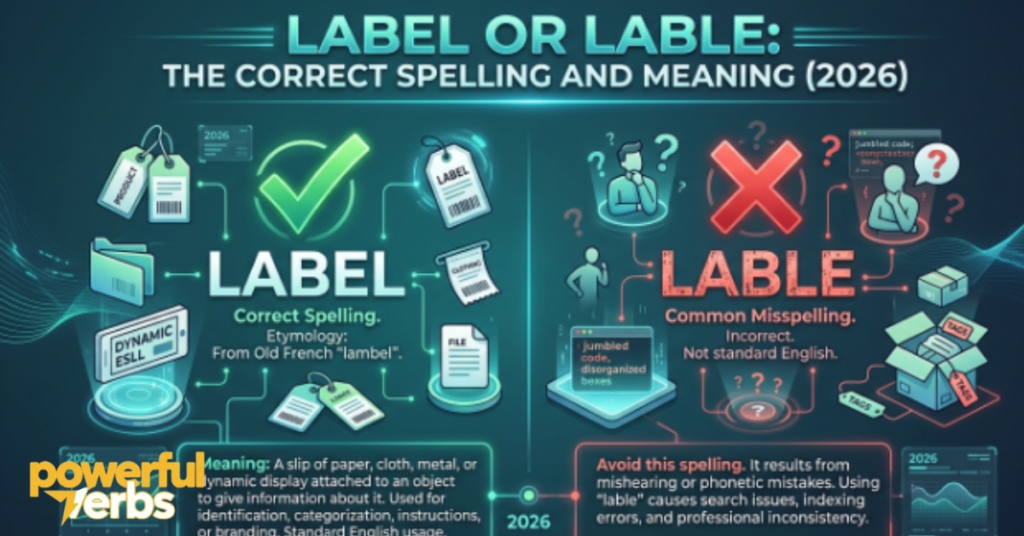
If you have typed this word into a search bar, an email, or a school assignment and then paused, wondering whether it should read label or lable, you are not alone. This is one of the most commonly searched spelling questions in English, and the confusion is understandable — the word is short, it is used constantly in daily life, and the “wrong” version sounds almost identical to the “right” one when spoken aloud.
This guide gives you a complete, no-confusion answer. You will learn the correct spelling, the reasoning behind it, where the word originally came from, how it differs (or doesn’t) between American and British English, and how to permanently stop second-guessing yourself when you write it. We will also cover synonyms, real-world usage, and practical tips for writers, students, and content creators who want their work to look polished and error-free.
see also: Green Fruits with Photos: Complete List of 80 Green Fruit Names
The Correct Spelling: Label, Not Lable
Let’s settle this immediately so you can move on with confidence.
Label is the only correct spelling in the English language. Lable is not a recognized word in any dictionary — American, British, Australian, or otherwise. It is simply a misspelling that has spread because of how the word sounds and how often people type quickly without checking.
A few quick examples of correct usage:
- The pharmacist asked me to read the warning label before taking the medicine.
- Every jar in the pantry has a handwritten label on it.
- She refused to label her artwork as belonging to any single genre.
And here is what incorrect usage looks like, so you can recognize it instantly:
- ~~Please lable each folder before submitting.~~
- ~~The shipping lable fell off the box.~~
If you ever see “lable” in a document, an email, or even on a website, treat it as a typo — not an alternate spelling.
In simple terms, a label is any small tag, marker, or piece of text used to identify, describe, or categorize something — whether that’s a printed sticker on a jar, a name given to an idea, or a field in a piece of software.
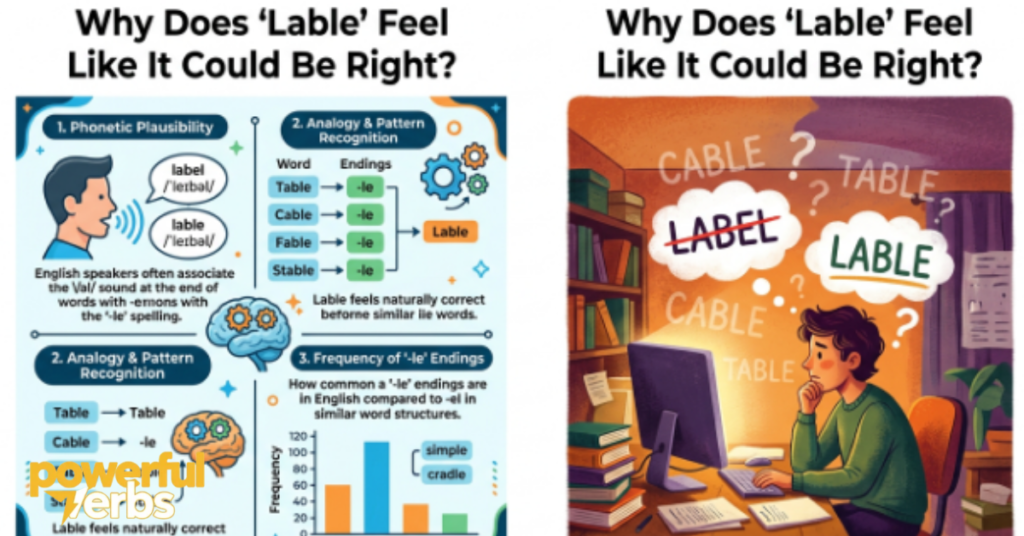
Why Does “Lable” Feel Like It Could Be Right?
This is the part most articles skip, but it is actually the most useful thing to understand if you want the correct spelling to stick in your memory permanently.
The confusion happens for a few specific reasons:
- Phonetic guesswork. When people sound out the word, the “a” and “b” blend in a way that makes “lable” seem like a reasonable spelling, especially for fast typists or non-native speakers translating sound into letters.
- Pattern matching with other words. English has plenty of words ending in “-able,” such as capable, durable, and comfortable. Because “label” sounds like it might belong to that family, people unconsciously borrow the “-able” pattern even though it doesn’t apply here.
- Repeated exposure to errors. Once a misspelling appears often enough online — in comments, low-quality articles, or social media captions — it starts to look familiar, even normal, to readers who encounter it repeatedly.
- Keyboard and autocorrect habits. On mobile devices, letters next to each other can get swapped or mistyped, and not every keyboard catches the error.
None of these reasons make “lable” correct — they just explain why the mistake is so common.
Where Does the Word “Label” Come From?
Understanding a word’s history often makes its spelling much easier to remember. “Label” entered English during the medieval period, borrowed from Old French, where it referred to a narrow strip or band of cloth, often used as a decorative or identifying piece attached to clothing or documents. That French term traces further back to a Germanic root associated with strips, ribbons, or bands.
Over the centuries, the meaning shifted from a literal strip of fabric to any small tag, slip of paper, or marker attached to an object for the purpose of identification. By the time it became common in English, the spelling had already stabilized as label — with no “-able” ending in sight, because it was never related to that suffix family at all.
In modern usage, the word has expanded well beyond physical tags. We now use it to describe:
- A printed or written tag identifying a product (a nutrition label)
- A category or classification assigned to a person, idea, or group (to label someone as lazy)
- A record company or brand (a music label)
- A descriptive tag in software, design, or data systems (a chart label or form label)
Label as a Noun and a Verb
One reason the word causes so much confusion is that it functions in two different grammatical roles, and both are extremely common.
As a noun, a label is a physical or digital tag that identifies, describes, or classifies something: The bottle’s label listed all the ingredients.
As a verb, to label means to attach a name, category, or description to something or someone: Reviewers were quick to label the film a masterpiece.
In both cases, the spelling never changes to “lable” — only the grammatical role shifts, not the letters.
British English vs American English: Is There a Difference?
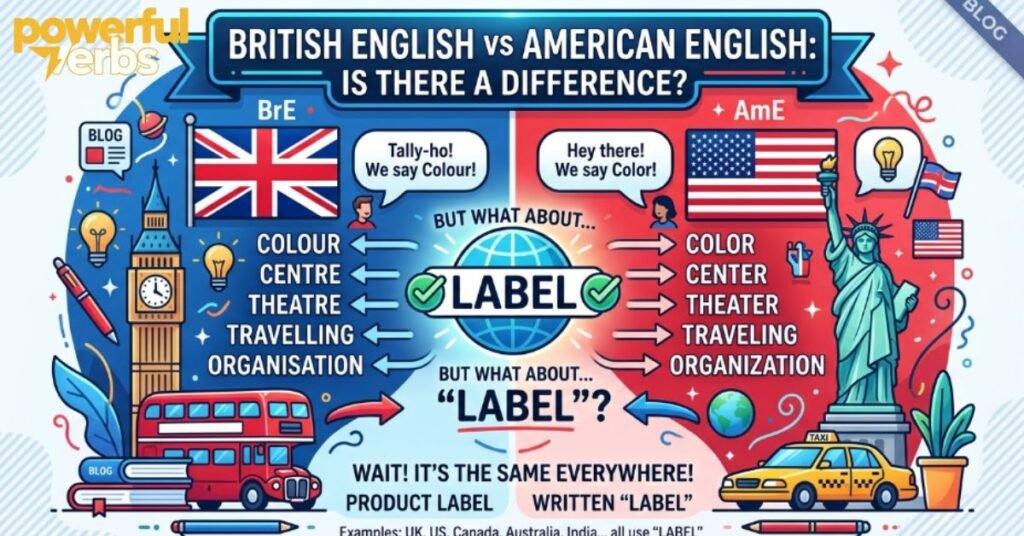
Many English words split into two camps — think colour vs color, or centre vs center. Naturally, people assume “label” might follow the same pattern. It doesn’t, at least not in its base form.
| Region | Correct Spelling | Example |
| United States | label | warranty label |
| United Kingdom | label | designer label |
| Canada | label | bilingual label |
| Australia | label | wine label |
| Pakistan & India (English usage) | label | brand label |
The base word “label” is identical everywhere in the English-speaking world. The real regional difference shows up only when you add certain suffixes — which brings us to the next point.
Label vs Labeled vs Labelled vs Labeling vs Labelling
This is where American and British English genuinely part ways, and it trips up even fluent writers.
- American English typically uses a single “l”: labeled, labeling
- British English typically doubles the “l”: labelled, labelling
Both versions are correct — they simply depend on which English convention you’re following. If you’re writing for a US audience or using American style guides, stick to the single “l.” If you’re writing for UK, Australian, or Commonwealth readers, the doubled “l” is standard. What never changes, regardless of region, is the base spelling: label, never lable.
Why the Doubling Rule Applies Differently Here
The reason British English doubles the “l” while American English doesn’t comes down to stress, not randomness. “Label” is stressed on its first syllable (LA-bel), so under the standard doubling rule, American English shouldn’t double the final consonant when adding “-ed” or “-ing” — and it doesn’t. British English, however, doubles the final “l” in these cases regardless of where the stress falls, which is why “labelled” and “labelling” persist there. It’s the same underlying pattern behind travelled/traveled and cancelled/canceled.
A Quick Reference Table of Common Errors
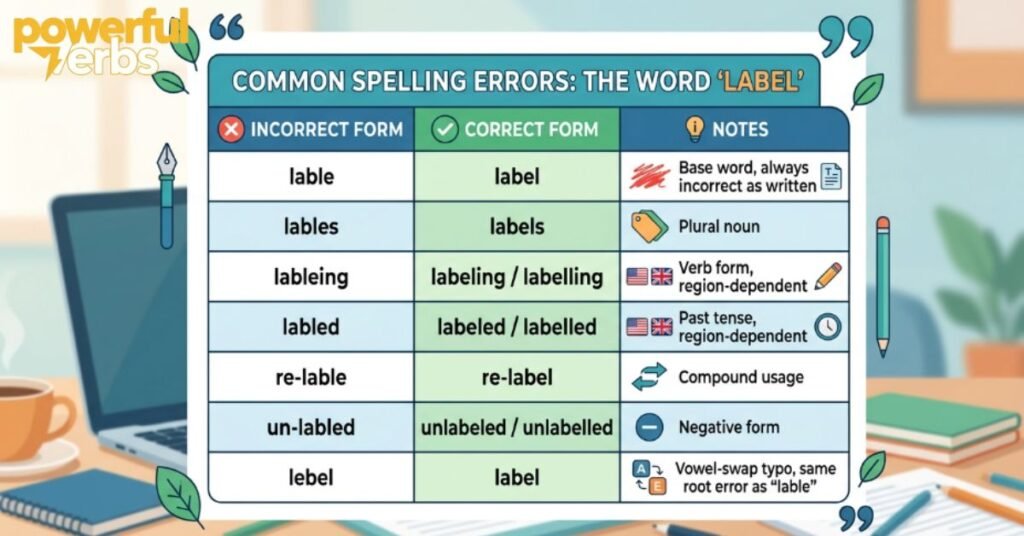
| Incorrect Form | Correct Form | Notes |
| lable | label | Base word, always incorrect as written |
| lables | labels | Plural noun |
| lableing | labeling / labelling | Verb form, region-dependent |
| labled | labeled / labelled | Past tense, region-dependent |
| re-lable | re-label | Compound usage |
| un-labled | unlabeled / unlabelled | Negative form |
| lebel | label | Vowel-swap typo, same root error as “lable” |
Simple Tricks to Never Misspell It Again
If you’ve struggled with this word in the past, try one of these memory aids:
- Think of “label” as containing the word “able” broken apart by an “L” — visually, L + able — which helps you remember there’s no extra “a” floating in the middle.
- Associate it with “table” — both are short, five-letter-feeling words with a clean “a-b-l-e” rhythm, and nobody misspells “table” as “tabel.”
- Remember that the word is related to a ribbon or strip, historically, not to the suffix “-able” used in words like durable or valuable.
Repetition also helps. Writing the correct word a few times in context — in a sentence you actually care about — tends to fix it in memory faster than simply reading a rule.
Label in Everyday Contexts
To see how naturally the word fits into different situations, here are a few realistic examples:
Retail and packaging: Every food product sold in stores is legally required to carry an ingredient label.
Workplace communication: Could you label these files by department before the meeting?
Music and entertainment: The band signed with an independent label rather than a major studio.
Social and cultural discussion: People often resist being labeled by a single trait or identity.
Technology and design: Each button in the interface needs a clear, readable label for accessibility.
Academic and scientific writing: Researchers labeled each sample to avoid contamination during testing.
Related Words and Synonyms Worth Knowing
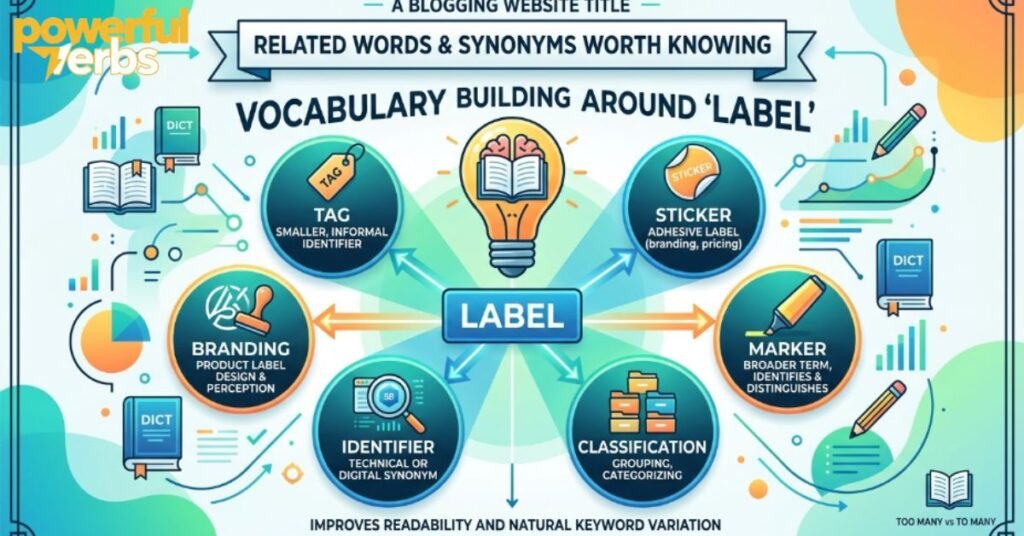
If you’re building vocabulary around this topic, it helps to recognize words that share meaning or context with “label,” even though they aren’t interchangeable spellings:
- Tag – a smaller, often informal identifier
- Sticker – an adhesive label used for branding or pricing
- Marker – a broader term for anything that identifies or distinguishes
- Classification – the act of grouping or categorizing, closely tied to the verb “to label”
- Identifier – a more technical or digital synonym
- Branding – often associated with how a product’s label is designed and perceived
Knowing these related terms can also help you avoid overusing “label” repeatedly in the same piece of writing, which improves both readability and natural keyword variation.
Small letter and word mix-ups are everywhere in English — our guide on Too Many vs To Many covers another frequent one.
Why Spelling Accuracy Actually Matters
A single misspelled word rarely ruins an entire piece of writing, but small, recurring errors quietly chip away at how credible a writer appears. For students, it can cost marks. For professionals, it can make an email or report look rushed. For anyone publishing content online, search engines and readers alike tend to associate clean spelling with trustworthy, well-researched information — while frequent errors can make even accurate content feel unreliable.
Getting “label” right isn’t just about following a rule. It’s about writing with the kind of precision that makes people trust what you’ve written.
Shorthand and abbreviation habits cause similar mix-ups elsewhere — see our guide on welcome short forms for another common one.
Final Thoughts
The debate between “label” and “lable” really isn’t a debate at all — it’s a simple case of one correct spelling and one common typo. Unlike many English words that shift between American and British forms, “label” stays the same everywhere; only its extended forms, like labeled versus labelled, change depending on regional style.
Once you understand where the word comes from and why the mistake happens in the first place, it becomes much easier to get it right every single time — whether you’re labeling a product, a file, a category, or simply writing a clear, professional sentence.
see also: name off 150 cleaning tools supplies with pictures
FAQs
Is “lable” a real word in any dictionary?
No. It does not appear as a valid spelling in any major English dictionary, including American, British, or Australian editions.
Why do so many people type “lable” instead of “label”?
Mostly due to how the word sounds when spoken quickly, combined with confusion with words ending in “-able.”
Does British English spell it differently from American English?
No, the base word “label” is identical in both. The difference only appears in forms like labelled (UK) versus labeled (US).
Is “labeling” or “labelling” the correct spelling?
Both are correct depending on region — “labeling” is American style, while “labelling” is British style.
Can “lable” ever be acceptable in casual writing?
No. Even in informal contexts like texting or social media, “lable” is considered a spelling mistake rather than an accepted shorthand.
What’s the easiest way to remember the correct spelling?
Picture the word as “L” plus “able” — this visual split helps avoid adding an extra letter where it doesn’t belong.

Liam Johnson is a dedicated language expert with 4 years of professional experience. He specializes in Grammar, Vocabulary, and Sentence structure.
