

You’re halfway through typing an invoice, an email, or an exam answer, and suddenly you freeze. Is it amount or ammount? The word looks simple, yet thousands of people stumble over it every single day — and a quick glance at search trends proves it.
Here’s the short version: amount is the only correct spelling. Ammount, with a double “m,” is not a real word in English and never has been.
This guide breaks down exactly why this mix-up happens, where the word comes from, how to use it correctly in real sentences, and how to make sure you never second-guess yourself again.
see also: Pursue or Pursue? The Spelling Mistake Almost Everyone Makes
The Correct Spelling at a Glance
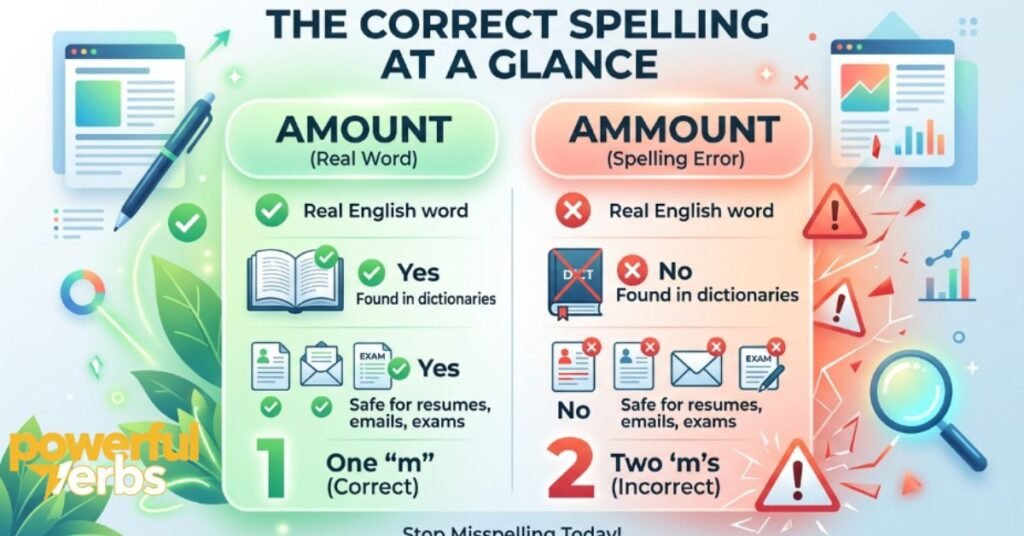
| Amount | Ammount | |
| Real English word | Yes | No |
| Found in dictionaries | Yes | No |
| Safe for resumes, emails, exams | Yes | No |
| Number of “m” letters | One | Two (incorrect) |
Right: Please pay the full amount by Friday. Wrong: Please pay the full ammount by Friday.
If you remember nothing else from this article, remember this: one “m,” not two.
see also: Trys or Tries: The Correct Spelling Explained (Simple Guide)
How to Pronounce “Amount”
“Amount” is pronounced uh-MOUNT (IPA: /əˈmaʊnt/), with the stress on the second syllable — the same syllable where “mount” sits. That stress pattern is actually a useful memory anchor: you’re hearing one clear “mount,” not a doubled sound, so there’s no reason for a doubled letter either.
Why Do So Many People Write “Ammount” by Mistake?
This isn’t a sign of poor grammar — it’s a pattern your brain falls into. English is full of words that double a consonant for no obvious reason: common, summon, recommend, accommodate. Because the brain spots a pattern, it tries to apply that same pattern to amount, even though the rule doesn’t apply here.
There’s also a pronunciation factor. When people say the word out loud quickly, the stress on the first syllable can make it sound like it should carry extra weight on the “m,” nudging writers toward doubling the letter without realizing it.
Add in autocorrect fatigue — where people start ignoring red squiggly lines after a while — and you get a spelling mistake that keeps repeating across emails, social posts, and even printed documents.
Where Does the Word “Amount” Come From?
Tracing the word back helps explain why the spelling has stayed fixed for centuries.
Amount entered English through Old French, derived from the phrase a mont, meaning “upward” or “to the top.” French speakers used it to describe a total that rises or accumulates — much like a pile growing higher. By the time it settled into Middle English, the spelling had already smoothed into a single-“m” form, and it has remained that way ever since.
No stage of that history ever introduced a double “m.” The spelling ammount isn’t an old or regional variant — it’s simply a modern typo that has never had any linguistic basis.
Is “Amount” Used the Same Way in British and American English?
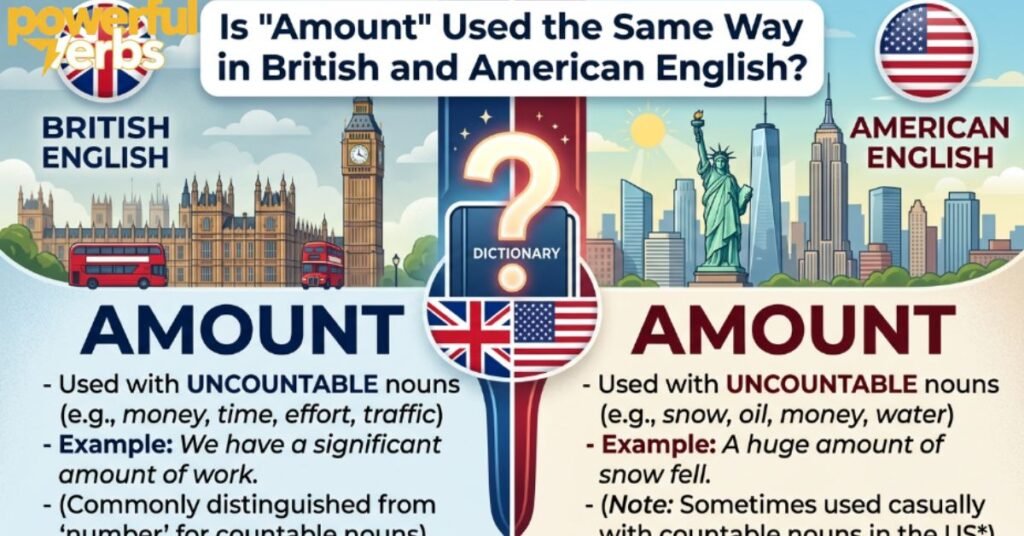
Yes — completely. This is one of the rare English words with zero regional variation. Words like colour/color or organise/organize split between British and American spelling, but amount does not follow that pattern at all.
- 🇬🇧 British English: amount
- 🇺🇸 American English: amount
- 🇦🇺 Australian, Canadian, and other English-speaking regions: amount
No matter your audience or location, there is exactly one acceptable way to spell it.
What the Dictionaries Say
If you want it straight from the source: Oxford, Merriam-Webster, and Cambridge dictionaries all list “amount” as the standard spelling, and none of them recognize “ammount” as a valid alternative or variant. When a word has zero dictionary backing across every major English reference, that’s as close to a settled question as spelling gets.
How to Use “Amount” Correctly in a Sentence
Amount is flexible — it can function as a noun or as part of a verb phrase.
As a noun (referring to a quantity or total):
- The amount on the receipt looked too high.
- A small amount of rain fell overnight.
As a verb (meaning to add up to or equal):
- The damages amount to nearly $2,000.
- Her contributions amounted to far more than expected.
Plural form:
- Different amounts of sugar were tested in the recipe.
Common related forms:
- Amounting (present participle): The bill is amounting to more than we planned.
- Amounted (past tense): The total amounted to $750 by the end of the month.
Note that the verb forms never gain a second “m” either — ammounting and ammounted are just as incorrect as ammount.
Amount vs. Ammount: Side-by-Side Comparison
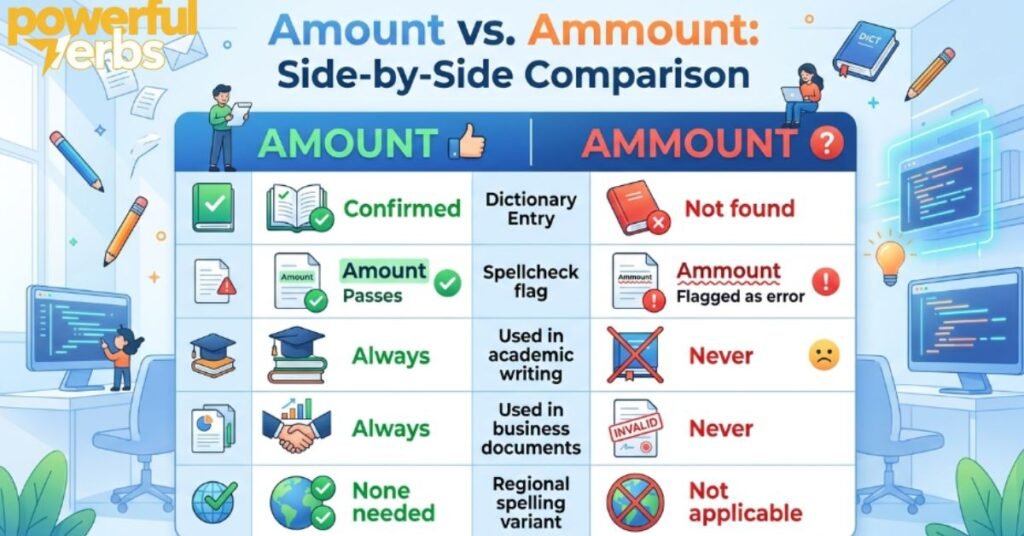
| Category | Amount | Ammount |
| Dictionary entry | Confirmed | Not found |
| Spellcheck flag | Passes | Flagged as error |
| Used in academic writing | Always | Never |
| Used in business documents | Always | Never |
| Regional spelling variant | None needed | Not applicable |
Real-World Examples of “Amount” in Context
In a workplace email: “Could you confirm the total amount owed before we close the invoice?”
In a news headline: “Officials report a record amount of snowfall this winter.”
In casual conversation: “Honestly, the amount of traffic today was unbelievable.”
In academic writing: “Researchers measured the exact amount of nitrogen absorbed by each plant.”
In financial paperwork: “Enter the loan amount in the field below before submitting your application.”
Seeing the word used naturally across different settings — formal, casual, technical — reinforces that there’s only ever one correct way to write it.
see also: Openned or Opened: Which Spelling Is Actually Correct?
Amount of Money – Correct Usage
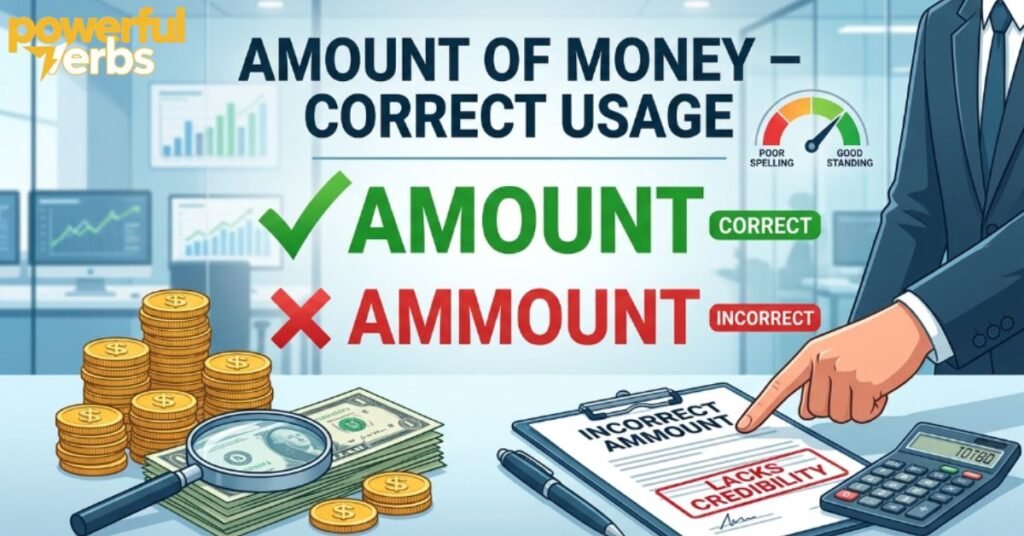
One of the most common contexts for this word is finance. You’ll frequently see phrases like “the amount due,” “the total amount owed,” or “the correct payment amount.” Getting this spelling right matters especially in financial and business communication, where a misspelled word like “ammount” can make an otherwise professional invoice or bank form look careless — the same way people often trip up on receive or recieve when filling out formal paperwork, another spelling error that quietly undermines credibility in official documents.
All Amount or All Amounts – Which Is Correct?
This depends entirely on context. Use “the total amount” when referring to a single combined sum, such as “the total amount of the invoice.” Use “amounts” (plural) when referring to multiple separate sums or quantities, such as “various amounts were donated by different sponsors.” So “all amounts” is correct when discussing several individual sums, while “all amount” is grammatically incomplete unless followed by “to” as a verb phrase. This kind of singular-versus-plural confusion shows up elsewhere in English too — the debate around analysis or analyses follows a similar logic, where the correct form depends entirely on whether you’re referring to one instance or several.
Why “Amount or Ammount” Keeps Trending in Searches
Search interest in “amount or ammount” spikes consistently because the word sounds like it should carry a doubled letter, even though it doesn’t. This is a common pattern across English spelling — writers pattern-match against similar-looking words with double consonants and assume the same rule applies. It’s the same instinct behind mistakes like combating vs combatting, where people aren’t sure whether a consonant should double before adding a suffix. In both cases, the safest approach is checking a dictionary rather than relying on how the word sounds when spoken aloud.
Other Words People Confuse with “Amount”
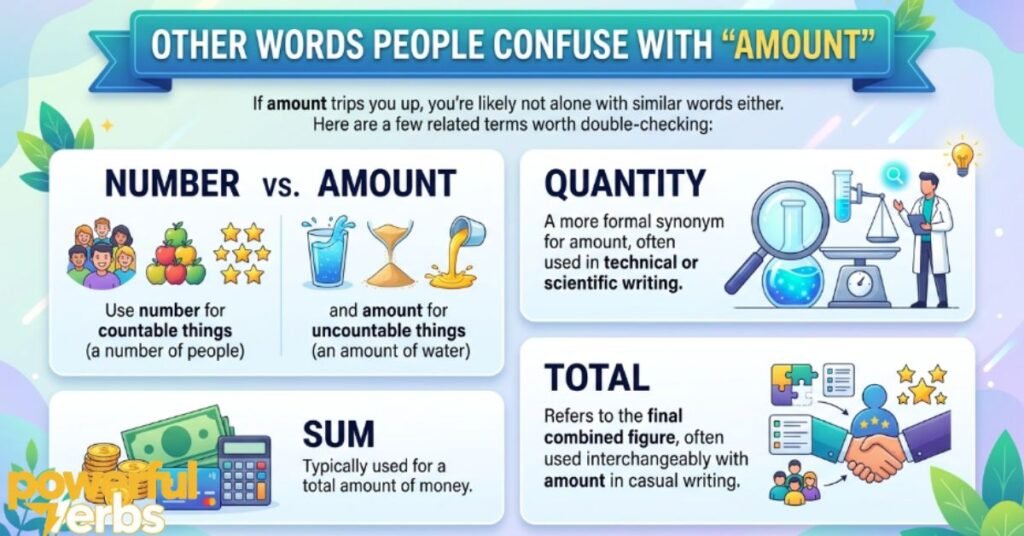
If amount trips you up, you’re likely not alone with similar words either. Here are a few related terms worth double-checking:
- Number vs. amount — use number for countable things (a number of people), and amount for uncountable things (an amount of water).
- Quantity — a more formal synonym for amount, often used in technical or scientific writing.
- Sum — typically used for a total amount of money.
- Total — refers to the final combined figure, often used interchangeably with amount in casual writing.
Understanding these nearby words can actually make it easier to remember amount, since you’ll start recognizing the small differences in meaning and spelling between them.
A Simple Trick to Never Misspell It Again
Try this memory trick: think of the phrase “a mountain of one.” It reminds you that amount starts with a + mount, and that there’s only one “m” holding it together — just like there’s only one peak on a single mountain.
Another quick test: if you’re tempted to double the “m,” picture the word summit — but remember that amount doesn’t follow that rule. The moment you picture the mountain trick instead, the correct spelling should click into place.
Doubled or dropped letters trip people up across English — see our guide on Label or Lable for another common mix-up.
Conclusion
The debate between amount and ammount really isn’t a debate at all — it’s a simple case of one correct spelling and one common typo. There’s no historical exception, no British-versus-American split, and no situation where the double-“m” version becomes acceptable.
Once the “a + mount, one m” trick sticks in your memory, you’ll spell it correctly every time, whether you’re writing a quick text, a formal report, or anything in between.
see also: Eyeing vs Eying: Which Spelling Is Correct? (2026 Guide)
FAQs
What is the correct spelling, amount or ammount?
Amount is correct. Ammount is a common misspelling and isn’t recognized in any English dictionary.
Why do people spell it “ammount” by mistake?
It usually happens because English has many double-letter words, so writers assume amount follows the same pattern, even though it doesn’t.
Is “ammount” acceptable in informal writing, like texting?
No. Even in casual messages, ammount is still a spelling error, not an informal variant.
Does British English spell it differently from American English?
No. Both use the exact same spelling — amount — with no regional difference at all.
Can “amount” be used as a verb?
Yes. For example, “The total expenses amount to $1,200,” where amount means to add up to a certain figure.
What’s an easy way to remember the correct spelling?
Break it into a + mount, and remember it has only one “m,” similar to how a single mountain has one peak.

Liam Johnson is a dedicated language expert with 4 years of professional experience. He specializes in Grammar, Vocabulary, and Sentence structure.
