

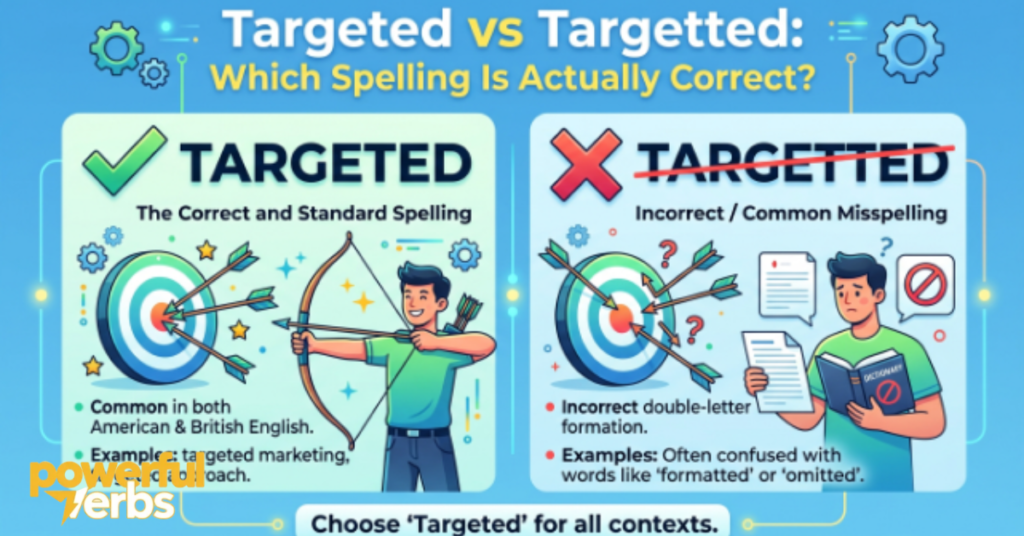
Typing a word a hundred times and still pausing before you hit send — that’s exactly what happens with targeted. One extra letter and suddenly the word looks wrong, even when it’s right. If you’ve ever stared at “targeted” and “targetted” side by side wondering which one belongs in your email, blog post, or resume, this guide settles it for good.
The Quick Answer
Targeted is the only correct spelling.
Targetted is a common misspelling. It doesn’t appear in Merriam-Webster, Oxford, Cambridge, or any other recognized dictionary, and it isn’t accepted in either American or British English.
Why So Many People Get This Wrong

English has a habit of doubling consonants before adding endings like -ed or -ing, but it doesn’t do this consistently. That inconsistency is the root of almost every “double letter” spelling mistake in the language.
Think about words like committed, regretted, and permitted — all of them double the final letter. Since “target” ends in a similar pattern (a vowel followed by a single consonant), it’s natural to assume it behaves the same way. It doesn’t, and that’s where the confusion starts.
The Actual Grammar Rule
Here’s the rule English teachers rarely explain clearly: whether a final consonant doubles depends on where the stress falls in the word, not just how the word is spelled.
- If the stress lands on the last syllable, the consonant usually doubles before -ed.
- If the stress lands on the first syllable, the consonant almost always stays single.
Say “target” out loud — the emphasis falls on TAR, not get. That single detail is the entire reason “targeted” keeps one T.
Compare it with words that follow each pattern:
see also: Repore or Rapport: Which Word Is Correct? (2026 Guide)
Stress on the first syllable (no doubling)
- VIS-it → visited
- OFF-er → offered
- TAR-get → targeted
Stress on the last syllable (doubling occurs)
- ad-MIT → admitted
- pre-FER → preferred
- re-GRET → regretted
Once you hear the stress pattern, the spelling almost writes itself.
Where Does “Target” Come From?
The word target has military roots that go back centuries. It originally referred to a small shield, and later evolved to describe the object someone physically aimed at during archery or firearms practice. Over time, English speakers expanded the meaning far beyond weapons and shields — today, people “target” customers, diseases, markets, computer systems, and research goals. Despite this broad evolution in meaning, the spelling rule never changed: adding -ed still follows the same first-syllable-stress pattern it always has, the same way certain terms carry old structural quirks forward even after their context shifts completely, similar to how high school or highschool remains a common spacing debate despite the phrase’s meaning staying perfectly clear either way.
Why the Wrong Spelling Sometimes “Feels” Right
There’s an actual psychological explanation for why “targetted” looks convincing to so many writers: it’s called the illusory truth effect. When people encounter the same incorrect spelling repeatedly — on forums, unedited websites, or social media — their brain starts treating that familiarity as a signal of correctness, even though repetition has nothing to do with accuracy. This is the same mental shortcut that makes people misjudge all kinds of visually similar things, from spelling patterns to subtle distinctions like whether violet, indigo, and purple are actually the same color — familiarity quietly overrides careful analysis unless you deliberately stop and check the source.
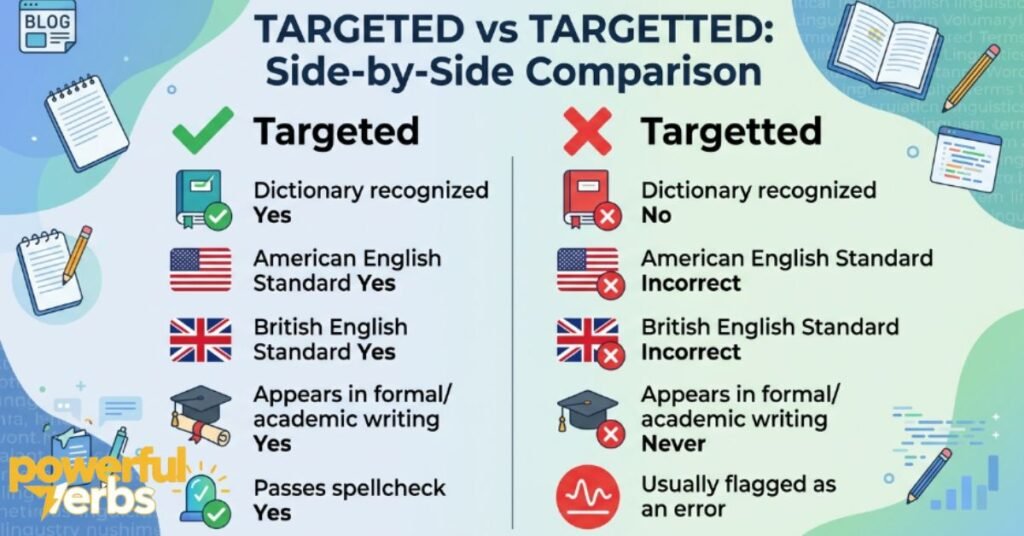
Targeted vs Targetted: Side-by-Side Comparison
| Aspect | Targeted | Targetted |
| Dictionary recognized | Yes | No |
| American English | Standard | Incorrect |
| British English | Standard | Incorrect |
| Appears in formal/academic writing | Yes | Never |
| Passes spellcheck and grammar tools | Yes | Usually flagged as an error |
Does British English Spell It Differently?
Not in this case. Plenty of words shift between American and British spelling — color/colour, traveling/travelling, organize/organise — but “targeted” isn’t one of them. Both regional standards agree on a single T, so you never need to adjust this word for a UK or US audience.
Where Writers Slip Up Most
- Assuming every verb ending in -et doubles its final letter, when many don’t (budget → budgeted, market → marketed, ticket → ticketed).
- Mixing it up with genuinely double-consonant words like format → formatted or regret → regretted, which creates a false pattern in the brain.
- Relying entirely on autocorrect, which occasionally misses this exact error depending on the tool or browser extension.
- Typing quickly and doubling the letter out of pure muscle memory from other words.
“Targeted” Used in Real Sentences
- The new policy is targeted toward small business owners.
- Doctors recommended a targeted treatment plan after the diagnosis.
- The newsletter uses targeted content to reach different reader segments.
- Investigators launched a targeted search of the warehouse district.
- Her resume was targeted specifically for roles in data analysis.
Notice the common thread — the word always signals precision, intent, or focus toward something specific.
Words With a Similar Meaning
If you want variety in your writing instead of repeating “targeted” over and over, these alternatives work in similar contexts:
aimed · directed · focused · intended · customized · tailored · specific · pinpointed · oriented · calculated · geared toward
Example swap: Original: The campaign was targeted at college students. Alternative: The campaign was tailored for college students.
Industries Where This Word Shows Up Constantly

- Marketing — targeted ads, targeted campaigns, targeted outreach
- Medicine — targeted therapy, targeted drug delivery
- Education — targeted instruction, targeted intervention
- Cybersecurity — targeted attack, targeted phishing
- SEO and content strategy — targeted keywords, targeted traffic
Across every one of these fields, the spelling never changes — it’s always one T.
A Simple Way to Lock It In Permanently
Pick a word you already spell correctly without thinking — visit. Nobody writes “visitted.” The stress sits on the first syllable in both “visit” and “target,” so they follow the exact same rule. Whenever you hesitate, mentally swap in “visited,” and the correct version of “targeted” follows automatically.
Conclusion
The rule comes down to one detail: stress placement. Because “target” is stressed on its first syllable, the final consonant never doubles, no matter the tense or form. This single fact explains every related form of the word, including “targeting” and “targets,” so there’s no need to memorize separate rules for each one.
Writers often overthink this spelling simply because English doubles consonants in so many other common verbs, but “target” was never part of that group to begin with. Once the stress pattern clicks, the correct spelling stops feeling like a guess and starts feeling automatic. Whether you’re writing a marketing email, a research paper, or a quick text message, sticking with one T will always be the safe and accurate choice. Keep that single rule in mind, and “targetted” won’t trip you up again.
see also: Knaw or Gnaw: Which Spelling Is Correct? (2026 Guide)
FAQs
Is “targetted” a real word?
No. It isn’t listed in any major dictionary and is treated as a spelling error in both American and British English.
Why doesn’t “target” double its final letter like “commit” does?
Because the stress in “target” falls on the first syllable rather than the last, so the consonant-doubling rule doesn’t apply.
Should “targeting” have one T or two?
One T. “Targeting” is correct; “targetting” is not.
Is the spelling different in British English?
No. Unlike words such as “colour” or “travelling,” this word is spelled the same way in both American and British English.
Can “targeted” function as more than one part of speech?
Yes. It works as a verb (“She targeted the audience”) and as an adjective (“a targeted strategy”).
What’s the fastest way to remember the correct spelling?
Just attach -ed directly to “target” with nothing extra in between: target + ed = targeted.

Liam Johnson is a dedicated language expert with 4 years of professional experience. He specializes in Grammar, Vocabulary, and Sentence structure.
