

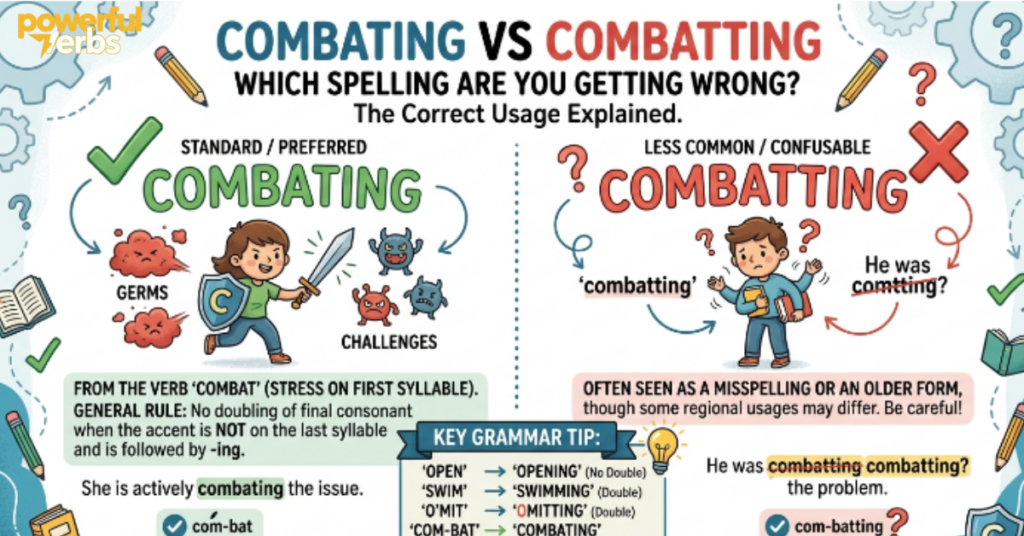
Every writer eventually runs into a word that refuses to sit still. Combat is one of them. The moment you try to turn it into its –ing form, English suddenly offers two competing spellings, and neither one feels obviously wrong. If you have typed combating, deleted it, retyped it as combatting, and then stared at your screen wondering which version a grammar checker, an editor, or a search engine would actually accept, this guide settles the question for good.
By the end of this article, you will know exactly which spelling to use, why English allows both forms to exist in the first place, and how to apply the same logic to dozens of other tricky verbs that behave the same way.
see also: Shiney or Shiny: Which Spelling Is Actually Correct?
Combating vs Combatting in One Glance
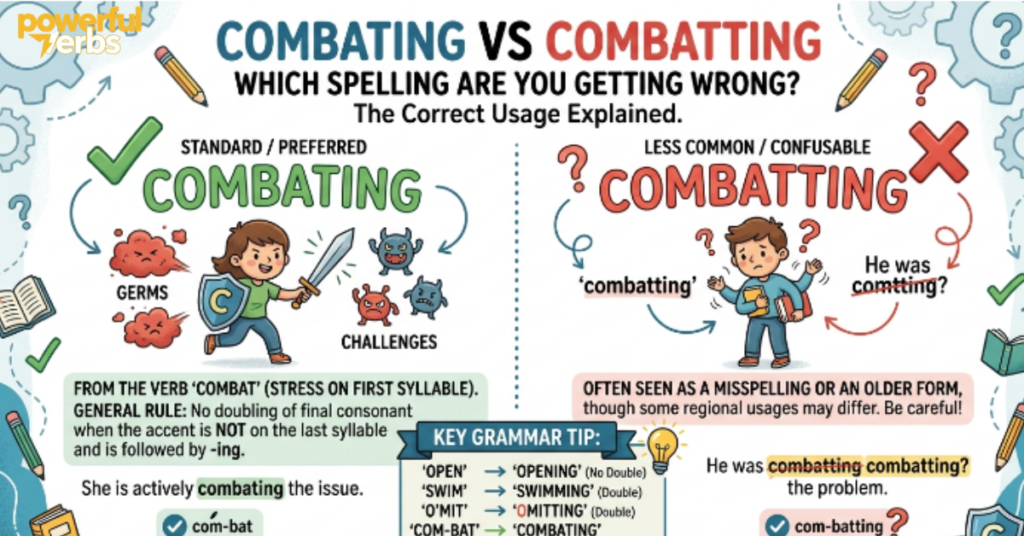
If you only need a fast answer, here it is. Combating is the standard, widely accepted spelling in American English, global publishing, and most digital content. Combatting is the variant spelling that shows up mainly in British and Commonwealth English, although even there combating is increasingly common. Neither spelling is grammatically incorrect, but one is far more universally recognized than the other, and that difference matters more than most writers realize.
Breaking Down the Word “Combat”
To understand why the spelling splits in two directions, it helps to look at how combat actually functions in a sentence. The word works as both a noun and a verb, and that dual role is exactly where the confusion begins.
As a noun, combat refers to fighting, conflict, or active struggle, as in “the soldiers prepared for combat.” As a verb, it means to actively work against something or to take action to stop a threat, as in “the city is working to combat homelessness.”
The verb form is the one that matters here, because English builds present participles and gerunds by attaching –ing to a verb’s base form. That single step, adding three letters to the end of a word, is where combating and combatting part ways.
The Grammar Rule That Decides Everything
English has a long-standing rule for deciding when a final consonant gets doubled before adding a suffix like –ing or –ed. The rule depends on syllable stress, not on personal preference or random tradition.
When a verb ends in a consonant, and that final syllable carries the stress, English typically doubles the consonant. That is why begin becomes beginning and admit becomes admitting. The stress lands directly on the syllable being modified, so doubling protects the original vowel sound.
Combat breaks that pattern. The stress in combat falls on the first syllable, COM-bat, not on the second syllable. Because the stressed syllable is not the one receiving the suffix, the traditional rule says no doubling is required. That single detail of pronunciation is the entire reason combating exists as the grammatically expected spelling.
This same consonant-doubling logic trips people up elsewhere too — see our breakdown of puting vs. putting for another example of the rule in action.
Combating: The Preferred Spelling in American English

American English follows the stress-based rule closely, and that consistency is exactly why combating is the dominant spelling across the United States, Canada, and most international digital platforms.
Major American style guides, including AP, APA, MLA, and Chicago, all default to combating. You will see it in news headlines, academic papers, government documents, and corporate communication. A few real examples show how naturally it fits into everyday writing: the agency is combating misinformation through public education campaigns; local governments are combating rising housing costs with new zoning policies; researchers are combating antibiotic resistance by developing alternative treatments.
Because American spelling reform, championed by lexicographers like Noah Webster in the early nineteenth century, deliberately favored simpler and more phonetically logical spellings, combating became the natural outcome rather than an exception.
Combatting: Why British English Keeps the Double T
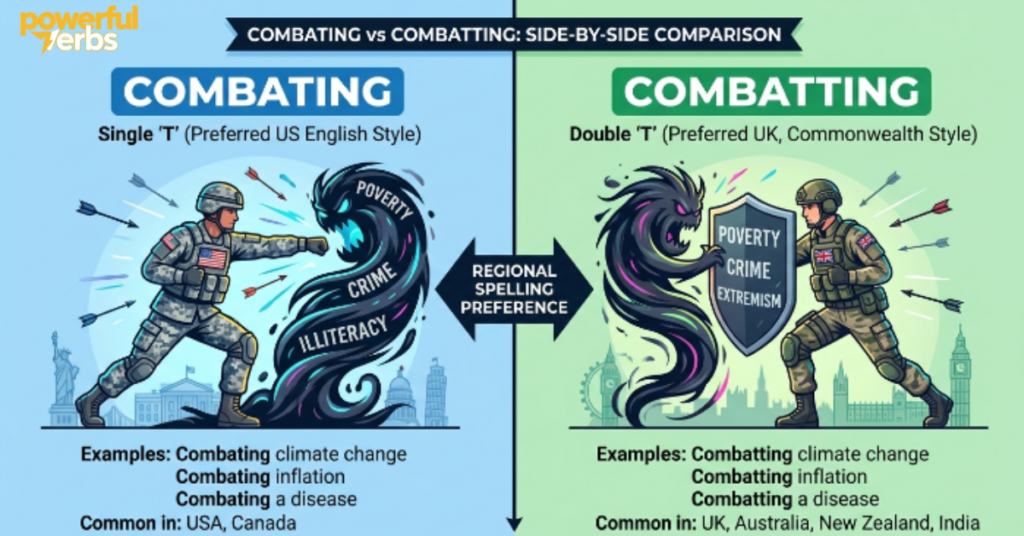
British English never went through the same large-scale simplification movement, which is why it still tolerates spellings that ignore the stress rule. Combatting survives in British usage partly out of tradition and partly because British spelling has always been more comfortable doubling consonants regardless of where the stress falls.
You will still encounter combatting in UK newspapers, parliamentary documents, and academic writing, although combating is gaining ground there too, especially in digital and international contexts. A few examples illustrate the British pattern: the council is combatting youth unemployment through new training programs; officials are combatting drought conditions across several regions; the charity is combatting food insecurity in rural communities.
It is worth noting that combatting is not “more correct” in Britain; it is simply more tolerated there than it would be in an American publication.
Combating vs Combatting: Side-by-Side Comparison
| Feature | Combating | Combatting |
| Primary region | American English, global digital content | British and Commonwealth English |
| Style guide preference | AP, APA, MLA, Chicago | Oxford and Cambridge (less strict) |
| Follows the stress-based doubling rule | Yes | No |
| Recommended for SEO and international content | Yes | Not typically |
| Trend in modern usage | Rising | Declining outside the UK |
The History Behind the Spelling Split
Spelling did not always work the way it does today. Before the twentieth century, English spelling was inconsistent across regions, and writers often spelled words the way they sounded to them personally rather than following a fixed standard.
American spelling reform changed that. Noah Webster and later American lexicographers pushed for cleaner, more logical spelling that stripped out what they considered unnecessary letters. That movement is why American English dropped extra vowels and consonants in dozens of words, not just combat. British English, by contrast, held onto older conventions, partly out of tradition and partly because no equivalent reform movement gained the same momentum there.
This is the same historical split responsible for differences like color versus colour, theater versus theatre, and traveling versus travelling. Combating versus combatting is simply one more entry in that long list.
see also: Take Effect or Take Affect? The Real Difference Explained
Other Verbs That Follow the Same Rule
Combat is not alone. Several other verbs share first-syllable stress and follow the identical doubling pattern, which means understanding this one word actually helps you with many others.
Travel behaves the same way, producing traveling in American English and travelling in British English. Cancel follows the same logic, giving you canceling versus cancelling. Model splits into modeling and modelling, while benefit produces benefiting in most American writing, even though benefitting still appears occasionally in British and academic contexts.
Once you recognize the pattern, the choice between combating and combatting stops feeling like a random exception and starts feeling like part of a predictable system.
Which One Should You Use? A Simple Decision Guide
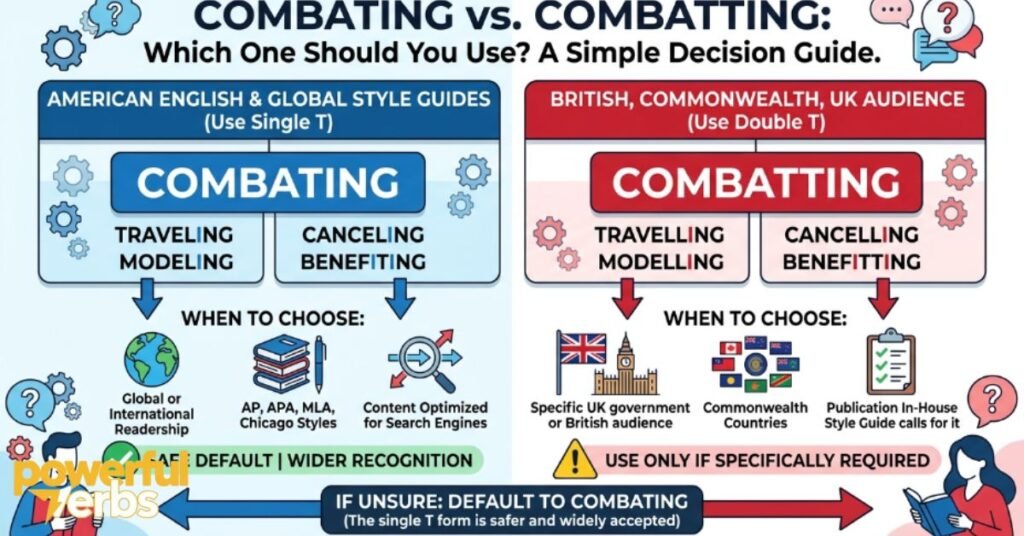
The right spelling depends almost entirely on your audience and the style guide you are following, not on any universal grammar law.
Choose combating if you are writing for an American audience, working with a global or international readership, following AP, APA, MLA, or Chicago style, or publishing content meant to rank well in search engines, since combating consistently shows higher search volume worldwide.
Choose combatting only if you are writing specifically for a British, Commonwealth, or UK government audience that has historically used the double-T form, or if your publication’s in-house style guide explicitly calls for it.
If you are ever unsure which audience you are writing for, default to combating. It is the safer, more globally recognized choice, and it will not look out of place in front of American, British, or international readers.
Common Mistakes to Avoid
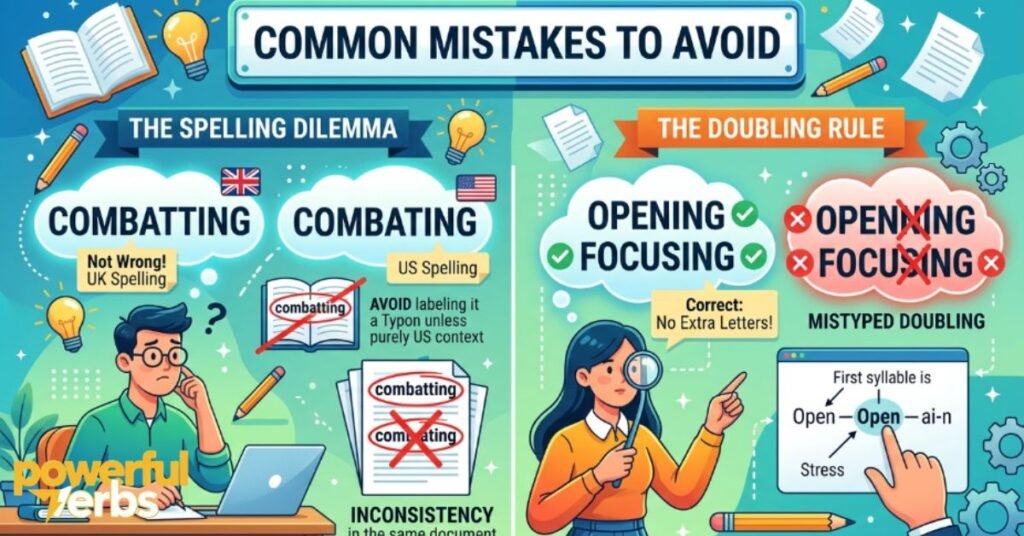
One frequent mistake is assuming combatting is simply wrong. It is not incorrect; it is regionally specific, and treating it as a typo can come across as overly rigid to British readers. Another mistake is switching between the two spellings within the same document, which signals inconsistency to both readers and search engines.
Writers also sometimes misapply the doubling rule to other first-syllable-stress verbs, doubling consonants in words like opening or focusing when no doubling is needed at all, since those verbs follow the exact same stress logic as combat.
Spelling confusion isn’t always about doubling letters, either — check out Flite vs Flight for a completely different kind of mix-up.
Why This Distinction Matters for SEO and Content Writers
Search engines pay close attention to consistency, and a spelling choice that seems minor to a casual reader can have a real impact on how content performs. When you mix combating and combatting in the same piece, you fragment your own keyword signals instead of reinforcing them, making it harder for search engines to recognize your content as a clear, authoritative answer to a single search query.
Since combating has substantially higher search volume across English-speaking regions, building your primary content around that spelling, while still mentioning combatting for completeness, tends to capture more search traffic without sacrificing accuracy. Most professional editors recommend picking one spelling per project and applying it consistently across every heading, paragraph, and meta description rather than switching mid-article.
Quick Memory Trick to Never Get It Wrong Again
Here is a simple way to remember the rule permanently. Say the word combat out loud and notice where your voice naturally lands the stress. If you hear COM-bat rather than com-BAT, the stress sits on the first syllable, which means no doubling is needed and combating is the spelling to reach for. Pair that with the general guideline that American audiences expect a single T while British audiences may tolerate two, and you will rarely second-guess yourself again.
FAQs
Is combating or combatting the correct spelling?
Both are accepted, but combating is the standard form in American English and the most widely recognized spelling internationally, while combatting is mainly used in British English.
Why does English double consonants in some –ing words but not others?
Doubling depends on syllable stress. Words with stress on the final syllable, like begin or admit, double the consonant, while words like combat, which stress the first syllable, typically do not.
Is combatting considered a spelling error in the United States?
It is not technically an error, but it looks unusual to American readers and goes against most US style guides, so it is best avoided in American-facing writing.
Which spelling should I use for an international or global audience?
Combating is the safer and more universally recognized choice for global or mixed-audience content, including most website and blog writing.
Do other words follow the same spelling pattern as combat?
Yes. Travel, cancel, model, and benefit all follow similar first-syllable-stress logic, producing parallel American and British spelling pairs.
Does the spelling choice change the meaning of the word?
No. Combating and combatting mean exactly the same thing and function identically as a verb’s present participle or gerund form. Only the regional spelling convention changes.
conclusion
Combating and combatting are not a grammar mistake waiting to be corrected; they reflect how American and British English evolved along different paths after splitting from a shared linguistic root. For everyday writing, blogging, business communication, and most professional content, combating is the smarter default because it aligns with major style guides, reads naturally to the widest possible audience, and avoids drawing unnecessary attention to a spelling choice that should not distract from your message. Save combatting for the specific cases where your audience or publication genuinely expects it.

Liam Johnson is a dedicated language expert with 4 years of professional experience. He specializes in Grammar, Vocabulary, and Sentence structure.
